
Translated material
Novgorod "Phoenixes"
Part 1. The Temple of the Savior on Kovalev
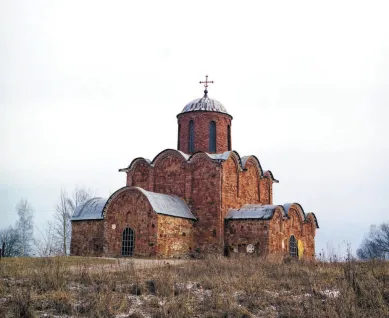
In the old days of people who came to Veliky Novgorod from Moscow, two temples were met at the entrance to the city, on both sides of the road. Built at approximately at the same time, painted equally unlike everything else that was created in Novgorod, the churches in neighboring villages divided one but amazing fate. After 600 years of life, they were destined to die in order to then be reborn with murals. We will talk about the second temple - the Church of the Assumption in the Volotov Field next time, and now we will talk about the Church of the Savior on Kovalev.
The Savior Church was built in 1345 by a certain Akinf (or oncifor) Zhabin. Apparently, it was a very rich boyar, but not held high posts in the Boyar Republic of Novgorod. Either a little earlier than the building, or at the same time a male monastery was founded here.
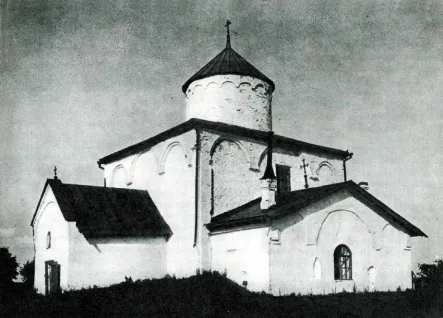
It was a period of searching for new forms in architecture. As a result, several decades later came to such masterpieces as the Savior Temple on Ilyin Street or Fedor Stratilat on a stream (see TRV-N, No. 73, 02/15/2011, “The Temple of Warriors on a Stream”). But on Kovalev we see some intermediate option. The cubic shape of the temple is surrounded by three submits of different sizes, form and purpose. The western served as an input vestibule, the north, two -story did not connect with the temple at all and was used for household needs, and in its upper, arched opening there was a belfry, while the southern bore was first a tomb, and then became an entrance to the temple.
35 years after construction, the temple was painted. According to experts, "the colorism of the frescoes does not know equal in Novgorod art." The frescoes of the Savior on Kovalev are really impressive, however, if not for the feat of several dozen people, we would hardly have been able to talk about it now.
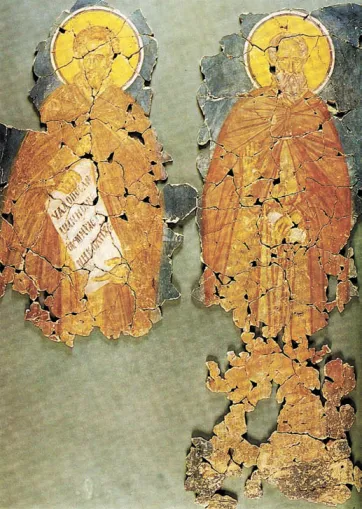
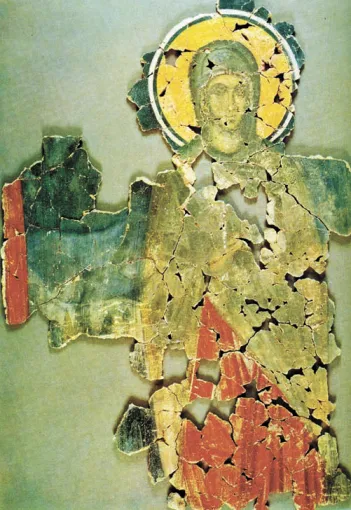
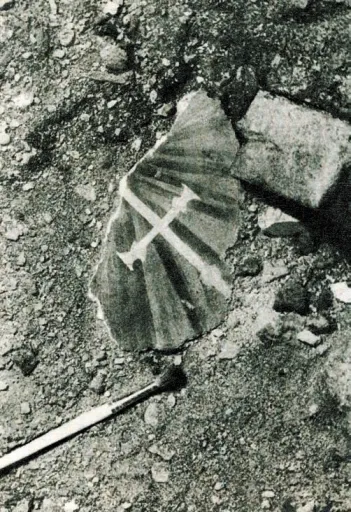
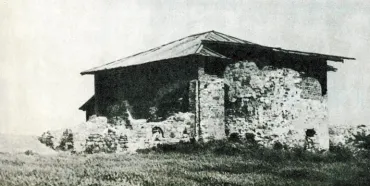
During the Great Patriotic War, the temple was on the line of fire and was almost completely destroyed (like Volotovsky): no more than 30% of the masonry was preserved. At first, the ruins were mothballed, and since 1965 they began to be carefully disassembled, a layer by layer choosing all fragments of plaster and gradually collecting broken frescoes. The “Games of Puzzles” under the leadership of the restorer A.P. lasted more than 15 years. Grekov led to the fact that it was possible to collect about half (in the area) of the volume of murals that existed by the beginning of the war. What no one believed in immediately after the war can be seen in the Novgorod Museum-Reserve. The temple was also restored, although due to the lack of field research before the war, the upper parts are a kind of restoration hypothesis. The thin white line separates the restored part from the preserved. And the restorers after Kovalev were waiting for the ruins of the Temple of the Assumption on the Volotov Field.
Alexey Paevsky
Illustrations from the book A.P. Grekova "Frescoes of the Church of the Savior of Transfiguration on Kovalev"