
Translated material
Tempel Comet 1: Five years later
On February 14, the STARDUST spacecraft (translated - “Star dust”) took the flight near the core of Tempel Cometa 1 and handed it to Earth 122 of its images (including 72 - high resolution). The smallest distance from the nucleus was ~ 178 km. In addition, the apparatus devices measured coma parameters. The total amount of data obtained was 468 MB.
This meeting was the second in the biography of both the apparatus and comets. The Stardust probe was launched for a flight near the comet Wilda 2 (Wild 2), which he successfully completed in 2004 and sent a returned capsule with particles of a coma to the ground. However, since the fuel in the tanks of the apparatus was enough, the mission was extended, and in 2007, Stardust, which received a new name Stardust-Next (New Exploration of Tempel), went to Tempel Cometel 1.
In 2005, this comet was already visited by one man-made object-the Deep Impact probe (for more details about it, see the TRV-N, No. 66, 09/09/2010, “Small, active, mysterious” [1]). The case was not limited to the span: a special probe probe was sent to the comet, which was supposed to knock out the substance from the surface of the nucleus.
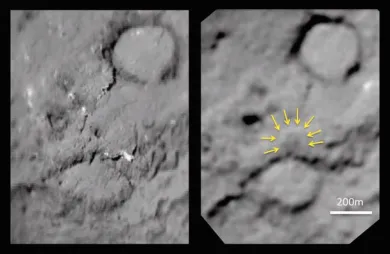
This experiment ended safely, but then, in 2005, the scientists could not see the crater itself due to the rising cloud of substance. Now it finally succeeded in the Stardust device. The experiment was also interesting because the scientists had to see pictures of the same comet with an interval of five years and fix the changes that occurred during this time.
According to Joe Veverka, chief researcher at Stardust-Next mission, the mission was 100 % successful. Stardust cameras filmed a crater with a small hill in the center, which may indicate that part of the discarded substance then fell to the same place. A comparison of the pictures with photographs of 2005 made it possible to see traces of erosion. And on the images of new parts of the surface, deposits of matter were found. According to the Veverka, it may be about the fact that part of the substance, thrown from the inside of the set, then “returned” to the surface.
Of course, data processing will continue for quite some time, but the first images have already been released by NASA. The Stardust apparatus will also continue to observe the cow's nucleus and some time after rapprochement. This meeting will be the last stage of his biography. The STARDUST mission belonged to the category of missions of low value, and its conduct cost NASA at about $ 29 million.
ABOUT . H.