
Translated material
Demarsh Pincoles-2
In the opposition
 Demarsh Pincoles-2
March 9, 2011 Nutella Boltyanskaya
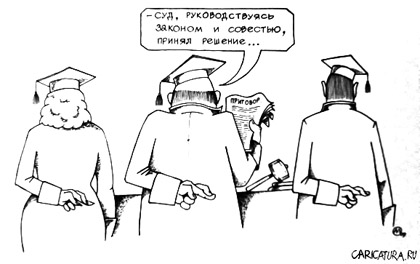
Recently, against the background of the second process in the case of the leaders of the NK Yukos MB Khodorkovsky and P.L. Lebedeva Society was drawn into a campaign to discredit the judicial system.
I will even lay one of such a member of society now. We don’t know that the judge is taking bribes?! Take it. But who is easier to catch the hand - a policeman or a judge? Of course, a policeman, investigator, prosecutor, state civil servant. Judge - go catch. So This member of the company has the surname Medvedev, his name is Dmitry Anatolyevich. So - a campaign to discredit or still needs to be reformed?
So, it is necessary to reform. However, there is no need to start with the Khodorkovsky case. Why? Because this business has already become a significant process of Russian justice? Or because in this case those who were used by the “desire of relatives and the near environment of the accused to use all the opportunities and resources to build a protection system” have already been expressed in this case?
I list: Akhedzhakova and Akunin, Strugatsky and Ulitskaya, Yuri and Efremov, Shevchuk and Fateev, Basilashvili and Granin, Bonner and Bukovsky, Yasulovich and Ryazanov, Yuri Ryzhov and Gidon Kremer, Gorbanevskaya and Litvinov, Nobel Laureate Visel. Even the cautious Russian rockers could not stand it by December 2010 and quietly announced the need for an justice sentence (apparently they had doubts) ... Perhaps I am mistaken, and knights without fear and reproach - we have other people. Chairman of the Council of Judges of Russia Yuri Sidorenko, for example, about 55 says this: “There were people who had the courage to rebel against a generally accepted opinion.” Well, everyone has their own courageous people. Can I limit myself to a few lines listed in the list?
The discussion in the most resonant court cases of recent times is not a comparative analysis of the evidence base - most of its participants are not familiar with the materials of the investigation and, in fact, exchange mutual reproaches and resentment on the basis of personal political addictions. As usual, Nothing Personal. None of the so -called resonant matters is mentioned. By the way, this successfully allowed all the signathers of this appeal to avoid the question of why certain affairs became resonant.
... A pardon becomes a way of pressure on the president and an attempt to encounter him with the judicial system. The requirement of pardon is in these cases absolutely populist and is rather aimed at creating a public emotional background than for the implementation of legal procedures.
How menacingly the word "requirement" sounds! Just cut the head of our homeland! By the way, neither in the articles of the Constitution of the Russian Federation, nor in the articles of the Criminal Code of the Russian Federation related to pardon, nowhere is the phrase “only convicted” and where it is written (I'm talking about the Putin Decree of 2001) is an so -called act. And, therefore, personally, I, Natella Savelyevna Boltyanskaya, can ask the president every day to have mercy on anyone. And do not, Tina Kandelaki, forbid me to contact the taxpayer hired by me, the taxpayer, and the manager calling for his constitutional right to pardon. Tomorrow I’ll start sending messages to his blog, Twitter and, as we are now called, “na-Verse-grandfather” from morning till night. He, however, has the lousyers everywhere sit: they clean the excess. But can I ask?
And finally.
A wide discussion on ensuring the independence of the court and judges has become the efforts of some public activists into manipulating public opinion and unprecedented pressure on justice.
IN In 2008, Elena Valyavina, Deputy Chairman of the Supreme Arbitration Court of Russia, said she was under pressure from the Kremlin. The judge gave relevant testimony in the Dorogomilovsky court of Moscow. And it did not scare anyone. Think about the pressure ... When in 2003, Judge Olga Kudeshkina spoke about the pressure on her from the chairman of the Moscow City Court Egorova, her (Kudeshkin, and not Egorov) was deprived of status, and no ECHR did not help restore the lost. The pressure on the other side does not surprise anyone or upset. The signatures of the letter believe that the pressure on the judicial system is increasing. We must agree with this - yes, intensifies. Previously, and now the pressure was carried out by prosecutors, investigation, and authorities. Now the pressure from society has been added - this is great. Perhaps it will balance the excessive pressure of the authorities.
And with my opinion on this issue, the already mentioned member of the Russian society Dmitry Medvedev quite agrees. “It is necessary to do everything so that the court is as independent from the authorities and at the same time absolutely dependent on society,” the president said at a meeting with members of the Public Chamber on January 20, 2011. Dmitry Anatolyevich, I support you. Where to subscribe? I am glad that between Dvornikov, the initiator of the letter of 55, and Strugatsky, who signed the appeal in defense of Khodorkovsky, you chose the latter for yourself.
Drawing from the site caricatura.ru