
Translated material
Billions in the sand
What and how much Russian companies lose in Libya
Billions in the sand. So far, military operations are going on in Libya and people who are working in this country are dying of their own account - financial. What it is for Russian companies - The New Times was interested in
The UN Security Council adopted sanctions against Libya: a ban on export of all types of weapons. On March 4, the director of Rostechnologies (the composition of this state corporation includes Rosoboronexport) Sergey Chemezov said that due to the introduced embargo, Russia is not counting $ 4 billion. At the same time, Cheyzov emphasized that “Russia is strictly observing the UN Charter when trading its deadly weapons”: as soon as the sanctions were immediately launched, Rostecnology was immediately deployed back Drinking, which is taken to Libya spare parts for aircraft. ” 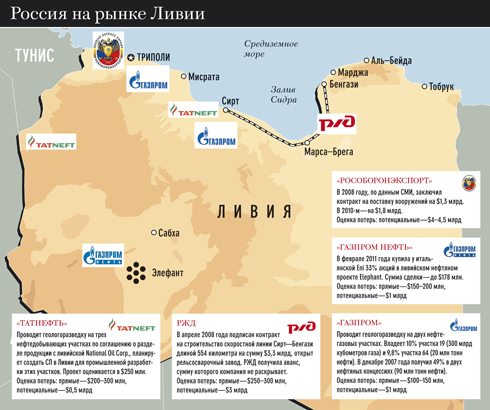
Goodbye, weapons!
Libya became one of the largest buyers of Russian weapons among the countries of the Middle East and North Africa relatively recently - after a visit to Tripoli Vladimir Putin in 2008. Then, at the highest level, an agreement was reached to write off the Libyan debt in the amount of $ 4.5 billion instead of the admission of Russian companies to the Libyan market, and most importantly, in return for contracts for the supply of Russian weapons to Jamakhiria. In the same year, an agreement was signed for the supply of three Lightning missile boats with a total value of about $ 200 million. In 2009, data on the modernization of 145 T-72 tanks for about $ 70 million leaked to the press. Independent experts evaluate the total volume of Russian arms supplies in Tripoli in 2008-2009 in $ 1.3 billion.
In January 2010, Russia and Libya signed another contract for the supply of weapons, including a rifle one, by $ 1.8 billion. According to the Center for the Analysis of World Trade of Weapons (CAMTO), today the armed forces of Libya are 90 % equipped with an obsolete, requiring modernization and replacement. On these purposes, Tripoli was ready to spend $ 1.8 billion stipulated by a contract.
Today, the fate of all military contracts is under a big question.
Moscow now insists on receiving money from Tripoli. “Libya must pay for all the weapons contracts performed, despite the embargo introduced against this country by the UN Security Council,” said Sergey Lavrov, head of the Russian Foreign Ministry on March 1.
Meanwhile, independent experts, for example, TsAMTO experts, estimate the possible lost benefits of Russia in the Libyan arms market in the amount of $ 4.5 billion. At the same time, it answered the question of where the Russian industry will replenish losses, answered: “Latin America always remains.”
Runned the sleepers
Russian railway workers implement a grandiose project in Libya - Russian Railways is building a railway with a length of 554 km here. It is designed to connect two large cities - Sirt and Bengham - and become the central link in the International Transport Corridor in northern Africa. It is curious that since 1965 the railway has not been used in Libya at all (all the old sleepers were dismantled). Only at the beginning of the XXI century, Gaddafi decided to restore a railway message in the country. The search for a partner capable of solving this problem was delayed until 2008. And after Putin’s visit, a 4-year contract with Russian Railways was signed by $ 3.3 billion.
Shortly after the start of hostilities in Jamahiria, Russian Railways evacuated most of their employees from the country. To the question of whether work on laying the track continues today in the “truncated composition”, the Russian Railways press service did not give an answer, but expressed hope that after the end of hostilities, the company “in any case” would return to the fulfillment of its contract obligations and intend to bring the construction of the branch to the end. It is known that Russian Railways received a certain advance on work: the amount in the company is not disclosed.
Anastasia Sosnina, an analyst with Investkafafa, believes that the direct losses of Russian Railways can be about $ 250-300 billion. As for the missed benefit, its scale will have to be estimated later - depending on whether the company will return to the Libyan market after the end of hostilities.
Who remained on the pipe
The development of Jamahiria Russian business began with oil: Libya is a member of OPEC and one of the world's largest oil and gas suppliers * * * see more than The New Times No. 7 of February 28, 2011, there are such global giants as British BP, American EXXON, Italian ENI and others. The first Russian company entering the Libyan oil market was Tatneft. In 2005, she on a tender basis received the right to develop an oil block in the Gadamama area. A year later, Tatneft won the rights of three more oil blocks in the basins of Gadamama and Sirts. The company's activities are regulated by an agreement on exploration and division of products concluded for 30 years. The Tatneft project in Libya is generally estimated at $ 250 million, of which, according to various estimates, from $ 70 million to $ 120 million are already invested. The Tatneft press service in response to the New Times categorically refused to name some figures regarding the presence of the company in the Libyan market.
"

The head of Gazprom, Alexei Miller, without false modesty, said that the concern was ready to buy from Libya all its oil and gas reserves
"
According to the leading expert of the 2K engineering company, Sergei Voskresensky, if Tatneft will not return to Libya for some reason, it will lose its invested funds (however, after the establishment of legal authorities in the country, judicial appeals are possible on this subject), plus what is not received over the last weeks of expression and division of production-due to a decrease in production. According to European analysts, by the end of February the daily volumes of oil production in Libya had halved by half * * before the unrest in Libya, 1.6 million barrels of oil per day were produced in Libya, and now, according to unofficial data, four times. Including because foreign companies have already evacuated at least half of their Libyan personnel. This fully applies to Russian companies. According to the analysts of the Investkafa, the Tatneft deposits, before the unrest, gave approximately 415 barrels per day. In terms of today's prices, this may mean a daily loss of about $ 15 million. The short losses in the oil market of Libya, according to experts, are Gazprom, which began to master local bowels after Tatneft. In 2007, the concern signed a memorandum of cooperation with the National Oil Corporation of Libya (which under Gaddafi had a monopoly right to extract and trade in Libyan oil). Almost at the same time, he received licenses for the development of promising areas on the Mediterranean’s shelf and 300 km south of Tripoli. At the end of 2007, Gazprom became the owner of 49% in Libyan oil concessions belonging to Wintershall AG. Agreements on these concessions are designed until 2026. It is curious that in 2008, after Putin’s visit to Tripoli, the head of Gazprom, Alexei Miller, without false modesty, said that the concern was ready to buy from Libya all its oil and gas reserves * * * annual oil production in Libya is 80.1 million tons, consumption - about 12 million tons, the rest is exported, 90 % to European countries. Proven oil reserves in Libya are about 5.5 billion tons.
* The ElePhant oil and gas field has been mastered since 2005. For five years, about 28 million tons of oil have been obtained. It is developed by the consortium of foreign companies: 66 % - with ENI, 33 % - Knoc National Oil Corporation.
The case never reached “all”, but Gazprom Neft - another “daughter” of Gazprom - was supposed to soon become a full -fledged participant in the oil production consortium in southern Libya. We are talking about the development of the ElePhant * oil and gas field. In early February, even before the start of mass unrest, an agreement was signed with the ENI, according to which a 50 % package belonging to the Italian concern was transferred under the control of the Russian company for $ 178 million.
The press service of Gazprom Neft refused to evaluate possible financial losses, saying that "the main thing at this stage is to ensure the safety of employees working in Libya." According to Sergey Voskresensky from 2k, if Gazprom cannot return to Libya after the end of the riots, this will be a “significant strategic loss for a gas concern”. Anastasia Sosnova, an analyst with Investkafafa, believes that the possible losses of Gazprom, associated with the exploration of Libyan deposits, are relatively modest and can be $ 100-150 million. Well, the main minus for Gazprom is at the risk of lost benefits if the company loses the promising ElePhant field with 6 million tons of oil. 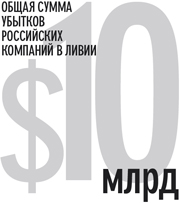
Risky contracts
“The total volume of existing but unrealized contracts of Russian oil companies in Libya is approximately $ 3-5 billion,” said Agwan Mikaelyan, CEO of Finspertiza. According to the expert, today the loss of these contracts is theoretically possible “due to the serious instability that has developed in Libya and the obscure prospects of what is happening.”
Oleg Deripaska also became another victim. Analysts recall that in January 2010, during the IPO Rusala in Hong Kong belonging to Deripaska, the Libyan State Fund Libyan Investment Authority * * was personally controlled by Muamar Gaddafi, the fund management was $ 40 billion. It purchased 1.43% of the shares of the Russian company for $ 300 million. This money was extremely extremely It is necessary for the Russian oligarch to pay a large external corporate debt. In financial circles, they say that Deripaska intended to sell Gaddafi up to 10% of his shares, as well as open joint aluminum production with Libya. Now all these plans to come true, apparently, are unlikely to be destined.
Sergey Chemezov estimated the total amount of losses of Russian companies due to unrest in Libya $ 10 billion. The deputy general director of the Center for Political Technology Alexei Makarkin, who, in a conversation with The New Times, said that “in the near future investments in Libya will be considered very risky, so Russian companies that previously actively actively working in Libya, due to this assessment. They will not force their plans to develop business in this country. ”