
Translated material
This is not for you to eat lobio
Georgia does not let Russia into the WTO
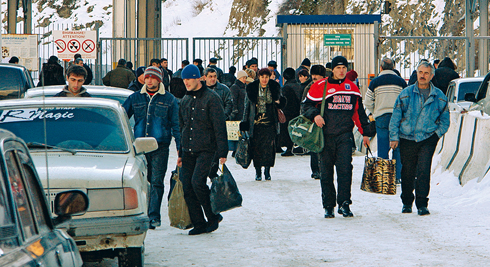
Georgia still considers the Russian-Georgian Customs Border, as well as the checkpoint on the Abkhaz section on the PSOU river
WTO is not to eat lobio. Russia and Georgia held negotiations in Switzerland on the entry of the Russian Federation to the World Trade Organization (WTO). This fact Moscow did not even officially confirm that it was not surprising: after August 2008, Dmitry Medvedev proclaimed any contacts with the Saakashvili mode. However, there is no way out: Georgia is the only of the 153 members of the secondary school objects against the accession of the Russian Federation and threatens to apply the right of veto. Which cat once again ran between the two countries - found out The New Times
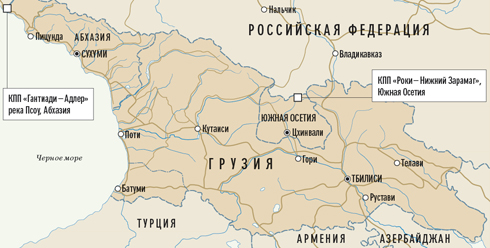
Increase the image (348 KB, 1024x518, will open in the new window)
Georgia requires a solution to the issue of customs checkpoints on the PSOU River in Abkhazia and at the Rock Tunnel in South Ossetia: both checkpoints insist, Tbilisi, must have the status of the customs border between Russia and Georgia. “We cannot support Russia's entry into the WTO until these conditions are met,” said the press secretary of the Georgian President Manana Manzhgalaladze. Moscow, first of all, achieves from Georgia to relieve the threat of veto to enter the WTO, bearing in mind to resolve the customs procedures “in a working order”. The third is the unspoken, but visible - a participant in the collision - the USA, the most important strategic ally of Saakashvili. The problem of Tbilisi is that Washington has very much supported by Russia very much and the mouth of President Obama promised Moscow in every possible way to assist in this. It was the Americans who convinced Georgians to go to Switzerland and try to resolve disagreements with the Russians. “The situation is not easy: there is no diplomatic relationship between Russia and Georgia, the positions of the parties are very far from rapprochement,” the director of the Information Bureau for the accession of Russia to the WTO Alexei Portan commented for The NEW Times.
"Last turn"
Meanwhile, Tbilisi's objections were quite expected. Last autumn, the then Minister of Reintegration (simply put, responsible for the occupied territories) Temuri Jacobashvili outlined the position of his country: “The WTO regulates the issues of trade between its members. From the point of view of the vast majority of the countries of the world, South Ossetia and Abkhazia remain part of Georgia. So, the Russian-Georgian customs points should be located on the PSOU River (Gantiadi-Adler's checkpoint.-The New Times) and near the Rock Tunnel (Rocky-Nizhny Zaramag.-The New Times). The only one who prevents Georgia’s legitimate law to put their customs officers at these points is Russian troops who occupied Abkhazia and the Tskhinvalsky region. ”
“It is clear that the disagreements with Tbilisi did not arise yesterday, and the Russian negotiators perfectly understood: sooner or later they would bury in the“ Georgian Wall, ”explains Alexei Portan. - At the same time, the position of all our Western partners came down to the following: first, remove controversial issues with other countries, and leave Tbilisi last. And this "last turn" has come. "
The warnings of Jacobashvili were not heard also because Moscow inspired the forecast of the US presidential adviser to the economy (now former) Lawrence Summers, made after negotiations with the First Deputy Prime Minister of the Russian Federation Igor Shuvalov in October 2010: the process of Russia's entry into the WTO can be completed within a year. True, Summers connected this with the need for certain “creative solutions”.
Authoritative Biden
What exactly is Creative, it became clear during a visit to Moscow by the US Vice President Joseph Biden-in fact, one of the few members of the US administration, whose opinion in Tbilisi enjoys unquestioned authority. It was this that Moscow relied, turning about a month before the visit to Biden with a request to put on the unyielding Georgians. During the negotiations, Biden -Putin found out: the Americans strongly advised the Georgians not to interfere with Russia's entry into the WTO, and instead agree to a compromise option - let the passage points from the Georgian side control customs outfits from the EU.
For Tbilisi, as the New Times told sources in the official structures of the Georgian capital, this is a “not very good option”. The point is not only in the "diplomatic loss of face." The Georgians are afraid of Europeans, it will be difficult to understand both the tricks of the design and the very nature of the goods following the Russian Federation to Abkhazia and South Ossetia and vice versa. Meanwhile, the main question is now: what, in fact, are these commodity flows? Who really controls them on both sides of the so -called "boundaries of friendship"? And is Russia ready to make them completely transparent? 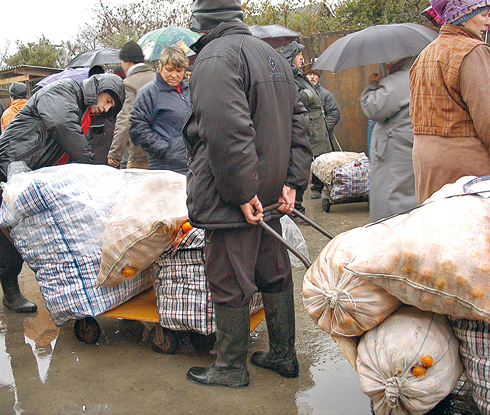
Nevertheless, as our Georgian interlocutors were made to understand, their delegation in Bern, led by the adviser to Prime Minister Tamara Kovzeridze, is ready to give in to US exhortations and agree to the transfer of customs affairs to the EU. But "there is nowhere to retreat for Georgia."
The headache of Moscow
Having recognized Abkhazia and South Ossetia at the end of August 2008, Russia itself created an extra headache. And not only because it sharply complicated the process of its joined the WTO, which has already been going on for 17 years. It’s just that now Moscow is forced to build its trading policy based on the needs of two quasi -state formations that do not have a full -fledged economy, nor a combat -ready army, or a normal diplomatic service. Meanwhile, both parafers, completely dependent on Russian injections, categorically object to any customs control: Georgian or European (considering it to Besweight).
As a result, Russia also had to be “creative”. In the days of negotiations in Bern, the head of the Rospotrebnadzor Gennady Onishchenko, from time to time, who was working on the field of foreign policy, announced: Russia may be opened by a gate for Georgian wine. However, Mr. Onishchenko’s proposal for many experts looked like a primitive bribery. Inexperienced in diplomatic intricacies, the sanitary specialist managed to directly attach the question of Georgian wine to the WTO negotiations as “comedy” and call an equal partner in negotiations with “national-territorial education”. Thus, the question of Russia's accession to the WTO, as expected, was dependent. The question is how for a long time?
Dmitry Dokuchaev and Boris Yunanov participated in the preparation of the material
Moscow has been seeking membership in the WTO since 1993. Georgia joined this international organization in June 2000. Bilateral negotiations on the issue of Russia's accession to the WTO successfully ended back in 2004, however, after the August war of 2008 and the recognition of the independence of Abkhazia and South Ossetia Tbilisi, by Russia, he withdrew his signature under the document and put forward additional conditions.