
Translated material
Crazy card
Passion for WEK
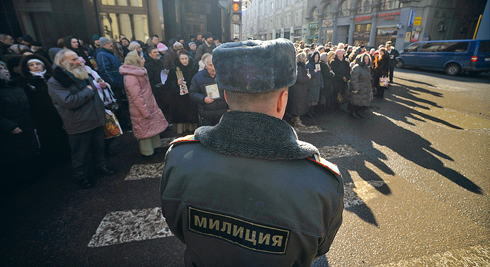
March 9, 2011. The universal electronic card has not yet been released, and the protest against its introduction has already begun
Crazy card. From January 2012, Russians will begin to issue universal electronic cards (UEC). It is assumed that the UEC will combine the functions of the policy of compulsory medical and pension insurance, student tickets, travel documents, bank cards and even a passport. Is the idea of life compatible - The New Times found out
Prior to the appearance of cards, another 10 months, and the novelty is already advertised with might and main. On the main page of the site “Universal Electronic Card” OJSC, a whole family of six people - adults and children is blurred in happy smiles. The materials on the site notify that the UEC will be accepted in the subway, buses, trolleybuses and trams - it will be enough to bring it to a contactless reader. In addition, it will be possible to pay for goods and services. Finally, unlike social maps, WEC will have to operate throughout the country, and not just in his “home” region. But about the risks associated with the novelty, nothing is said. Which is at least dishonest.
Free cheese
The recent Levada Center survey found out: only half of the country's population ** was conducted at the end of February among 1.6 thousand Russians in 45 regions of the Russian Federation. The second half has no bank account, and 40% of them does not even plan to start it. Despite this, the modernization experiment decided not to postpone. A universal electronic card will be managed for each Russian citizen from 14 years old and older and will be issued, as the state promises, absolutely free. All costs, according to the authorities, will fall on the state budget: the head of the Ministry of Economic Development Elvira Nabiullina said that the implementation of the UEC would need 150-170 billion rubles ($ 5.2–5.9 billion). This is where the questions begin.

“In terms of one citizen of the Russian Federation, it turns out about $ 40, if the cards are issued only to citizens who have reached the age of 14, then about $ 50,” says Maxim Osadchiy, the head of the analytical department of the corporate financing bank . “This amount is unlikely to cover even the costs of issuing cards (taking into account the necessary degrees of protection), not to mention the costs of administration.” Osadchiy does not exclude that as a result, a significant part of the expenses associated with the UEC will fall directly on the owners of the cards. Let's say they will give out cards for free, and then they will introduce some annual payments “for service”.
By the way, at a meeting of the Presidential Commission for Modernization, representatives of Sberbank issued their own calculations on the costs of UEC: according to the introduction of cards, it will take an amount 2.5 times higher than the one that the mayor speaks of is 450 billion rubles, and for banks cards will be beneficial only if they receive a commission 0.3% of the transfer amount and 0.5% - with each financial transaction. So the "free" of the entire venture for citizens is a myth. Moreover, the opinion of Sberbank on this issue may be decisive.
The fact is that the founders of the Universal Electronic Card OJSC *** is the federal authorized coordinator and the project operator. There were three large credit organizations: Sberbank of Russia (share in the authorized capital - 34%), Uralsib Bank (33%) and Ak Bars Bank (33%). All are direct participants in the process of creating and introducing a map. At the same time, two out of three banks are private. “It turns out that private credit institutions will have exclusive access to the tax information of citizens,” Maxim Osadchiy fears. - The question is, by what right is they given to such a preference? " According to the analyst, to gain access to tax information (which is also contained in the salary data) is the dream of any bank: this would sharply reduce the costs of monitoring their customers. So, for those who are deprived of this information, there is a temptation to receive it. In the case of a universal electronic card, the possibilities for this seem to open unlimited.
Catch, fish!
The creators of the cards claim: the risks of revealing personal information are reduced to zero. “All data about the citizen will be stored in the same place as now, in the databases of state ministries and departments. And only these departments have access to records, ”says Andrei Nesterov, head of the press service of the Universal Electronic Card OJSC . “And the card only helps to find the necessary from them faster.” In addition, according to Nesterov, the universal electronic card is protected "both by hardware and software of protection, which are under thorough state control." And to apply the card, you will need to introduce a personal PIN code (excluding transport payments). 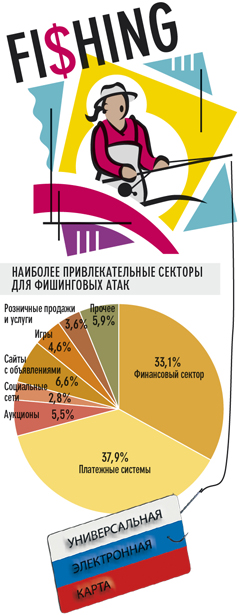
These arguments do not seem convincing independent experts. “The risks of the disclosure of personal information today cannot be reduced to zero, especially when it concerns banking information,” objects Irina Levova, a leading analyst in the Russian Association of Electronic Communications (RAEC) . One of the most common cybercrime - phishing * * from the English word Fishing - fishing, learning., The main purpose of which is to obtain identification data of users: passwords, credit card numbers, bank accounts. “A typical example of phishing is a notification received by e -mail and containing some significant reason for the user to give his own personal information immediately,” Levova explains. For example, frauds refer to a mythical technical failure in the bank’s computer system, due to which the client’s data are allegedly lost, and if they are not urgently restored, the card will be blocked. The gullible client, afraid to be left without money, is in a hurry to duplicate his personal data that are in the hands of scammers to the specified address. According to Levovich, now there are an average of 70 phishing portals per month in Russia, directed against Russian banks and payment systems. The damage from Phishing in our country for 2010 is estimated at $ 10 million in RAEK, and the growth of this type of fraud by 300% is predicted - as the card system develops in Russia * * Damage from phishing in the United States - $ 150-200 million, in Canada - $ 70–100 million .. “The mass introduction of a universal payment card will only increase this percent Irina Levova.
Hacking is inevitable
The skepticism does not hide the skeptic and Anton Nosik, the chief editor of the Internet portal Bfm.ru : “Any guards who wish to check the citizen a residence permit or a driver’s license will now immediately receive his credit card, the history of the disease, and the income declaration.” According to the nose, ideally Cardrider * * Electronic bank cards reader. Each individual service should be cut off from the rest: after all, a lot of confidential information is stored on the map. For example, a policeman (policeman) should not have access to the medical history of a citizen, and the doctor - to his driver's rights. And both have no need to have information about his credit card. “Today in free commercial circulation there are all types of readers,” says Nosik. “And on their basis, for illegally hacking a universal card, it is quite possible to make and release a universal reader on the black market.” 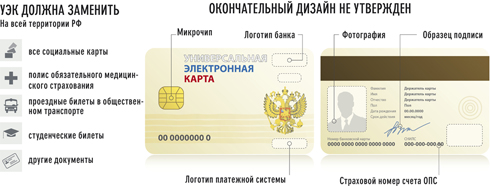
According to the nose, the idea of combining all the information on one card is erroneous: “The card, which is designed to use many times a day, is doomed to quickly become unusable. Instead of the declared convenience, we get a headache. Everything that the UEC is supposed to be stuffed should be contained on separate maps with chips and magnetic ribbons, ”the expert said. The nose gives an example the experience of Israel: its citizens when arriving at the country or flying out of it do not show a passport - it is replaced by a free electronic card, which is enough to attach to a special reader. All other information - driver’s license, medical and credit stories, data on a bank account - is stored on separate cards, and no one, it seems, is not experiencing from this inconvenience.
However, the idea to combine all the information into one chip rests on one small barrier - today in Russia such a chip simply does not exist. This was recognized by the Minister of Communications and Mass Communications Igor Schegolev: according to him, it was originally assumed that the domestic chip would release the Citronics concern. But President Medvedev gave other introductory ones: “We will not wait until we create our chip, otherwise it will never be created. Introduce it with a foreign chip. As soon as the domestic chip is created, a reinfection will be made and the maps will be re -released with the Russian chip, ”the president said. How quickly this re -sanction will occur and what it will cost taxpayers - today a secret covered with darkness. However, the Universal Electronic Card OJSC claims that skeptics can refuse their brainchild - to date, UEC is used as a purely voluntary one.
Foreign experience
In the United States, there is a social security card (SSC). Her unique nine -digit number is necessary when applying for a job, opening a bank account, paying taxes, receiving benefits. The vast majority of Americans have SSC. In Belgium, an electronic identification card (EID) has been issued since the end of 2009 to each subject of the kingdom, which has reached the age of 12. It allows you to certify personality, move inside the EU, and also use an electronic signature. The card can be used to visit libraries, sports halls, museums. In Malaysia in 1999, a program of creating a national ID card was launched. It became the world's first plastic card with an electronic chip, in which the owner of the owner and his biometric data are simultaneously sewn. The card is issued to all citizens of the country who has reached 12 years. It combines the functions of identification, driver’s license, passport, electronic wallet and medical card. In Germany , in the early 2000s, an ID card project was launched, but it turned out to be unsuccessful: it turned out that citizens carried out only 1-2 transactions per year on a map. Currently, a new electronic card system is being developed in Germany, the implementation of which has not yet been named.
By open sources