
Translated material
Tsunami went through the markets
How will the Japanese catastrophe affect the world economy
Fortune -telling in the economy. The catastrophe inflicted a strong blow to Japan's economy. The scale of damage has yet to be appreciated, but Prime Minister Nato Kan has already stated that the country has not experienced such a crisis since the end of World War II. What to wait for investors and markets - The New Times interviewed experts 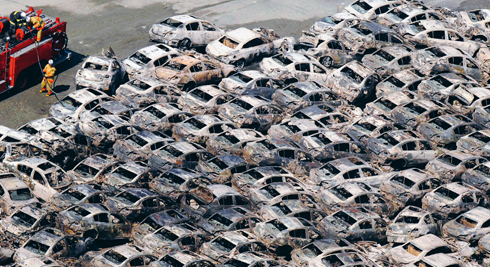
The burned cars in the Hitagi port-the symbol of the losses of the Japanese automobile industry Analytical centers evaluate the amount of damage caused by the Japanese economy in different ways-from 0.5% to 6% of GDP. Such a scatter is completely explained: time to calculate the final losses has not yet come. However, given that the economy of Japan is the third in the world after the United States and China in terms of GDP
* * According to the results of 2010, Japan's GDP is $ 5.47 trillion. , in any case, the damage is calculated by hundreds of billions of dollars. During the week, which passed after March 11 (when a terrible earthquake occurred, and behind the cities of the coastal zone, the tsunami fell), the total capitalization of Japanese firms fell by $ 600-620 billion. The losses of the Japanese industry during this time were calculated by Nomura analysts, amount to $ 160 billion, which at least one and a half times more losses that caused the country to the country The 1995 earthquake is in the area of the city of Kobe. And this is only a preliminary assessment, experts warn.
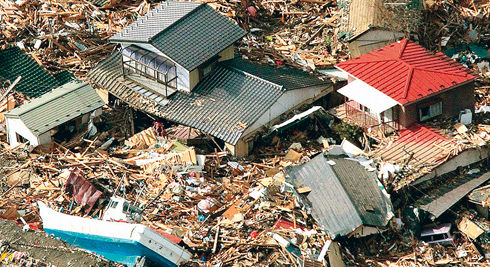
What remains of the city of Minomasanrik (Prefecture of Miyagi) after the tsunami. Building companies are facing large restoration work of the energy of the accident at the Fukushima nuclear power plant led to a stop 11 of the available 55 reactors of Japanese atomic energy. According to the International Agency for Nuclear Energy (IAEA), before the accident, Japanese nuclear power plants provided the country's needs for electricity by 30–33%. Trading Tokyo Electric Power Co. - The largest energy company of Asia, the operator of the Fukushima NPP - temporarily discontinued.
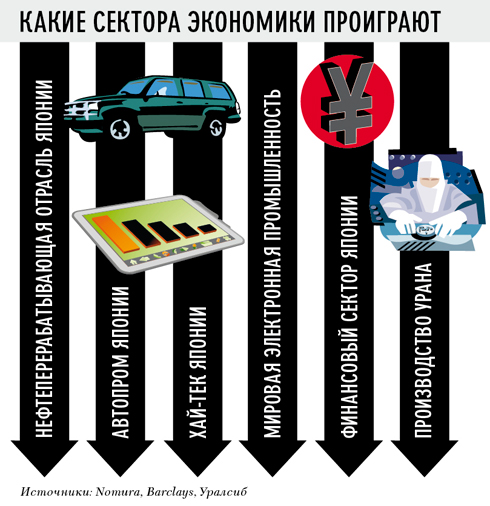
After the earthquake and tsunami, the largest refineries of the country ceased to work. But Japan is the second largest oil refiningor of the Asia-Pacific region after China: 28 Japanese refinery can be processed about 4.4 million barrels of oil per day. Now almost a third (29%) oil refining capacities of Japan has been stopped, which reduced oil consumption by 1.3 million barrels - and this is 25% of the daily oil refining in the country, the consulting company Wood Mackenzie notes.
A decrease in oil demand in Japan did not slow down to affect the price of black gold in the world: in a week it fell on international exchange platforms by 3.4% - to a level below $ 100 per barrel.
“For some time, the demand for raw oil will remain low. The elimination of destruction in oil refineries can take up to six months, ”said Tetsi Emory, manager of the Astmax raw materials. Then, analysts believe, new growth may begin. The price of the Brent brand by the end of the year will be $ 125 per barrel, quotes Bloomberg the forecast of American strategists Kemga Gregory and John Marshall. The disaster in Japan can even increase oil consumption, writes The Wall Street Journal: oil and fuel oil will become the most likely replacement of 11 destroyed nuclear reactors in the National Energy System of Japan.
“In the medium -term or long -term perspective, when oil refineries, unlike nuclear reactors, will recover, oil prices will win,” Goldman Sachs analysts say. World prices for natural gas are already rising on fears of increasing demand from Japan. In the UK, gas contracts with the supply of the next winter have risen in price by 7.4%. In New York, April gas futures rose by 3.8%.
“The protracted risks associated with the suspension of the work of atomic reactors can redirect the routes of tankers with liquefied natural gas to Japan,” Barclays analysts believe. Japan is the world's largest consumer of liquefied natural gas (LNG): according to BP, the country accounted for about 35% of the total import of gas in 2010. Most experts include that gas generators compensate for the falling fraction of nuclear energy. This has already led to a serious jump in liquefied gas prices. This situation is beneficial primarily to the Russian Gazprom, which controls the nearest LNG production plant on Sakhalin. But the shares of the Australian manufacturers of Uranus (it was mainly purchased for Japanese nuclear power plants) went down: Uranus, the Japanese seem to be needed soon.
Cars in the near future, experts believe, the offer of cars, household and industrial electronics and machine -building machines - the main articles of export of Japan may be reduced. The largest car manufacturer in the world - Toyota Corporation - can reduce the production of cars by 40 thousand pieces.
Several Honda plants are closed. Due to the lack of electricity, the Nissan, Mitsubishi, Mazda, Subaru, Suzuki plants were temporarily closed. The shares of car companies at exchange -offs in Tokyo collapsed: Toyota, Honda, Sony, Mitsubishi lost 8-10%per week. They face a partial loss of sales markets, which their competitors will try to enter.
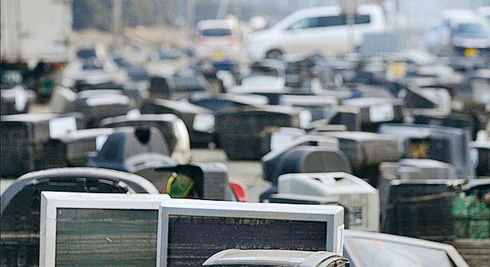
Underground shocks destroyed the warehouse of electronic household appliances in the Aomori Prefecture. TVs and computers were in the open air right on the pavement
Electronics of the Toshiba, Canon, Fujitsu, Panasonic and Sony plants - world leaders in the field of electronics and high technologies - confirmed the closure of factories in the Tokokhu prefecture, which suffered from the disaster. In total, about 12 plants specializing in the production of microchips and household appliances, including computers, cameras, smartphones. Yaroslav Lisovolik, the chief economist of Deutche Bank Russia, believes that the negative effect of this may spread to other companies of sectors that are not directly related to Japan. For example, Toshiba supplies 35% of the so-called NAND chips used in smartphones and computers to the world market
* These chips, for example, are in the iPad 2, iPhone Apple, Droid X smartphone (motorola). . As a result, the volumes of gadget production of the same Apple can be seriously reduced. Toshiba shares have already lost 17%on exchanges, Fujitsu - more than 6%.
Financing is faced with the threat of production reduction, the Japanese authorities are forced to stimulate the economy. As the manager of Japan, Masaki Sirakawa, announced, over the past week, the bank made large monetary injections - about 28 trillion yen ($ 346 billion) - in order to maintain industry and prevent the country's stock market collapse. As a result, by March 18, the Japanese Nikkei funds index rose by 2.7% (after a four -day fall by 14%), and the yen course strengthened. But the expert of the consulting company IHS Global Insight Nariman Beravesh doubts that the positive movement will have a long -term nature. He believes: the markets are waiting for Japanese investors to begin to withdraw their money from foreign shares and invest them in the economy of their country.
And this is a direct threat to the financial system of the United States, says Boris Nemtsov, politician and private investor. “Japan, directing funds to restore its economy, can reduce the amount of purchase of American government bonds, which will create difficulties in financing the US public debt,” he said.
“The costs of restoring the economy with a heavy burden will fall on the budget of Japan, which already has the highest level of public debt among developed countries - about 26% of GDP,” said Stephen Dashevsky, managing partner of Dashevsky & Partners. - However, the yen course will grow, since Japanese companies and citizens will transfer funds to national currency to finance recovery. At the same time, strengthening yen relative to other currencies can negatively affect the profit of Japanese exporters. ”
The cynical business most world analytical centers are not inclined to worry too much about the influence of events in Japan on the world economy. “The Japanese economy, although the third largest, is unlikely to cause a global world decline. The previous crisis struck the financial system in the very heart - the USA. Now the situation in America and Europe is significantly better, ”said Matt Riordan, manager of Paradice Investment Management Pty. Since Japan has not played the role of an international “locomotive” recently, there is no need to wait for special negative effects, IHS Clobal Insight Analysts echo. It will mainly manifest in the field of international trade. In particular, deliveries to the world market of cars, communications and household electronics will be reduced. At the same time, the supply of these goods from other countries of Asia, Europe and the USA will grow as a result of global competition. The growth of world GDP this year, due to events in Japan, can decrease by 0.1-0.2%, but it will increase by the same amount next year, IHS Global Insight experts predict.
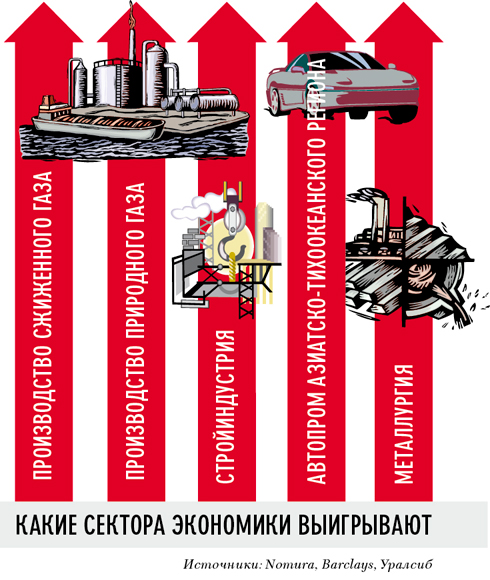
And the analyst of the Three Dialog Anton Struchenevsky (and he is not alone) and completely believes that the world economy as a result of Japanese events is not at all a decline, but the rise: “The business is cynical, and the Japanese tragedy will turn into a win for a number of industries. For example, the world has already begun in the world's increase in metallurgy products: it will be needed for the future restoration of the Japanese economy. ” The expert notes that the construction industry will win (its products will also be needed to restore the country), the enterprise of the auto industry and high-tech, especially from the Asia-Pacific region, competing with the Japanese plants of these sectors. And Russia is already counting on an increase in the sale of its energy carriers, as well as for an increase in oil and gas prices.
However, there are also pessimistic forecasts in the market. Natalia Orlova, the chief economist of Alfa-Bank, believes that “if the situation on Fukushima gets out of control, a scenario is possible according to which all stock markets will instantly roll. And the Japanese economy will simply bury this: the world will give up goods for a long time that they will think that they can be infected with radiation. ” In this case, the power of an economic blow will be a knockout, Orlov believes, and no potential winnings of competitors compensate for the damage: the world economy will again be in crisis.