Translated material
The planet swayed
The last earthquake surprised scientists
Scenario from the Lord God. “The death of Japan”, “Tokyo. Magnituda 8.0 ”,“ The day after tomorrow ” - the filmmakers will be called from the heels of the films, where, as a result of a terrible earthquake, the Land of the Rising Sun is on the verge of destruction. Reality is always worse-for the simple reason that does not guarantee a happy end. And this reality is laid down from the creation of the Earth. What is happening in the Japanese under their feet - The New Times asked scientists to the Japanese monstrously unlucky. As, however, the Chileans were also unlucky (the worst earthquake of magnitude 9.5 points in history
* * Hereinafter - Magnitus on the Henks -Kanamori scale, which is used for large earthquakes. It occurred there in 1960), residents of Alaska (9.2 points, 1964), the Indonesian island of Sumatra (9.1 points, 2004) and our Kamchatka (9.0 points, 1952). And everyone - for the same reason: they managed to be born at those points of the Earth where oceanic slabs collide with continental
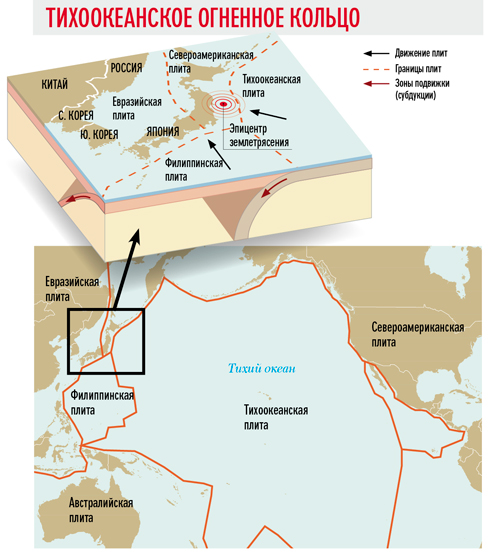
* Earth’s bark, according to the theory of tectonics of the plates, is divided into 14 large plates. . And not only are they encountered: more subtle, ocean-Pacific, Philippine, Mexican climb under the granite foundations of the continents-South American, Eurasian, Australian, rub on each other, but at some point, love ends as it ends-a long-copy voltage requires a discharge, which follows a break, shaking and divorce. The tip of the oceanic slab slides down into the soft and hot mantle of the Earth, the visor of the continental, on the contrary, slightly rises. Temporary rest occurs for the slabs, and people-dozens, thousands, two hundred thousand perishes on their surfaces, as it was in 2004 after an earthquake at Sumatra, for which a 25-meter wave went). They gave birth, thought about the future of their children, studied at universities, planned revenue from the crop grown, dividends from investment in the action, uro political opponents, arranged conspiracies, built intrigues ... several minutes of monstrous shaking, then a wave, then - everything.
8.3 cm per year “east of mainland Japan, in the ocean, where the Japanese break is leaking, the Pacific plate at a speed of 8.3 cm is moved over a year (geologists call this subduction) to the North American - Eurasian slabs. From a geological point of view, this speed is very high-it is more than anywhere else on the planet. Here in the place where the plates are in contact, and an earthquake has occurred, ”says Professor Gregory Berosa, dean of the Faculty of Geophysical University, and one of the leading earthquake specialists in the world.
“This place” and the space around it is called the Pacific Fire Ring. The Japanese were not lucky three times: the Filipino Oceanic slab crawls under the Eurasian, north - Pacific collisions from the North American, and the border of the Eurasian and North American continental slabs passes through Japan. Hence the endless earthquakes. “But earlier, relatively small earthquakes took place on the border between the plates - a magnitude of 7.8 points. The current - 9 points, this has never happened here, ”says Berosa
* The Canton earthquake of 1923 had a magnitude of 8.3, the great Khanshin earthquake (Kobo) - 6.3 points. .
The broken between the plates was 450-500 km in length, 150 km wide (however, the earthquake in Sumatra formed a break of 1200 km). The plates moved 15 meters, and perhaps Berosa believes, in some places and twice as much. As a result, an amplitude of 8-10 meters passed in the earth's firmament. “This is practically not amenable to explanation,” says the American professor.
“The current models, within the framework of the tectonic theory of such an earthquake, did not provide for 9 points. Now they will have to be reviewed, ”agrees the Russian professor, deputy director of the Institute of Oceanology of the Russian Academy of Sciences Leopold Lobkovsky.
The time and place why the earthquake occurred right now, in March 2011? Neither Professor Berosa and Lobkovsky, nor a leading specialist in the earthquakes of the California branch of the US Geological Service, geologist engineer Keat Knadsen do not know. “The slabs moved for centuries, for a long time the process was inhibited. And it took some couple of minutes so that the tension that accumulated in the fault was released in such a terrible way, ”Berosa is amazed. “But why now - we do not know: we can only observe the consequences.” The consequence was the tsunami, which took the lives of more than 15 thousand people. ” “The wave in the earthly firmament rapidly deformed the ocean bottom in a space equal to the length of the formed fault,” explains Knvnesis. “It answered with a pillar of water.”
In this part of the Japanese archipelago, the last earthquake of a similar scale occurred in 869, that is, 1142 ago, Professor Berosa says: “These data are based on the analysis of those deposits that left the past tsunami on the plain,” he argues.
But if the current earthquake of power is the second in a thousand years, then what does it signal: the end of the cycle or the beginning of a new consequences with all the ensuing consequences? Unknown. The tremor of the plates is still ongoing - more than 100 shakes have already occurred, including one magnitude of 7.1 points. And they, Berosa says, will last a few more months, perhaps years: “It remains unclear whether the other part of the Japanese gutter will move in the south and in the north of Japan; Is it worth expecting new powerful earthquakes - we do not know. ”
The future if now the Pacific Ocean plate climbed under the Eurasian by 15 meters, then it can not want to get out later - you must agree, a reasonable question. “A good question,” says Berosa. “The Pacific plate is moving in the northwestern direction in relation to Eurasia for 200 million years,” the professor once says thoughtfully, as if trying to cover this time that is quite meaningless for the Negeologist-for the simple reason that it cannot be presented: 200, 500 million years-all one. And he concludes: “She, the stove, moves the power of currents inside the Earth, and we think that this process will continue. At some point, the resulting break will close, irritation will accumulate again and an earthquake will occur again. ”
When?
“We cannot predict earthquakes. True, in July last year, a number of scientists said that there is a chance that earthquakes will occur in a number of places, including Japan. But this January they made a revaluation of their forecast and decided: the period of increased probability of earthquakes passed. Two months later, what happened happened, ”Berosa states not without pleasure.
Knadsen is more optimistic: “Those models that I describe, display a decrease and increase in voltage in the zones of the collision of plates. Based on this, you can try to assess the probability of an earthquake with an accuracy of 10–20% for a period of more than 30 years. But to say that the earthquake will happen on the next Tuesday - this cannot be done. ”
And finally, the most sacramental question: can a script from Hollywood blockbusters like “2012” happen - say that Japan will go to the bottom of the sea as a result of natural cataclysms?
No, cannot. “The same is said about California - that part of it will fall into the ocean. This is a fiction, ”says Knadsen. Berosa is more circumstances: "The Japanese islands consist of a breed, which, of course, is very heavy, but it is easier than the material on which they are located, and this provides the islands with buoyancy." “All these conversations are probably an entertaining topic for thought,” Berosa believes. “If you, of course, do not live there,” he concludes.
PS The incredible excitement of the public of interest was caused by the fact that, as a result of the Japanese earthquake, longitude of the day was reduced by two milliseconds and slightly shifted - a little more than 15 cm - the axis of the Earth’s rotation. In other words, the planet swayed around its axis. However, this does not threaten anything, including climate changes. “I think so,” added Professor Berosa.