
Translated material
Trembling land
Confront elements, they studied centuries
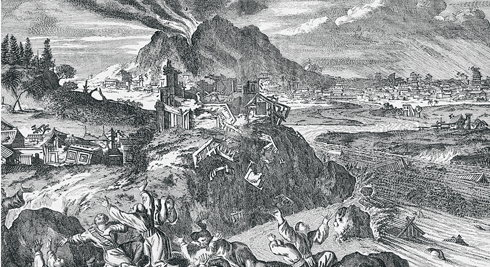
The German engraving depicting the strongest earthquake in Tokyo 1650 "Why is there no looting?" - the American television company CNN asked, comparing the situation in the Japanese towns destroyed and ruined by the elements with what was happening in New Orleans after the Typhoon “Katrina” fell upon him, and where the police had to use weapons. Indeed, why do the Japanese show stoicism, a high level of self -organization and amazing in extreme conditions in extreme conditions in the face of the elements? They studied this for centuries, historians of Japan are shaking every day and throughout its long history. However, no matter how paradoxical it seems, in the old Japanese chronicles about that - quite a bit. There are no “colorful” descriptions at all. It says simply: there was an earthquake or volcanic eruption. The Sandai Dzitsuroku chronicle, the record from 864, contains the most picturesque and terrible description of Fuji's eruption. “From the province of Suruga they report:“ The Great Mountain is the Great God Asama
* * God of Mount Fuji. the third senior rank
* In the same way as officials, deities were assigned ranks; The third rank was given only to representatives of the highest aristocracy. , drew the fire, he was very strong. The slopes of the mountain burned at 12
* 1 RI - in ancient times about 660 m., The height of the flame reached 20 jus
* About 3 m., The roar resembled the rings of thunder. The earth was shaking three times. Ten days have passed, but there was no end to this. The rocks burned, the top collapsed, the stones fell like rain. Smoke swirled, moisture evaporated, people could not get close. The lake, which is located northwest of the Great Mountain, was flooded with a stream of lava. The flow length was 30 RE, the width was 3-4 RI, the depth was 2-3 j. Ashes reached the border of the CAI province
* Yamanashi Prefecture; Located behind Fuji if you look at it from the ocean. ".
The silent story why are the Japanese chronicles so restrained in fixing natural disasters? There are two main reasons for that. Firstly, the traditional Japanese house-and in ancient times, and often today-is built taking into account the threat of earthquakes: its frame is worked out of wood, its “walls” are paper, the foundation is absent. The supporting pillars are not dug into the ground, they rest on the stones. With a slight push, this design bounces up and becomes in its former place. In the case of a push, it can fall apart more, but without causing people especially great injuries. Therefore, in ancient Japan, drought, fraught with inexpensive rice and hunger than earthquakes, were much more afraid. The second reason is purely ideological. In the political philosophy of Japan (like the entire Far East), it was believed that the earthquake serves as a punishment of the sky for bad and unrighteous administration. A person who would dare to describe an earthquake or to portray it in the picture fell into the category of power critics. Japanese power, like any other, did not complain to the opposition.
The hour of the bull Mount Fuji is now perceived as a symbol of Japan and the beauty of its nature. However, Fuji for a long time was an acting volcano, and people not only admired it, but also were afraid of her. One of the strongest eruptions in Fuji happened in 1707 after a series of earthquakes that swept through the country.
The description of this cataclysm was left by Arai Khakusec (1657–1725), who held key posts at the shogun court. During the eruption, he was in Edo (current Tokyo). “Last night, the earth began to shake, and at the hour of the bull
* Between the 11th and 13th hours of the day. There were rings of thunder. I ran out of the house and clearly saw how the white ash fell - as if it were snowing. He looked to the south-east: black clouds swirled there, lightning often sparkled. I got to Sailso
* Modern Prefecture of Saitama. , the earth there was covered with white ash, grass and trees also became white ... at the hour of dogs
* Between the 19th and 21st hours. The ashes stopped falling, but the earth all the time buzzed or shook. The 25th day of the sky darkened again, the intermittent peals of thunder rang out, and in the evening the ashes began to fall again. People said that on this day a fire that burned out [the ground] erupted from Fuji. ”
As for the images, there is not a single work at all on which the eruption would be drawn. Japanese artists still preferred to draw a beautiful and calm Fuji, as if nothing happened.
Apocalypse-1923 Truly the Japanese began to be afraid of earthquakes only in the twentieth century. The growth of the population, its concentration in close cities, a gradual rejection of wooden buildings in favor of the bricks led to the fact that the damage from the revelry of the elements began to increase. People began to settle more on the coast, and the death of hundreds of people during the typhoon became ordinary. The most terrible spontaneous disaster that befell Japan in the 20th century was the earthquake, which happened on September 1, 1923 in the Tokyo -Iookogam region. About 3 million people lived in the Big Tokyo. In the capital, burned alive, died under the wreckage of buildings and drowned about 100 thousand people. The power supply system, telegraph, telephone, water supply system failed.
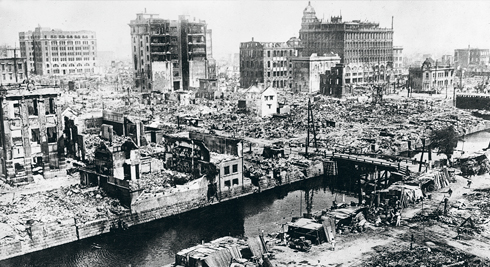
Destruction in Tokyo after the 1923 earthquake. The underground tremors caused a strong fire that destroyed wooden buildings. Most stone houses turned into ruins an earthquake, the epicenter of which was under the bay sagas, happened at the moment when housewives prepared dinner. The flame of gas stoves, foci and kerosene escaped out. The wind threw the fire from the roof to the roof of standing houses standing close, the wooden city burned hotly, the coins sintering into the ingots. Due to the lack of water, fires lasted three days. The 221,718 houses burned down. Of the 675 bridges, 360 was destroyed by fire. 824 firefighters of the imperial capital with their 50th cars could not help business. Jewed a tree, the fire rested on the rivers and wastelands and stopped by himself. Tokyo lost all stone buildings, which guides were enthusiastic about. The famous Orthodox Resurrection Cathedral was also destroyed, built by the gifts of Bishop Nicholas in 1891. Only the Imperial Hotel, erected a year before, was the famous Frank Lloyd Wright. This hotel was the first in Japan to a seismo -resistant stone building.
Fleeing from the fire, people gathered in parks, in the territories of temples and sanctuaries, rushed into ponds and rivers. In the square in front of the imperial palace, 300 thousand people gathered - she never saw so many people. These people lost their roof over their heads. The total damage caused by the earthquake exceeded the country's annual budget four times. It is impossible not to say: this disaster aroused in people both high and low: terrible events turned out to be pogroms for the Koreans and Chinese who lived here, who were considered the culprits of fires.
But in another, the Japanese remained the Japanese. Boris Pilnyak wrote in the book “The Roots of the Japanese Sun”: “When, after the fires, the survivors came to dig up the dead, these alive saw that these dead people died, were charred in perfect order, strict trellis, the living under the dead found living children. Adults, organizedly charged, died without panic, almost without panic and - in any case, charred - the coal of their bodies - saved the children. " The Polish diplomat Stanislav Patet watched how, among this horror, his father managed to discover his daughter. “They did not rush into each other, no,” they bowed to each other with the deep bow that Japanese politeness bow, on their knees and hissing their lips, they congratulated each other in a good evening, they did not touch each other. ”
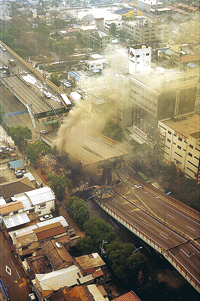 |
| It collapsed as a result of the earthquake on January 17, 1995 Hyway in the city of Nisinomy, the prefecture of Hyo |
The lessons of the next large earthquake by force 7.2 points occurred in the Kobe -Osak region on January 17, 1995. It claimed the lives of 6 thousand people and discovered many constructive shortcomings in the construction and organization of rescue work. Dissatisfaction with the sluggishness of the government was so great that even the mafia (Yakuza) came to the aid of the victims: the bandits delivered water and products. There was no question of any looting: the hungry people remaining without shelter - as well as now - did not rob shops, but calmly stood in lines to the diet points. From the 1995 disaster, many important lessons were extracted, the requirements for seismic resistance and the quality of construction became even tougher. Training in the entire population how to behave in extreme situations was carried out even more consistently. And this had its fruits: high -rise buildings withstood the main victims - the result of the tsunami, from which the Japanese have not yet found an antidote. And the words of the Great Akutagawa Ryunoske, written more than 80 years ago, after the tragedy of 1923, sound as if they were written now: “After the great earthquake has finally subsided, people who, fleeing the earthquake, left their homes, became friendly and friendly. Everywhere ... one could see scenes when people, regardless of whether they were neighbors or not, were talking about themselves affably, offered each other cigarettes, sweets, nursed children ... a picture of an unprecedented good -heartedness, who was among the many people gathered on the lawn, truly beautiful ... ".