
Translated material
The zone of alienation
“Fukushima” no longer
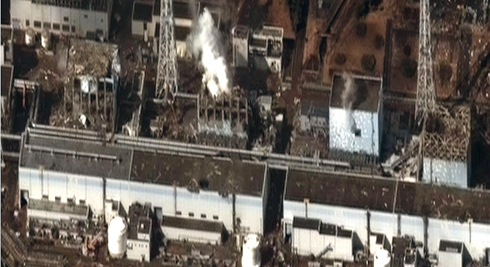
The island of misfortune. There was no one left near the nuclear power plant - in a radius of 20 kilometers everything died out. More than 200 thousand people left their homes, left their things, quit the acquired and left. Radioactive smoke swirls in the air, from time to time hydrogen explodes at the station, reinforced concrete pieces of buildings torn by explosions are lying. How all this can end-the New Times found out the Fukushima-1 nuclear power plant is located 270 kilometers north of Tokyo, on the east coast of Japan. For two weeks for this place, the name of which is translated as the “Island of Happiness”, the attention of the whole world has been riveted. A series of earthquakes, tsunami, electricity shutdowns, repeated shocks - several fires occurred at the station per week, three explosions, radioactive elements were thrown into the air, the concrete frames of three power units were destroyed, the other three were damaged, the fuel rods of four reactors were exposed and their partial melting, the level of radiation over the station constantly jumps to the levels critical of life. During the work, two station employees disappeared, 21 people were wounded and 21 received serious doses of radiation radiation.
The world immediately panicked. In Germany, demonstrations were held for a revision of national policy in the field of nuclear energy, in the USA, where the most in the world of nuclear power plants, the same were required by lawmakers, Hugo Chaveza froze the development of all Venezuelan programs in the field of a peaceful atom, the State Council of the PRC demanded to strengthen the inspections of safety at its current nuclear power plants and introduced a temporary ban on the approval of new projects in the field of nuclear energy. The families of diplomats and other foreigners urgently began to leave Japan, most foreign companies and representative offices were closed. In the Russian Far East, people bought up almost all of iodine, red wine and tickets for airplanes to Moscow. The Sakhalin Ministry of Emergencies was even forced to post on his website the testimony of the dosimeter: every minute you can make sure that the radiation background in Yuzhno-Sakhalinsk is not growing.
“Fukushima 50” with a nuclear disaster of the station, 750 employees, who balancing on the verge of nuclear disaster - the conditions are no longer intended for safe work. 180 people are left - engineers, equipment, operators, operating staff, soldiers, firefighters, volunteers. Most of these people, whose names are still unknown, are older than fifty years old, are trying not to take young people for shifts - they still have to live and it would be good to give birth to children. They understand the situation better than others-even if the situation that has gone out of control can be stabilized, they still face serious health problems, some-death.
To reduce infection, 50 people work in shifts. These units of selfless samurai nicknamed the Fukushima 50 (Fukushima 50), journalists call the last line between disaster and humanity. A disaster that could be avoided.
The Fukushima-1 NPP station is one of the 17 Japanese nuclear power plants. It belongs to the “first generation” stations that appeared in the middle of the last century, when they decided to receive energy from the atom for commercial purposes: the construction of the first power unit, from which today's problems began, started in 1967, in 1971 it was launched into operation. On March 26, the power unit will turn exactly 40 years. The remaining five reactors were launched in the second half of the 1970s. Despite its age and obsolete security systems, Fukushima showed itself worthy during the earthquake: initially the station was designed to withstand an earthquake of magnitude 8.2 points, and withstand almost ten times more - 9.0. But the tsunami did not transfer: the wave destroyed the concrete frame and, most importantly, disabled the cooling system, in the absence of which the fuel rods turn into a nuclear bomb.
In simple words, the principle of the boiling nuclear reactors, which is equipped with Fukushima, The New Times, took the specialist of the Rosatom State Corporation Andrei Timonov. “Imagine a thick sealed metal barrel - it will be the reactor case. In this barrel, fuel rods are placed - tall beams, their shell is zirconium, inside a low -enriched uranium. The chain reaction is launched, the rods are heated, the heat that they release must somehow be removed, so water is pumped through the reactor case. The water heats up and begins to run in a circle - one pipe from the reactor to the exit, on the other - to the input. Circulation pumps are driven through pipes. Water turns into steam, steam scrolls through the turbine's shoulder blades, the turbine rotates the generator, and the generator produces electricity. The steam condenses, the resulting water again runs into the reactor. And so - endlessly. "
The memory of Chernobyl to compare the Chernobyl accident with an accident at Fukushima that everyone began to do it together, somewhat incorrect, experts say. First of all, because they are constructively arranged in different ways. The Fukushima reactor can be compared with the kettle: there is a boiler inside - nuclear rods that heat water, water goes through the nose and moves the turbine. If there is no water in the inclined kettle, then it will melt: this problem arose and arose on several station reactors.
The stations like the Chernobyl nuclear power plant are more like a large pots, in which they stuck a boiler and closed the lid. But there are no water in these "pots". When an explosion occurred at the Chernobyl nuclear power plant, the pan cover demolished and part of the radioactive contents scattered around. The correctness of such an analogy-with all the obvious simplification-the correspondent of The New Times was confirmed by the Doctor of Physical and Mathematical Sciences, the head of the laboratory of the problems of Chernobyl Kurchatov Institute, Alexander Borova, whom we spoke in the first days of the accident at Fukushima, when Russian specialists have not yet been given a team from above-silent!
Then Borova said that in terms of the level of radiation pollution, the accident at Fukushima is in no comparison with Chernobyl: “Even the hundredth of Chernobyl does not expect us.” According to the scientist, there are a lot of excessive panic around Fukushima, including regarding the levels of radiation: “When we called the numbers of the radiation level, we, those who worked in Chernobyl, laughed loudly. The dose is 3-5 millithgen per hour-just the dose that we had in dormitories on the beds when we arrived there in the 86th year. We worked for a month, nothing happened. ”
However, the situation has changed rapidly, and by the end of last week, comparison with Chernobyl ceased to seem so funny even for former liquidators.
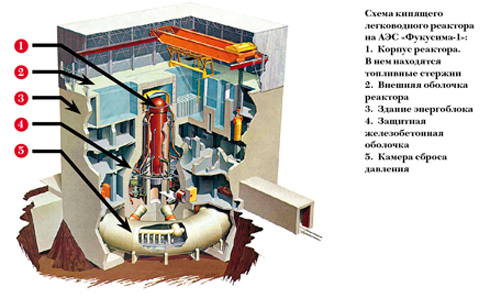
The reasons when the earthquake happened, the four nuclear power plants located in the catastrophe zone were automatically stopped. The standard power supply system, necessary for cooling reactors, was also disconnected. In return, emergency diesel generators earned. And then the tsunami hit and on Fukushima-1 the generators stopped working. Moreover, mobile generators were also damaged, since the warehouse where they were stored was also covered with a wave. Other, army mobile generators were delivered, but nothing happened to them-they were also failed to connect them due to the difference in the connectors. Consequently, there was no energy that drives the water of the cooling system, the water gradually began to evaporate, the fuel rods were exposed and began to melt. To reduce pressure in the membranes of the reactors, the resulting steam was allowed into the turbine hall, which led to an explosion of hydrogen accumulated in power units. “The design life of this station is 30 years. It was supposed to be stopped in 2001. And the fact that she worked for another 10 years - as many as 40 years - this is the junk and led to such consequences, ”says Professor Vladimir Kuznetsov, a member of the Rosatom Public Council, formerly the head of Rosatoenergonadzor. - Two years ago, the International Atomic Energy Agency drew the attention of the leadership of the Fukushima Safety station. According to Kuznetsov, the Japanese government needed to change the management company TEPCO (Tokio Electric Power Company): “In several tens of years, the management company made up to two hundred and different falsifications on security. There were endless scandals on this subject. ” Kuznetsov also believes that the nuclear power plant being bought in the United States was not adapted to the conditions of such seismically dangerous zones as the eastern coast of Japan.
Rosatom’s employee Andrei Timonov believes that a more modern security system could prevent an accident that was not installed, most likely, due to financial reasons. According to him, nuclear power plants like Fukushima-1 are equipped with a “single-circuit system”, while modern nuclear power plants are “double-circuit”, which does not allow a steambox mixture that exploded into three of the six Fukushima reactors. There was no security system at the Japanese station, that is, one that works without electricity and human intervention. They are equipped with our Balakovo, Kalinin, Rostov and Novovoronezh NPP.
True, Timanov says, it would be very difficult to put these modern systems on Fukushima: “They simply would not have crawled out of their overallness. And the restructuring of power units could be so expensive that it is easier to build a new station. ”
Vladimir Kuznetsov sums up: “At the time of the design of Fukushima, this was a triumph of engineering thought. But humanity every time, with each accident becomes smarter, and then there was no knowledge about such situations. That's all. "
The consequences of all the New Times specialists converge in one thing: no matter how the situation ends, the consequences will be sad. “There will be an alienation zone, of course. Perhaps all 30 kilometers. And when people are returned back, it is unknown, ”says Alexander Borova. Valery Volkov, senior researcher at the All-Russian Scientific Research and Design Institute of Atomic Energy Engineering (VNIIAM), notes that in any situation of the Fukushima station, as nuclear power plants is no longer there-as there is no Chernobyl. “We must bury it because restoration is too expensive. Yes, and there is no need. But the process of creating the burial ground is not easy - it will need to be followed, ”says Volkov. - He must be guarded, cool. The controlled storage lasts 100 years: this means heat, staff for these years, then work on disassembly will be carried out. ” Vladimir Kuznetsov agrees with the colleague: "This is a long process, and not the closure of the ice cream factory, unfortunately."
To avoid such disasters in the future, “you need to change the entire nuclear energy system,” Volkov said.
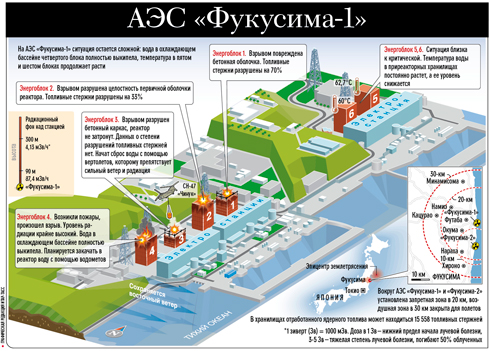
Increase the image (1656x1190, 1.2 MB, will open in the new window)

Chronicle of the accident
March 11
Due to the earthquake of magnitude, 9 of the points of six power units (1st, 2nd, 3rd) are stopped by emergency protection. All emergency systems worked as usual. Power units 4, 5 and 6 - on planned repairs. Following the earthquake, the shore hit a 10-meter wave of the tsunami. Because of this, the supply of electricity was interrupted (including reserve diesel generators) to the cooling system, which led to an increase in temperature and pressure in the reactors. The three -kilometer zone around the station is evacuated. Station workers, in order to reduce pressure in the 1st power unit, lower the radioactive steam-first into the airtight shell of the reactor, and then, so as not to destroy the shell, into the atmosphere.
March 12
In the 1st power unit from the fall of water levels in the reactor and overheating, hydrogen forms, which, in contact with oxygen, explodes behind the protective body of the reactor. This explosion partially destroys the concrete design of the power unit, but the inner shell of the reactor was not affected. The radiation level increases by 5 thousand times - from 0.05-0.2 μSv/h to 1015 μSv/h, but then it subsides a little. The evacuation area expands to 20 kilometers. For cooling in the reactor of the 1st power unit, they begin to serve sea water with boric acid.
March 13
At 3 a.m., a similar problem arises on the 3rd power unit-the coolant overheats, the pressure grows. To reduce it, a radioactive pair begins in the herming. After 10 hours, pressure also grows in the 2nd power unit. Employees are preparing to cool it with sea water.
March 14
In the 3rd block, hydrogen explodes. The radiation background in the area exceeds the maximum permissible norm.
The second reactor begins to cool with sea water, part of the fuel rods is naked. The threat is a partial melting of the reactor nucleus.
March 15
At 00.10 at night, an explosion occurs at the 2nd power unit, which damaged the reactor shell. Two hours later, the level of radiation exceeding 8 times the maximum permissible annual norm is recorded. An hour later, a fire with radioactive elements into the atmosphere occurs at the 4th power unit. Because of this, the radiation level is already 400 times higher than the permissible norm. After 20 minutes, at 4 in the morning, hydrogen explodes on the 4th power unit. In the 5th and 6th reactors, the temperature rises. The French nuclear security agency (ASN) assigns situations of the sixth of the seven possible levels of danger on the international scale of nuclear events (Ines). The seventh level was at the accident at the Chernobyl nuclear power plant. On the same day, it is reported that nuclear workers cannot ensure the normal cooling of the storage of the spent nuclear fuel, which is located on the 4th power unit.
March 16
Due to the fact that the first flame in the 4th power unit was not completely extinguished, a fire begins in the outer body of the protective shell of the reactor. After half an hour, he disappears. A pillar of thick white smoke rises from Fukushima-1-the reasons for this are unknown. A radiation level of 6400 μSv/h, which is now reduced or falls, is recorded. At night from the second reactor there is an emission of steam. At 8 o’clock in the morning, work at the station for an hour is assigned to a safe place. As soon as the high level of radiation slept, they returned back. All this time, experts are trying to maintain an acceptable temperature of the 1st, 2nd and 3rd reactors using pumps in their shell of sea water.
March 17
At the fifth o’clock in the morning, Japanese military helicopters drop water to the 3rd block to prevent the storage of the spent nuclear fuel.
7.5 tons of water are dumped in one flight, 30 tons were dropped in total. After surgery on the power unit, pair clubs are noticeable, the radiation level decreased to 292 microsiverts per hour. An operation is carried out to connect the power line for the restoration of power supply of the 2nd power unit. The situation remains difficult.