
Translated material
Stunned by the elements
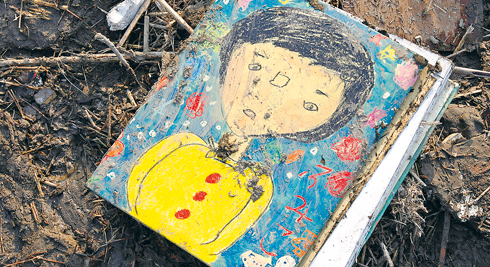
Life in Aftershok.
The wave, which covered the Japanese Prefecture of Miyagi on the afternoon of March 11, as if from the engraving of Katsusik Hokusai. The famous artist captured the “big wave in Canagava”: it menacingly hangs with white foam paws above the boats against the backdrop of the sleeping Mount Fuji (read about the experience of Japanese survival on page 21). In the town of Nator 20 years ago, a fir -tree was planted at the ocean itself - the trunks managed to rise 10-15 meters. On the 11th, they were completely covered with a wave that collapsed ashore at a speed of 100-120 km per hour. What happened next, we now know well: the swallowed to the abyss court, the descended trains and kilometers of lifeless fragments on land. The word “tsunami” (“a large wave in the harbor”) was invented by the Japanese, but no one knows how to deal with this element (which is generally known to science about the causes of such natural cataclysms - on page 16). According to the police department of Japan on March 18, when this issue of the magazine was presented, the dead were 6539 people, missing - 10,354, irradiated - 160. The exact number of victims will not be calculated soon. The accident at the nuclear power plant in Fukushima (p. 14) does not yet allow us to talk about the tomorrow's day of Japan, by the way, the third economy of the world (about the situation in the markets - p. 18), and the entire Pacific region more or less definitely definitely
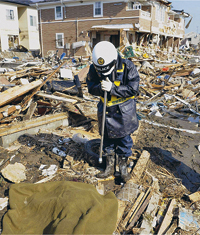 |
| Sendai. Police officer grieves in front of the body of the deceased |
On a huge screen at the Tokyo airport Narita, the Army Helicopter Chinook drops water to the nuclear power plant in Fukushima: you can see how the wind blows to the side the contents of the 15-ton container halfway to the "vent" of the power unit. From yesterday, winter has returned to the north-east of Honsu, snow has come, and all this operation has generally lost its meaning. “They will not cope, these kamikadze on helicopters,” the American neighbor stares at the screen in the waiting room, a programmer from Aidaho. “Soon another winter will come here, nuclear.” From his words frost on the skin. Here, in the Far East, we are all Koreans, Russians, the Japanese - now finally constrained by one chain. Fukushima does not allow us to sleep peacefully. She is now our common fate.
Why is the nuclear power plant standing by the water? - “And where else to build them, in the mountains, or what? So this will be a slotten detonator with so many earthquakes. The Miyagi has a 10-kilometer plain strip at the edge of the ocean-so it was used. No one thought there would be 10-meter waves ... ”-the American explains, sipping the sprite from a plastic bottle.
Home, in Seoul, has to fly “on a detour” through Australia: tickets for “normal flights” have long been sold out. 12 top managers of the Korean telecommunication company hired a private “jet” for $ 120 thousand, only to fly over the Sea of Japan.
Two worlds from Tokyo, which is 270 km from Fukushima, is driven by fear of radiation. Transport goes on schedule, the movement of metro trains and the local JR railway company is almost completely restored. The shelves of stores after the first, the most alarming days were again filled with food and bottles of drinking water. In the capital and suburbs in the houses there are gas and water. From time to time, the light is turned off for the sake of saving electricity, but the scheduled shutters are shown in advance on TV and published on the Internet. But even at these moments, the electric trains continue to walk.
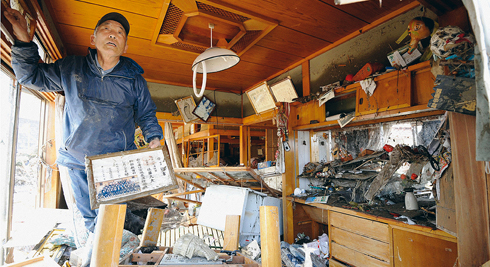
Minomasinric. The owner returned there that yesterday his house in the affected areas was a completely different picture. In Sendai, the administrative center of the Prefecture of Miyaga, there is not enough food and water. Many go shopping to the neighboring prefecture of Fukushima. The authorities supply local residents with free rations, but so far the diet is scarce. “We are fed three times a day, but there were no meat and fish yet,” 40-year-old Yuki Matsunobu tells your author. “On March 14, they distributed one tomato, cucumber and a piece of bread for breakfast.” Ms. Matsunobu, like many others, was left without housing. Partially such homeless as it was placed in the prefecture building. Several hundred people even got blankets. For themselves, on the floor, they put pieces of cardboard so as not to get sick. Nevertheless, a significant part of the "guests" has already been cold. Here, in the building, there is an operational headquarters, collecting information about the fight against the consequences of the earthquake.
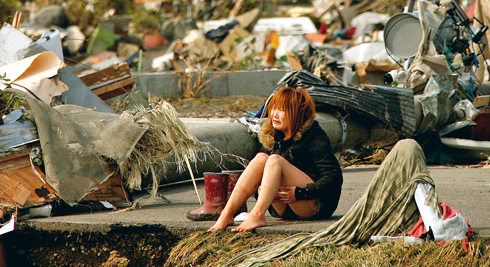
Natori. Crying on ruins nothing alive
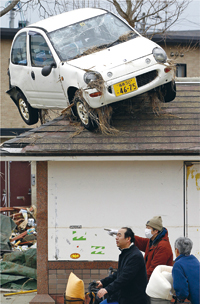 |
| Sendai. How did this car go to the roof of the house? |
There was nothing living left in the Minomisanrik (Miyagi) and Rikudzentacata (Prefecture of Ivate) - only the fragments of the houses, the so -fired pillars and cars. Those who survived still cannot recover. After a powerful earthquake in the office in 1923, the nation is methodically, from year to year, prepared for underground shocks and for the “large wave” - 3-4 meters high. When the Siren warning about the impending tsunami spread over the northeastern coast, people knew what to do. The “alarm suitcase” with a supply of food and drinking among the Japanese is always ready. So this time they calmly left their homes and headed for the gathering. “We identified them in advance, in special training: the city hall building, the public center, the gymnasium,” the mayor of Rikuzentakat Tobi Toba explains to the author of these lines. But it turned out that for hundreds of refuge people turned into deadly traps. Almost immediately, after a powerful earthquake, a 15-meter wave fell ashore and carried away people hiding where they were ordered. Of the 1000 people who used in three buildings in flooded Rikuzentacata, only 100 survived, those who found the highest place - the last floor of the city hall. In the next shopping center, everyone who was on the first three floors washed away. “In our town there was no panic,” Mr. Toba speaks with trembling in his voice. “We lived very good people ... I don’t know how to live now.”
The Japanese soul throughout the distress area counted only about 40 cases of looting and violence. We, Koreans, a sense of shame also does not allow you to steal. But it seems to me that in the Japanese this feeling is more developed. In the dilapidated city of Oarai, many shops and branches of banks are divided, and somewhere there are no walls at all. But the goods are on the shelves untouched, no one steals money from banks. In the Oaras, the elements spared five social parking lots - cars are intact and unharmed while they are looking for their owners. But on the next street you come across but a huge queue: people patiently stand behind grocery rations. Store owners reduce prices for mass demand products and distribute drinking water for free.
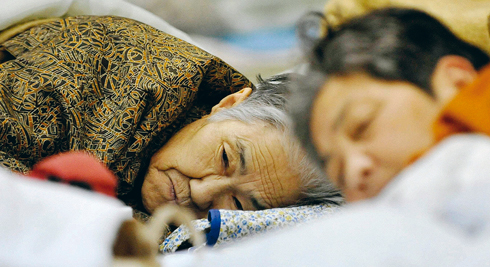
Miyako (Ivate Prefecture). It does not sleep (in the center for evacuated) ... The Japanese have a heightened feeling of cohesion: no matter how bad a separate citizen, he first goes to save others. On TV, a report was shown about an elderly firefighter from Sentay. He is looking for survivors and crying - his wife, his son and his wife and four grandchildren died. But he continues to work because he must take care of the living. One of them, Seiji Iyabashi, is now in the Sendai hospital. Sitting in a hospital bed with a bandaged hand, he shares his experienced: “I was in my car when the wave suddenly rolled to the city. He tried to run, but it was too late: the waves beat against the case of the car again and again, the water leaked inside, and I already began to sink. I still managed to break the window with my hand and get out. ” What was later, Iyabashi does not remember - he woke up already in an ambulance. Tsunami selected everything from him: a house, documents, money and, most importantly, a calm dream.
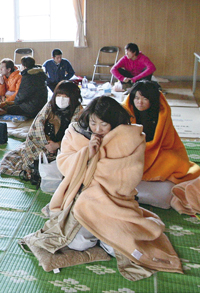 |
| ... and in the same center in Yamada (Ivate) is still uneasy |
The dangerous air of rest is now deprived of all the Japanese. The Fukushima-1 emergency nuclear power plant scares the whole world with three exploding reactors, one burned and two more overheating. The alienation zone around the nuclear power plant has spread 30 km, but radiation is felt much further - Ibaraki is reported about the irradiated prefecture. There are also affected ones in the 7th fleet of the United States: on the Ronald Reagan aircraft carrier, 17 members of the pilot groups who flew into the disaster zone with the help of the victims are in the hospital where they are treated with potassium iodide
* * This drug prevents the absorption of the thyroid gland of radioactive iodine isotopes and protects it from the action of radiation. The medicine has contraindications and serious side effects. .
The Tokyans also swallow these pills intensely, drink them with sedative tinctures and try not to remove the masks. "Where does the wind blow from?" - The main question is in the Japanese capital. Some still go to work, take children to gardens and schools. Others are sitting at home. Still others hastily sit on trains and leave to the south of the country. The 14 millionth city is slowly empty ...