
Translated material
Coercion to assessment
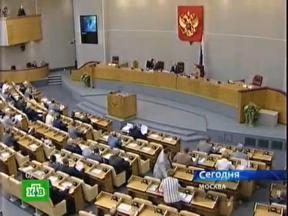
Tandemocrats put the deputies in a difficult position. The position of Russian leaders in Libya forced the State Duma to be careful with a parliamentary statement. Representatives of the Russian establishment do not want to definitely support one of the tandem. But circumstances are forced.
On March 23, the State Duma adopted the statement “On the situation in Libya”, which condemns ways to conduct an operation against the Muamar Gaddafi regime. The statement was supported by 341 deputy, 1 refrained, no one spoke out against. The statement, in particular, notes that "the situation in Libya is developing according to the most unfavorable scenario" and "the confrontation of government forces and rebels threatens to develop into a civil war."
Ten amendments were made to the document, but the deputies decided to accept the document in the initial edition.
The deputies recall that in the resolution of the UN Security Council, which was adopted on March 17, "primarily the protection of the civilian population of Libya was proclaimed, including through the introduction of the regime of the baseless zone, but in this resolution there is no clear limits of the application of military force."
According to deputies, a number of states used a resolution to achieve “other goals”. The State Duma calls to cease fire and stop violence against civilians, and also asks the leadership of Libya and participants in the coalition to follow the resolution. In the State Duma statement, that Russia abstained when voting in the UN Security Council is called "an adequate choice of our country." The Chairman of the Committee on International Affairs, Konstantin Kosachev, explained that Russia did not impose a veto on the resolution of the Security Council, because this would be a justification for the Gaddafi regime.
De-fact of the State Duma supported Dmitry Medvedev’s statement, which, in the words of Putin’s spokesman , is the only state position.
However, there is a nuance: the draft application was prepared immediately after the start of the bombing in Libya, but then the unforeseen occurred. At first, Vladimir Putin spoke about the “Crusade” (thereby supporting the Gaddafi regime), then Dmitry Medvedev forbade the use of the “Crusades” expression (thereby condemning the Gaddafi regime, see Pavlovsky drove the wedge ).
The rhetorical split of the tandem, noticed by almost all the state of affairs in the country, except for Russian viewers, put the deputies in a complex stylistic position.
After all, a de facto speak out in one way or another-means raising bets in the game for personal well-being in the form of an office on Okhotny row for the next five years. And this is a question of the first -Tous importance. They resolved the situation outwardly quite elegant: the United Russia mainly supported the statement, the Duma opposition to the mass reacted skeptically and ignored the vote. Only 342 people (EP - 313 deputies) from the list of four and a half hundred took part in the vote. 341 The deputy supported the decision.
Communist Leonid Kalashnikov noted that the discussion of the statement in the Duma takes place with the same rush as the adoption of the UN Security Council resolution. According to Kalashnikov, the problem is that "the deputies are confused between the towers of the Kremlin." “The resolution opens up the possibilities of a large -scale military operation,” said the representative of Russia at the UN Churkin. It was clear that the resolution was needed to suppress the Libyan air defense, which means for massive bombing, the communist believes. The UN Security Council resolution in Libya was directed against us, warned Kalashnikov, it did not establish the boundaries of the operation.
The LDPR deputy Semyon Bagdasarov called the Libyan opposition "terrorists" and also skeptically reacted to the resolution. “Support for terrorism allows us to access resources under the pretext of combating it and then there will be the richest gas of Algeria,” he said. “In Libya, the Americans are waging an information war and we need to saturate the region with our television groups, including from Tripoli,” Baghdasarov believes.
Socialist -Revolutionary Oleg Shein emphasized that the resolution does not violate the UN Charter and does not give the right to bombing. Accordingly, according to Shein, the charter violated the United States and their satellites, so Norway and Türkiye moved away from the operation. Shein considers it necessary to send an international commission to Libya, call the UN Security Council in full force, and not only hold a briefing, and immediately stop military operations.
The situation in which the Duma oppositionists are “hawks”, and the party in power looks moderate is often repeated when it comes to foreign policy problems. In the end, the author of the Duma statement - the head of the Committee on International Affairs of United Russia Konstantin Kosachev - was a personnel diplomat and is a rather careful politician. However, the Russian president with the prime minister in this case introduced a confusion in the deputy ranks.
Only on paper, the president is the highest person responsible for foreign policy. In practice, it turns out that the statements of Putin and Medvedev in Libya act as equilibrium political signals. Despite all the assurances of the press secretary of Prime Minister Dmitry Peskov that Putin expressed his personal position, and Medvedev-the state.
In Russia, the personal position of the leader (or the conditional Politburo) and ultimately acts as the position of the state.
And the deputy corps now begins a political suffering - each of the deputies has to navigate the situation to whom to ask for the mandate (those who decide to “purchase” on their own are more safety) in order to get into the next convocation. The deputies will go, of course, not to Putin and not to Medvedev, but any misfire is a great occasion that in the office of the conditional Vyacheslav Volodin, Vladislav Surkov or even Vagit Alekperov they were indicated by the untimely their reaction in Libya, the prices of oats or duties on bananas.
Therefore, even an exceptionally rhetorical “tandem split” has unpleasant consequences for a political establishment. Too earlier, the designation of the pros and cons is risky for the political career and financial well -being.
It turns out a chess “coercion to the go” (Zugtswang), when it is impossible to evaluate, but I don’t want to evaluate it very much.
In other, more peaceful conditions, some freedom was allowed that, according to Stalinism, that for other problems, where the stylistics and rhetoric of Medvedev and Putin somewhat diverged. Today everything is becoming much more serious. Moreover, the regional deputies where the governors were replaced cannot be calm for their seats, other prominent party members (mainly from the “ruling party”, but not exclusively) lose the internal hardware game slowly and risk not falling into short lists for reasons of party sprinkles and so on. Competition is aggravated both on duty election and on the “question 2012”.
In this sense, calls for tandems are often recently distributed-to finally declare a nominee for the presidential post 2012-2018 are a common desire for the establishment. Even the “non -reproduction” (by his own definition) Nikita Mikhalkov was extremely carefully speaking the day before in favor of Vladimir Putin (see conversation with Nikita Mikhalkov), although “Mikhalkov for Putin” only if both Duumvirs go to the elections. The desires of their political elite can leave their desires with them - the tandem’s decision is unlikely to be announced to the Duma elections. Until then, both deputies and other social activists should behave more accurately.