
Translated material
Enter and check
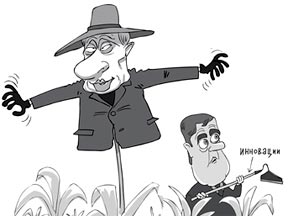
Failure to fulfill the presidential assignments will be punished tougher - such a decree was signed by Medvedev. That is: the president is unsatisfied with how formally subordinate to him people actually ignore his orders. Medvedev’s task is to build a Putin vertical for yourself and become a real president.
President Dmitry Medvedev signed a decree that introduces a new procedure for execution of his instructions and instructions. According to Medvedev, the document contains “delimitation of instructions and instructions of the president, records different legal consequences for their failure to fulfill, the procedure for adjustment, and so on.”
“The decree cannot prescribe responsibility for the failure to fulfill or violation of the deadlines for the commission of the President,” the head of the President’s control department Konstantin Chuychenko explained the essence of the measure. “But I believe that it is necessary to punish for this hard, up to the dismissal,” he emphasized. “The decree will enter into force on July 1 so that until this time other regulatory acts and intra -decovement procedures were brought into line with it,” said Chuychenko.
As the official noted, the decree approves the norm on the mandatory assessment of the validity of the request of the Contractor to extend the deadline for the order. “In fact, for each case, an additional check will be carried out how much the fact of failure to fulfill the order for the deadline was the result of objective reasons, and not the result of inefficient work,” he said. Hard personal responsibility for instructions is also introduced.
The punishment for the failure to fulfill the presidential assignments, the measure, on the one hand, is inevitable, on the other hand, indicating a strong crisis of the public administration system.
The first is obvious: the instructions, if they were already given, must be carried out and preferably done on time. Failure of them, of course, should lead to tangible consequences for ineffective bureaucrats. This, moreover, will keep officials in tone and motivate for normal work, at least in the directions marked by the president. Such work is already being carried out with might and main: according to Chuychenko, today there are practically no unfulfilled instructions of the president, thanks to the active work of his controls to spurring officials.
Upon closer inspection, it is not such a good -natured picture. The fact that the president with perseverance repeats the words about the need to fulfill his assignments and regularly requires respect for his authority in principle (as a vivid example, we give the phrase said by the chapter of “Rostekhnologies” Sergey Chemezov, about “Words cast in granite”) means that the bureaucracy regularly ignores or even consciously impacts presidential initiatives.
This may indicate a lot.
For example, that Dmitry Medvedev in the eyes of most managers of the Putin’s call did not become an influential politician - in the sense of generating decisions.
The conventional Igor Sechin (Deputy Prime Minister, Curator of the TEK), mentioned Sergey Chemezov, First Deputy Prime Minister Igor Shuvalov or even directly subordinate to Dmitry Medvedev Sergey Naryshkin (head of the presidential administration) and Alexei Gromov (deputy head of the presidential administration) are more likely to orient themselves to Vladimir Putin. It is Putin that each of them owes the appointment of posts. And to fulfill the presidential orders, in case of disagreement with them, they can make them a prime minister or a real threat of their position. What a threat to Dmitry Medvedev is not yet. Further, respectively, the infection of non -fulfillment flourishes on the lower floors of the bureaucratic structure.
If we add to this the intentional torpedoing of “corporate” initiatives of the president of various kinds of influence and lobbyists, whose interests directly affect the first person’s assignments, the picture is almost joyless.
True, do not forget that the president is not the Lord God and his instructions have little in common with the truth in the last instance. In such circumstances, the non -performance of presidential beautiful initiatives (like the ban on incandescent lamps, the topics of mainly lobbying) even looks not bad. As Prince Peter Vyazemsky was also known in the middle of the century before last, "from the evil measures taken by the government, there is salvation: bad performance." Turning to modern political science slang, we get: the system of checks and counterweights works better than the power vertical and devaluates the consequences from its - vertical - excesses.
The political meaning of the decree of Medvedev is also understandable. If the president remains in his chair for the next six -year term (and the chances of this are quite large), he will need an independent political resource.
And levers, including to combat the managers from the Putin cohort uncontrolled to him.
Otherwise, the second term of Dmitry Medvedev will take place under the sign of numerous restrictions on the part of the senior tandemocrat, which can put a cross on most of the mega-projects declared by Medvedev, such as the transformation of Moscow into an international financial center or a multiple growth of an innovative component in business.
The process of switching managerial levers to Medvedev’s team was launched two years ago. The most striking decision in this regard was Medvedev’s order on the mandatory agreement with the presidential administration of candidates for state managers (see not to manage without the Kremlin!). Despite the assurances of the administration that such an order existed, it was simply introduced into the legal field, it was the impression that after Putin the coordination was notious and made as a gesture of goodwill. The real switching of the personnel policy in corporations and officials to the Medvedev apparatus would be a significant victory of the president: in this case, only Putin’s personnel and partially the security forces of the Putin's call would remain uncontrolled to him.
However, from the point of view of the conformity of the declared values and real measures, Medvedev’s decision “hard to ask” leaves, rather, a painful impression. The rule of the law is declared as opposed to manual management, in fact, an attempt is made to close the control functions of the president (returning large financial flows to the monopoly order of the Kremlin). Instead of a total struggle with corruption, demonstrative flogging is carried out, instead of the reform of the power organs - a ritual change in the name of employees of the Ministry of Internal Affairs. Even with bureaucratic wires, as can be seen from the decree, it is customary to fight with bureaucratic methods.