
Translated material
Conservatives become leaders
Many animals gather in herds, fish - in jambs, birds - in flocks, and these groups act in surprise in agreement. But how do several individuals make a collective decision, who affects their choice: the oldest, the strongest - or other qualities are required from the leader? This problem was interested in the specialists of the group studying animal navigation (Oxnav, Oxford Navigation Group), led by Professor Tim Guilford. They were joined by an employee of the Mathematical Institute of the University of Upsala Richard Mann. Scientists published research results in Biology Letters.
Oxnav employees who studied the pigeons navigation, found that in a group of two birds, one always obeys another. When the two pigeons, accustomed to get from point A to point B in different ways, fly together, then follow one of two familiar routes, but they will never choose a compromise option. And it turns out, it turns out, with a high degree of probability to predict which pigeon will lead the flight and determine its trajectory. Oddly enough, leadership in the couple depends not on how quickly the pigeon finds the way to the house, but on how accurately he reproduces a certain route.
To establish what qualities lead the leadership, researchers conducted experiments with paired flights. 22 pigeons participated in them, which were taken 5-10 km from the house and released one by one. The birds, of course, flew home. (There were three groups out of 12, 6 and 4 birds, which were released from three different places.) Each pigeon made the same path 15 times and during this time he completely got used to the terrain. Researchers applied the routes of the next five flights on the map in detail. In the drawings in thin lines, blue or pink, the paths of six pigeons are indicated. Taken together, the flights of flights of every bird are not a line, but a strip, the width of which is different in different areas and in different pigeons. Researchers calculated for pigeons the average routes, which are shown in the drawings with fat lines of the corresponding colors. Some individuals repeat the route over and over again quite accurately and deviate little from the middle path. In some sections of the line of their flights, they converge at one point. But there are birds flying with a wide corridor, their deviations from the middle route in different sections vary from 85 to 282 m.
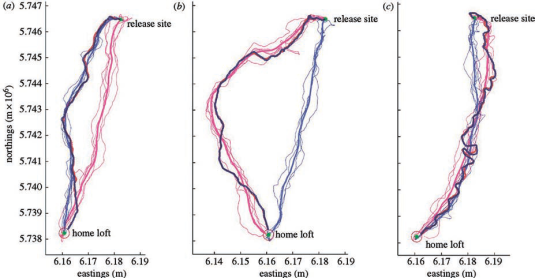
Having drawn the flight cards of the pigeons, the researchers randomly formed a pair of birds that went home from the same point, and began to produce them in two. In total, they amounted to 48 pairs, of which 13 broke up shortly after the start and got home. But 35 couples all the way was together, following the route of one of the pigeons. In 26 cases, out of 35 birds flew through the pigeon, which alone passed its route with the least deviations. The constancy of habits was the key to future leadership. The steam paths are indicated in the pictures with red-blue dashed lines. In cases a) and b) in pairs the leaders were leading, who did not like to deviate from the usual route, in the case of c) the pigeon-conservative did not become a host.
It is difficult to say why some individuals more accurately adhere to a given path than others. Perhaps these pigeons in flight are guided by certain points on the ground. The more they have such orientes, the more confident they feel throughout the route, so at the very beginning of the way they seize leadership. Or maybe they are simply not inclined to change their habits and do not compromise with a partner. On the contrary, birds, not very confident in themselves or inclined to change the route, are amenable to someone else's influence. As a result, they will come down from the usual route and follow the leader. Therefore, the pigeon leader is a confident and constant in habits, a “stubborn” bird. Conservative, in a word.
Natalia Reznik
Robin Freeman, Richard Mann, Tim Guilford and Dora Biro Group Depsisions and Individual Differences: Route Fidicts Flight Leadership in Homing Pigeeons (Columba Livid). Biol. Lett. (2011), 7, 63-66.