
Translated material
The scene of the scene
"Five evenings" in the workshop of Peter Fomenko
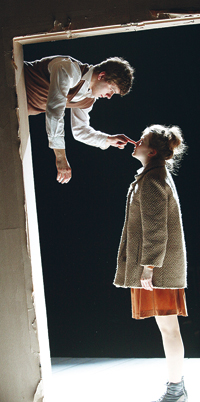 |
| The design of the scene resembles a huge spaceship floating in the blackness of the universe. Glory - Artem Tsukanov, Katya - Yana Gladkikh |
“Do not speak with longing: they are not ...” Volodinsky “five evenings” in the theater of Pyotr Fomenko - a requiem along the country, which disappeared from the map of the world and for people who left with it
Who could assume that the premiere of “Five Evenings” in the “Workshop of Peter Fomenko” will coincide with the departure of Lyudmila Gurchenko, an unforgettable Tamara in the film on the Volodinskaya play. Director of the play Viktor Ryzhakov and Alexander Volodin are not random people for each other. The director has repeatedly worked with the drama of Volodin, was familiar with the author and is the director of the Volodinsky Theater Festival in St. Petersburg. Ryzhakov in general, to Soviet texts, nourishes some special tenderness: in his arsenal there is already “do not part with your loved ones” (play Volodin, Moscow Art Theater), “forty-first” (according to Lavrenev, Moscow Art Theater), “Cursed and killed” (according to Astafyev, Moscow Art Theater). And his persistent love for the “new drama”, in particular for the texts of Vyrypaev, gives him a person’s literary, “shocked” in a word as the main guide of theatrical meanings.
Remember everything from the first remarks of the performance, there is a feeling that we are talking about people who are not there: strange, cracked intonations and mechanistic movements make them similar to broken dolls, frozen in the eternal permafrost of the past tense. As if waking up from lethargic sleep, they try to recall the human language, human emotions, meaning and purpose of parts of their own body, the name of the objects surrounding them. Broken, bent, once thrown out with unnecessary into the empty blackness of unconsciousness, the heroes in our eyes gain a voice and memory. The theme of memory pulsates with a vein inside the entire performance. "Do you remember?" - the heroes ask each other. “I don’t remember anything. I don't remember anything. How much time has passed, who will mention. " - “I remembered you. And you?" - “At first I remembered ...” - “Do you remember how you kissed me for the first time?” - “And if it's all over, why indulge in memories? -“That's why I’m indulging ...” Some kind of lag of a past life pops up in my memory: the obsessive melody that Ilyin whistles, then pursuing them the same memory of the beginning of the war, then the mysterious Fomichev from the technological, then the first kiss in the front door. And the further the heroes leads the memory, the warmer and more natural their voices and gestures become, as if color returns to life, as in the final shots of the Mikhalkov film.
The house-brown signs of Soviet life and Soviet consciousness are present in the form of the same solers who accidentally emerged from the subconscious, unconscious glare, which remain in the genetic memory of generations. This is an inevitable radio on the wall, from which a musical mixture is constantly heard from the popular prelude to Rachmaninov (which sounded in the film adaptation of the Vampilovsky “eldest son”) and the Russian folk song “Valenka”; A terrible look ugly female knitted hats “with a hose”, making all women equally repulsive; Pale pink flowers from cigarette paper-an integral symbol of all Soviet holidays; The door removed from the loops, which is placed on the table during noisy family feasts; nails driven into the wall, replacing hangers; Unbearable farmers on rude stockings, disfiguring female ankles ... All these household details are thrown into the fabric of a random scattering, in order to give accuracy that is happening, but random memory errors (as in the film "Solaris", when there was no elementary lightning in the dull dress of the ghost) will necessarily find a fake. And then you understand that the inexorable radio is drawn on the wall, just like driven out nails, and to get to the real door, you need to tear off a fake door from it, that the falling snowflakes are cut out of paper from paper and that there is no food - only dishes for her. There is an entrance to the house, which is either like a gigantic letter P, or to the arch in the gateway, and the white plank floor on the rotary circle. This luminous and spinning structure swims in the blackness of the universe, like a huge spaceship, like a fragment of a dead civilization, for which they cling so as not to disappear in zero gravity that survived wounded people. This house-ship, consisting of the door and floor, is their only hope for salvation.
"They are alive!" The performance contains more remarkable acting forces - Polina Agureeva (Fomenko Theater) in the role of Tamara, Igor Gordin (MTUZ) - Ilyin, Evgeny Dmitrieva (Maly Theater) - Zoya, Alexey Kolubkov (Fomenko workshop) - Timofeev, wonderful young artists Artem Tsukanov - Slava and Yana Gladkikh. You do not get used to them immediately, the first scenes by the will of the director are held in a desperate struggle with the Volodinsky text, which is quite difficult to pull out of the context of time, from everyday life. It’s not some kind of Sartre, but our native Alexander Moiseich, who always wrote only what he himself felt, and more than once gave the characters his birth features, habits and personal plots. To the dramaturgy of Volodin, our man grabbed his heart, fell to her like a hot stove, and without this human warmth, Volodin is impossible.
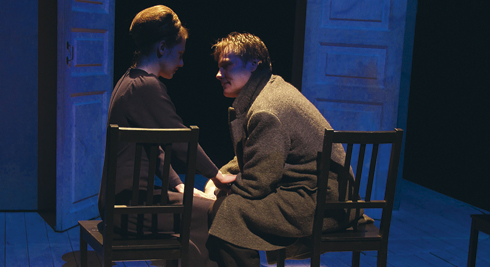
Tamara - Polina Agureeva and Ilyin - Igor Gordin Ryzhakov tried to transfer the Volodinsky text to a cosmic height, tear him off the ground, and deprive of earthly attraction. Oddly enough, the artists who managed, like Shagalov’s heroes, helped to fly up and justify this directorial task, take off to heaven, but not to freeze in beautiful poses. How the hero of Tabakov shouted from another Soviet play: "They are alive!"
There are several truly piercing scenes in the play-and a monologue of the drunken crushed Ilyin-Gordin (in which, nevertheless, there is no way, the features of Lyubshin are guessed: a hat, intonations, some kind of crazy border fun), and magnificent, notes played by notes Ilyin and Tamara-Aguureeva, and a cherishing theatrical finale, when all participants They sit on the chairs placed along the ramp with their backs to the hall and facing the door and wait for the appearance of the protagonist. The image of the performance, its atmosphere and music conveys an almost physical sensation of the inconsistency, the shakiness of this world, familiar to everyone of the feeling of panic fear, when the earth literally leaves under his feet when any support disappears. At such moments, the only salvation is in flight. Even nowhere.