
Translated material
The noise with the advanced
Over the past month, two hot news appeared in the media from the largest accelerators - Tevatron (Fermilab, USA) and the Big Adron Collider (Cern, Switzerland). Moreover, in other network comments, people mix this news in something unified confusing type “Scientists from Tevatron on the BAK opened an unknown science“ Particle of God ”called Bozon Higgs. In fact, we are talking about two completely different statements regarding completely different phenomena and having a completely different status.
Let's start with the first news, since its status is much higher.
The CDF installation collaboration on Tevatron published an electronic preprint ( Arxiv: 1104.0699v2 ), which gives the results that can be interpreted as a marginally significant indication of the existence of a new particle that does not fit into the framework of the standard model of physics of elementary particles.
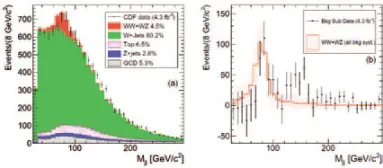
The experiment was as follows: on the oncoming beams of protons with energy, a little less than 1 TEV recorded the formation of a W-boson (a heavy fundamental particle responsible for weak interactions), and looked that it was also formed with it. Events were selected, where two adron streams are formed along with W, which in turn can form from the decay of another heavy particle, the same W or a related to it, but neutral Z-Bozone. When processing data, the invariant mass of these two jets was determined (if the jets formed from the collapse of the particle, then this is its mass). The distribution of events by invariant mass is shown in the figure. The color on the left panel shows the deposits of all known processes within the framework of the standard model. Excess in the region of 120-160 GEV is visible. If we deduct all the processes except the birth of the ww and WZ steam, we get the distribution on the right panel. It visible a clear peak in the region of 80-90 GEV-this is the birth of W and Z with the subsequent decay into two jets (W from Z with this energy resolution is indistinguishable). And then - the same excess about which the whole noise.
It is impossible to explain this excess within the framework of a standard model. On the other hand, it cannot be explained by the birth of Bozon Higgs. The fact is that the properties of an unbroken boson are quite rigidly set by the standard model. Its mass is unknown, but the ratio between the mass and the probability of different processes with the participation of this boson is known. It turns out that his contribution to this process would be hundreds of times less than the observed excess. If this excess is not a statistical fluctuation, then it can be caused by the decay of a particle of an unknown nature that does not fit into the standard model.
The most discussed candidate for the possible role of such a particle is a kind of super -symmetric partner of an ordinary particle. The theory of super -symmetry arose as an option to get rid of some “ugliness” of the standard model and is its hypothetical expansion. It implies duplication of all fundamental particles, but with a change in the whole back to semi -fingered and vice versa. Super-symmetric partners should be quite difficult-a hundred with something gigaelectron-volt is a very reasonable mass.
But there is a question that is still much more important than discussions about the nature of excess: how statistically is it? There is no very simple answer to this question. There is a result of modeling Monte Carlo by a fairly complex procedure, taking into account several systematic uncertainties. It turned out that the probability of a random fluctuation that imitates this excess, when there are no deviations from the standard model, about one thousandth. Is it convincing?
Suppose someone sets a clear task of statistical verification of a fact that has a definite answer: for example, there was a suspicion that this gambling roulette is Shulerskaya. For verification, a series of tests is carried out, they find out that black falls more often than red. Moreover, the statistical significance of this fact is attached to the number of tests is equal to one thousandth, i.e. The likelihood that an excess of hits on a black accident is equal to one thousandth. In the case of roulette, this is convincing: it cannot be used, the tests are not necessary.
A completely different thing is if the task is set something like this: is there any indications of a deviation from a standard model in the variety of data obtained on this installation? The data is rich and diverse, on their basis you can build many different distributions. Moreover, in each distribution there are implicit parameters, for example, circumcision thresholds to minimize the background. Therefore, if in one of dozens of or even hundreds of possible distributions you can see the effect of one thousandth, it is too early to beat the drums: in fact, they searched for a long and stubbornly look for a fluctuation that imitates the deviation from the existing theory, it may be just it (fluctuation). But maybe this is really an effect? May be. The problem is that the real significance, taking into account the poorly documented set of attempts to find a previously uncertain effect, is very difficult to evaluate. Therefore, the effects with the significance of the order of thousandth or even ten thousandth are not accepted on faith. In this case, they say: time will tell. And very often the time (a set of statistics or new experiments) shows that the effect was “resolved” - there is nothing there. And sometimes the effect is confirmed. For example, the first exoplanet was registered in 1992, three years before the undoubted opening of exoplanets. But the result was only marginally significant and was not accepted by the scientific community; The firm confirmation of this planet was made in 2004.
However, in this particular case, there is one circumstance justifying the publication of an unreliable result: this year Tevatron will be closed. The authors do not have the opportunity to significantly increase statistics and check the result. Therefore, even marginally significant results from Tevatron should be published in the order of the inheritance inventory: which should be looked at in other experiments. Already looking closely - this interaction channel has been checked in these Atlas and CMS installations of a large adron collider. They do not see the effect, but the statistics there are still less than on Tevatron.
Let's move on to the next “sensation” associated with a large Adron Collider.
At the end of April, an anonymous leak of information appeared. Anonymous, allegedly working at Tevatron, said on the Internet that he saw an abstract of the internal document of the ATLAS installation collaboration, which read the following:
There is a peak in the distribution of the invariant mass of two gamma quanta with an energy of 115 GEV. It is interpreted as the possible breakdown of the Higgs boson. Statistical significance - 4 sigma. The integral at the peak is 30 times higher than what can be obtained from the breakdown of the Higgs boson into two gamut quanta as part of the standard model.
On the one hand, the number 115 GEV adds drama. It is with this energy on the old accelerator LEP (it was located in the same tunnel where the tank is now mounted) saw a slightly significant indication of the possible boson of Higgs. On the other hand, physicists immediately paid attention to a number of inconsistencies. In particular, at the CDF detector mentioned above, they also watched the distribution along the bickening invariant mass and did not see anything like it. At the same time, Tevatron has much more statistics. The energy is smaller, but more than enough to give birth to boson with a mass of 115 GEV. The only loophole is to assume that Higgs Bozon is born only with some very heavy particle, so they see him in Cern and do not see it on Tevatron. True, such an explanation looks attracted by the ears.
However, the Atlas collaboration officially stated that they have no significant certificates of registration of Bozon Higgs. If you do not get involved in conspiracy, then there is no subject for further discussion.
So, the noise around the results of the largest accelerators does not yet have a firmly established reason. Nevertheless, there is a positive circumstance in all this: an indefinite noise is better than an indifferent silence.
Boris Stern
The author is grateful to Vladimir Gavrilov, the head of the ITEF laboratory, for valuable comments.