
Translated material
Eh, wounds ...
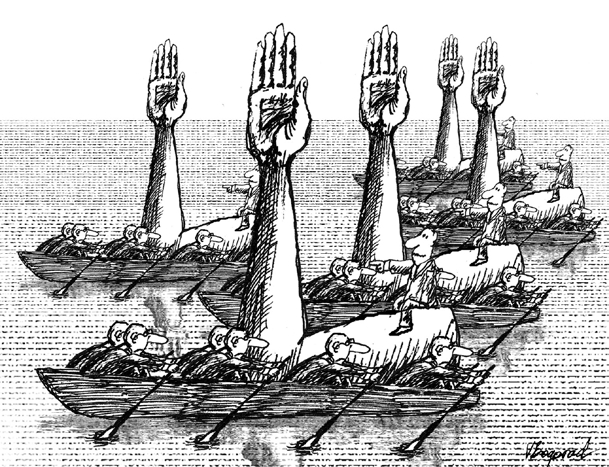
The chief researcher at the Institute of General Physics of the Russian Academy of Sciences Alexander Samokhin reflects on the kaleidoscope of “various little things” of academic life.
“The Russian Academy of Sciences was established by order of Emperor Peter I by Decree of the Governmental Senate of January 28 (February 8), 1724. It was recreated by Decree of the President of the Russian Federation of November 21, 1991 as the highest scientific institution of Russia ... On the territory of the Russian Federation, the Russian Academy of Sciences is the successor of the Academy of Sciences of the USSR,” the Russian Academy of Sciences in the historical certificate on his website www.ras.ru. In the part of the Decree of Boris Yeltsin cited on the RAS website, in paragraph 1, it really says: “Restore the Russian Academy of Sciences as the Higher Scientific Institution of Russia.” In paragraph 2, it is established that the Russian Academy of Sciences “is an all-Russian self-governing organization, it is indicated who to consider it members and corresponding members, and in paragraph 3-that RAS “ includes institutions, laboratories, enterprises and organizations that provide research in the main areas of fundamental science ... ”
About the staff of these institutions, laboratories and other elements of the “composition” in the decree, nothing is said in the decree, but the charter of the Russian Academy of Sciences still has such words about scientists: “The Russian Academy of Sciences unites members of the Russian Academy of Sciences-actual members (academics) and corresponding members elected by the general meeting of this academy, as well as scientific employees of subordinate Russian Academy of Sciences of Organizations.” However, the phrase “Higher Scientific Institution of Russia” in the charter of the Russian Academy of Sciences is not visible, and the meaning of these words is currently not quite clear. Is this definition, for example, by the official recognition of such a special status of RAS compared to others - not higher - scientific institutions for which it is supplied with a certain additional soldering of financing? Or is it just a philological "Zagolulin"?
This “academic” question ceases to be purely academic, if only because the state of the formal status of the Russian Academy of Sciences and its actual state can now hardly be recognized as completely satisfactory. A similar situation in many causes noticeable anxiety, including the leadership of the Russian Academy of Sciences. Such anxiety is expressed, for example, in a letter dated February 4, 2011, Vice President of the Russian Academy of Sciences, Academician Alexander Nekipelov, Deputy Minister of Economic Development Oleg Fomichev, in response to the appeal of the latter dated December 29, 2010 to the Russian Academy of Academy of Sciences in relation to the project “Strategy for Innovative Development of the Russian Federation for the period until 2020”. Academician Nekipelov writes: “The mentioned project, in our opinion, needs serious processing and cannot be approved in the proposed form ... A fundamentally erroneous message - the Russian Academy of Sciences is supposedly a monopoly in the field of fundamental science (in fact, this is a decentralized system of organizations in which the main scientific potential of our state is concentrated) - leads to recommendations for artificial the formation of "counterweights in order to develop a competitive environment." This approach, coupled with the installation of resources allocated for the development of science at the first stage of the implementation of the strategy, will not lead to the rational restructuring of the scientific complex based on a carefully verified, balanced development of its components, but to its further destruction. ”
Obstacles that the RAS “is supposedly, a monopoly in the field of fundamental science”, the vice-president of the Russian Academy of Sciences for some reason does not recall the words quoted above on the RAS website, positioning it “as the highest scientific institution of Russia”. So what does these words currently mean from the decree of Boris Yeltsin and why do they appear without any comments on the RAS website? What exactly can and/or should be done by the Russian Academy of Sciences, in order to pursue a decree of November 21, 1991, to really become a “higher scientific institution of Russia”, if only such formation is legally and actually feasible? And can RAS really analyze his own current state with the accuracy and completeness, which are necessary for an adequate answer to at least the most urgent time challenges? A sustainable idea is created that the leadership of the Russian Academy of Sciences cannot and does not want to seriously engage in a number of problems facing it.
* * *
In May 2010, the General Collection of the Department of Physical Sciences of the Russian Academy of Sciences, noting, in particular, not enough active defending the interests of Russian science by the Presidium of the Russian Academy of Sciences, addressed the general meeting with a proposal to devote the nearest general meeting to discuss the role and tasks of the Russian Academy of Sciences in the circumstances (TRV-NAUK No. 54, p. 1-3, “Scientific Community” No. 5, p. 14, “Bulletin of the Russian Academy of Sciences”, “ 80, No. 9, p. A year passed, in December 2010 another general meeting of the Russian Academy of Sciences, and the time of the next May general meeting of 2011 comes, and this WHO, it seems, is now there ...
However, in the same No. 9 of the “Herald of the Russian Academy of Sciences” in 2010, where Academician Andrei Slavov’s speech is given at a general meeting with the above appeal of the OFN RAS, an article by Academician Yuri Leonov “On small but important“ trifles ”in the life of the Russian Academy of Sciences”, in which, two expressive examples at the general meeting of the Russian Academy Disadvantages in the work of the Presidium of the Russian Academy of Sciences.
An obvious drawback of the work of the Russian Academy of Sciences is also that President Yuri Osipov does not give an answer to the Russian Workers' Trade Union addressed to him at the end of 2009, in which, in particular, it was written: “According to the trade union, the reports of directorates on the receipt and consumption of funds should be held in all institutions. It seems that such reports should take place annually at open meetings of scientific councils, have a paper (electronic) version available to the institute’s employees (it is desirable to post it on the institute’s website). The reports should contain detailed information about the budget and extra -budgetary funds entering the institutes, their distribution and spending. Particular attention should be paid to the expenditure of funds under the article “False costs” and the funds of the salaries of auxiliary units. One of the elements of the report, in our opinion, should be not a personified information about the distribution of salaries of employees of the institute as a whole. ”
Multiple printed prints (TRV-hobby No. 53, “Scientific Community” No. 12, 2010, p. 11, No. 3, 2011, p. 14) and other reminders of this “unrequited” letter to the present have not yet affected the situation, which clearly demonstrates the attitude of the leadership of the Russian Academy of Sciences both to this problem and to the trade union of workers of the Russian Academy of Sciences. The leadership of the Russian Academy of Sciences also does not show any prominent reaction to questions raised in the article by Alexei Krushelnitsky “Pilit, Shura, Pilit ...” (TRV-hunger No. 68 of December 7, 2010) due to some features of the Acadinotorg's activities.
* * *
Unfortunately, these specific examples of the internal problems of the Russian Academy of Sciences are not exhausted.
On October 12, 2010, the Presidium of the Russian Academy of Sciences issued Decree No. 201 “On approval of the Regulation on the Commission on the Establishment of the Effectiveness of the Scientific Organizations of the Russian Academy of Sciences and the methodology for assessing the effectiveness of the scientific organizations of the Russian Academy of Sciences”, the full text of which can be found on the RAS website and in the “Herald of the Russian Academy of Sciences” No. 1 for 2011 to fulfill this resolution of the Presidium of the Russian Academy of Sciences, but something was not well done, and all this case has moved, and all this case has moved. Somewhere in the fall of 2011, which separates two and a half years from the date of the relevant decree of the Government of the Russian Federation. What is behind such delay - the academic embodiment of the eastern parable about the donkey and Shah or banal organizational weakness? And how is this method of action reflected in the authority and the real role of the Russian Academy of Sciences in the current conditions? Be that as it may, but the monitoring and comparative analysis of the activities of the RAS institutions is a matter, of course, necessary and useful, although the approach to solving such problems can hardly be called optimal (see, for example, article 2011 in the Vestnik RAS No. 2, p. 134, 146 and in the “Scientific Community” No. 2, p. 15).
In connection with Decree No. 201, it is worth paying attention to one more circumstance. In the long list of indicators of evaluating the effectiveness of scientific organizations of the Russian Academy of Sciences, there is no mention of the received specific scientific results, which this organization considers its main achievements for the reporting period. It seems that such a “natural” indicator makes sense to take into account when assessing effectiveness, especially since in fact, every institution of the Russian Academy of Sciences annually submits a list of his achievements to the report of the Academician-Secretary of the corresponding department and the President of the Russian Academy of Sciences. If you do not abuse the principle of “at least small, but a lot”, then the list of basic achievements can be quite compact. As you know, on the fiftieth anniversary of Leo Landau, colleagues presented him with marble “tablets” with his ten “commandments” - a list of his main achievements. Such an example is quite worthy of imitation.
The subject of useful comparison may also be the practice of the work of scientific councils and directorate in various institutions, which is not everywhere the same and is hardly always optimal. Such an analysis and exchange of experience would have to be carried out for a long time, without waiting for any special decisions of the government on this subject. The feasibility of such a work was spoke recently (April 20, 2011) at a meeting of the Commission of the Academic Council of Iofan (the chairman of the commission-corresponding member of the Russian Academy of Sciences Vitaliy Konov). By the way, this process could well have contributed to the media associated with the scientific community (TRV-hobby, the “scientific community”, “search”, etc.) and the trade union of RAS employees, which cannot leave, for example, the mechanisms for the formation of wages of RAS employees and other issues.
* * *
Returning to the reaction of the Russian Academy of Sciences to the “Innovative Development Strategy” mentioned above, it is worth noting that it is largely in many ways echoes the analysis of this project, presented on the StRF website, deputy chief scientist of the Presidium of the Russian Academy of Sciences Vladimir Ivanov 1 . There is nothing special in this community, since obviously the authors of the application to the letter of academician Nekipelov are not indicated, and Vladimir Ivanov, apparently, has a direct attitude to both texts. Strange different. The test presented on the StRF website contains such a passage: “If we consider foreign experience, then, for example, the team of all US presidents, starting from the 40s of the XX century, included science advisers from among highly qualified scientists, including Nobel laureates. In the Soviet Union, these functions were performed by the USSR Academy of Sciences, without consultation with which important state decisions were not made. It is enough to say that it was academic scientists that were initiators and the most active participants in the largest innovative projects of the USSR in the 20th century (atomic, space, laser). ”
Such statements immediately give rise to the question of the ratio of roles of the Academy of Sciences of the USSR and the command and administrative system in the USSR. In the USSR, of course, there was a lot of everything, but when an appeal to this era, thoughts should be stated more clearly at the academic level, and it is hardly worth using common stamps, which sometimes only complicate the adequate perception of historical and current reality. In principle, the assertion that “it was academic scientists were the initiators and the most active participants in the largest innovative projects of the USSR in the 20th century”, leaves the question of the role of academic science and scientists in the collapse of the USSR, various (including sharply negative) consequences of which now affect the life of peoples not only of our country, but throughout the world.
The answer to this gaping question can be obtained after conducting full -scale fundamental studies of our latest political, economic and social history. Such studies correspond to the main objectives of the Russian Academy of Sciences quoted above, and they have long been sensible in them. Their results would be useful to the Academy itself in determining the strategy and tactics of behavior in society, which at present cannot be considered optimal.
The corresponding member of the Russian Academy of Sciences Alexander Sergeyev drew attention to this in a speech at the Institute of Applied Physics of the Russian Academy of Sciences at the round table “On the past, present and future of Russian academic science” on June 11, 2010 in the newspaper Scientific Community No. 6, 2010, on p. 10, it is said: “Commenting on the situation in the Russian Academy of Sciences, A.M. Sergeev noted that the Academy adheres to exclusively defensive tactics, meanwhile it has long been time to move on to the offensive version. However, such a transition, in his opinion, will almost inevitably require updating the leadership of the Russian Academy of Sciences, including the election of a new president. If the time is missed, then the collapse can follow - both from the breakthrough of the siege outside and the fact that strong and active institutions, not seeing the prospects in the Russian Academy of Sciences, will begin to leave it. ”
In the recent article “Halfway? The Academy has no time for respite ”(The Search newspaper, April 15, 2011) Academician Vladimir Nakuryakov, offering the option of reorganization of the Russian Academy of Sciences, gives the following assessment of its current situation: “ From my point of view, the modern market economy of Russia and the current organization of academic institutions (which are based on departments and laboratory) are in deep contradiction ... What is the fate of academic science and the Academy of Sciences? How can wounds be able to overcome an acute flaw in young frames? Our main trouble is the high average age of scientists. In the current situation, no one cannot be dismissed to accept a new employee. You can’t do this for purely moral reasons - throwing a world -famous scientist and a beggarly pension to a scientist street ruthlessly and inhumanly. There are still no reasonable proposals from the leadership of the Academy of Sciences. It works in a traditional style: it holds sessions on purely scientific topics, and the acute problems of the Academy itself have not been discussed in the last two years. ”
If the Russian Academy of Sciences without further delay does not take care of his internal state and its position in the structure of Russian being, then its further evolution is unlikely to be successful. And belated actions may no longer give the required positive results. Eh, wounds ...
1 http://strf.ru/material.aspx?catalog hamtalog=223&d_no=37781