
Translated material
Intuition (not) will let you down
There are topics that classical science bypasses. There are many reasons for this. For example, the lack of proper tools necessary for the study of "unidentified" phenomena. Or the scientific snobbery of individual researchers who do not want to spoil their reputation by studying dubious things. Among such dubious things is intuition.
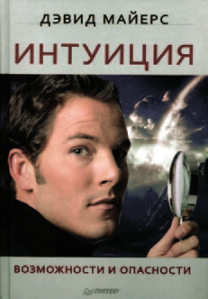
The American psychologist David Mayers, known for serious research in the field of social sciences, does not suffer from snobbery and is easily taken as an analysis of the most incredible facts and phenomena associated with intuition and intuitive knowledge. In the new book “Intuition. Opportunities and dangers ”The scientist does not at all understand the role of science in explaining the phenomena, which, from the point of view of ordinary consciousness, have a mystical or paranormal origin. On the contrary, the author tries to show that only a sober scientific view of the world will help us make life better and avoid the mistakes that we usually make, fully relying on the sixth feeling. The history of science, Mayers believes, is the history of a series of challenges abandoned intuition, and in order to distinguish true intuition from false, and grains of truth - from nonsense, you need a scientific approach: to be skeptical, but not cynical, open, but not gullible. ”
Therefore, most likely, most of the audience, which the publisher was counting on, reprinting the book in the series “Psychologist itself” (previously the book was published by the same publishing house in the series “Masters of Psychology”) will be disappointed. The reader will find there either methods for improving intuition, nor tips for the development of superpowers, nor confirmation of the myth that intuition exceeds other forms of knowledge and is not amenable to rational explanation. The book is more like an American textbook on practical social psychology or behavioral economy than a popular manual for psychics and “psychologists in life”.
David Mayers describes a large number of facts and phenomena, which, in his opinion, are somehow related to intuition. The author considers the intuition itself in the broad sense - as the ability to direct knowledge and immediate insight, without preliminary observations and reasoning. This ability is based on unconscious experience, but most often cognitive distortions, mistakes of perception and superstition, permeating our attitude to a variety of aspects of reality. On the example of individual fields of activity, such as sports, investment business, clinical practice and gambling, the author shows what consequences the blind leadership of intuition leads to a person, unwillingness or inability to think rationally.
The best way to check intuitive guesses or evaluate the adequacy of intuitive decisions, according to D. Myers, to turn to statistics. Being familiar with mathematical statistics firsthand, the author calls to trust more than emotions and apparent laws. With the same examples, the scientist shows that people tend to look for relationships where the case rules the case, find order among chaos. And as a result, to make the wrong decisions based on the illusion that the phenomena objective and non-depending on the will of man can obey our consciousness or some universal order.
But it cannot be said that the author underestimates the possibilities of intuitive knowledge and decision -making in human life. A warning against intuition errors, Mayers also describes situations when intuition helps to make correct decisions and wins in comparison with excessive rationality and self -digging. The purpose of his work is to show that a scientific approach helps to identify both amazingly strengths and serious dangers of unverified intuition.
One of the chapters of the book is devoted to a critical analysis of “paranormal” phenomena. The author describes the mechanisms of the formation of faith in supernatural people and debunk everyday ideas about psychic intuition, raises important questions about the ratio of science and spirituality. David Mayers does not contrast science and faith, but seeks the points of their contact. The scientist hopes that science can help separate genuine spirituality from pseudo -spirituality, the truth is from lies and superstitions.
In all the arguments of the author, a strong scientific grip is felt, healthy pragmatism and childhood delight before the unknown phenomena of nature. The scientist recognizes the limitations of modern science in explaining the poorly studied aspects of consciousness and human behavior, which include intuition. The lack of dogmatism and openness to new experience allow it to avoid categorical conclusions. “Demonstrating our ability to make nonsense,” the author warns, “this book creates the danger of being overly humble.” Nevertheless, psychology, the scientist believes, is the science of creative, aimed at strengthening human thinking by explaining and improving both rational and intuitive methods of cognition. Comparing intuition with existing evidence, we improve the quality of our thinking, because wisdom, D. Mayers is sure, comes with the loss of illusions and the acquisition of knowledge.
Igor Pavlov