
Translated material
The first fan of radio communications
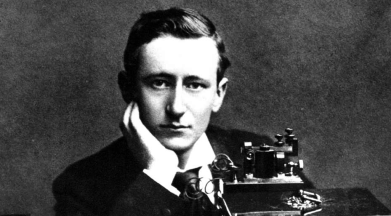
The sacramental question "Who invented the radio?" It just does not have a definite answer. To create devices for wireless transmission of messages using electromagnetic waves, no less than a dozen university professors and self-taught techies in Western Europe, Russia (this is, of course, Alexander Popov), America and even India. However, radio communications as a successful commercial enterprise was conceived and implemented thanks to the efforts of a young Italian who did not only have academic degrees, but even a school certificate. He is the real father of the radio-according to biographers, this was recognized by Popov himself during a conversation with Marconi in Kronstadt in the summer of 1902
Marconi translated into the practical plane new ideas that his predecessors only thought over or used in very modest experiments.
Augusto Riga
Wireless communication without radio
As you know, history does not know the subjunctive mood - including the history of science and technology. Nevertheless, one cannot but notice that the radio could be invented even before Henry Hertz in 1886-88. Experimentally proved the existence of electromagnetic waves predicted by Maxwell. I will tell you only about two works that could lead to this great event - in reality there were more of them.
In 1829, American physicist Joseph Henry began to experiment with Leiden banks. Over time, he found that their electric discharges cause indignation, as a result of which metal needles are magnetized at a distance. Now we know that this effect produce electromagnetic waves, but Henry, of course, did not suspect their existence. In 1859, the German physicist Berend Federmen experimentally proved that the discharges of the Leiden cans launch the etheric (as they said) oscillatory processes. In 1883, Dublin professor George Francis Fitzgerald proposed using such fluctuations as a source of Maxwell waves. However, he did not imagine how to register these waves, and therefore limited himself to a pure theory.
The most interesting thing is that a completely efficient electromagnetic wave detector by this time has already existed. This discovery was made by the wonderful English inventor David Edward Hughes - the creator of Televepe and coal microphone. In 1879, Hughes noted that the categories of electrostatic generators and induction coils significantly reduce the electrical resistance of the microphone, which he managed to register at a distance of about half a kilometer. Hughes with brilliant perspicacity guessed that the newly open phenomenon was generated by high -frequency electric waves, however, scientists who showed his experiments (and among them were such large physicists as George Gabriel Stox and William Crook), did not support this hypothesis. The disappointed Hughes did not publish anything and thereby missed the opportunity to bring the invention of the radio.
At the end of the 19th century, very successful attempts were made to establish wireless communication with the help of electromagnetic and electrostatic induction. One of these systems, invented by the famous Edison (his patent application was submitted in 1885 and approved in 1891), allowed railway passengers to receive and send telegrams directly during the movement of the train. The texts were transmitted along the telegraph lines located along the canvas, but they overcame the distance between the train and the cable without any wires. Edison equipment worked flawlessly on three railway routes, but she had no commercial success and therefore did not last long. Then, the chief engineer of the British Postal Service, William Ob (we will meet with him!) Successfully experimented with an induction program of Morzyanka between the coastal reception and transmitting stations spaced several kilometers. Similar experiments in 1894 were conducted by Professor Erich Ratenau near Berlin. In all these and similar experiments, signals were actually transmitted using low -frequency electromagnetic waves that are useless for practical radio engineering. Nevertheless, these experiments showed that wireless electromagnetic communication is fundamentally possible.
Radio waves: the context of the era
However, the real history of the radio nevertheless begins with the classic experiments of Henry Hertz. As a source of radio waves, he used the Rumorf induction coil - a high -voltage raising transformer that feeds on the galvanic battery connected through the capacitor and magnetic interrupt. Its secondary winding was closed on the spark gap (in Hertz it was formed by two small brass balls fixed on long copper rods, crowned with a hollow with a mobile metal sphere or square plate). If the coil supplies electrical impulses to the balls, sparks slip between them, generating the fading tsugs of electromagnetic waves (in Hertz experiments, their length was from 60 cm to 5 m). The detector was the so -called resonator - an open metal ring (or rectangular frame) with its own spark gap.
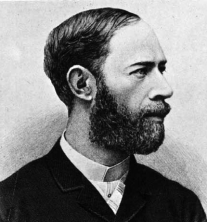
Hertz's emitor turned out to be the ancestor of all the first radio transmitters created at the end of the 19th century (transmitters with continuous generation of radio waves, first arc and electrodynamic, and then lamp, appeared only after 1900). In 1893-1894 Augusto Riga, professor of physics of Bologna University, introduced significant improvements to the Hersevsky structure, which made it possible to receive powerful radiation of the centimeter range. Over time, spark generators have established themselves in commercial radio communications.
But the detector Hertz was clearly not suitable for this. Visual monitoring of sparks, jumping through the gap of the resonator when passing wave impulses, was of interest from the point of view of physics, but did not provide reliable receiving either individual signals, or, especially, long messages. However, radio engineering is also lucky here. Somewhere in 1884, the Italian physics teacher Temikyokl Kaltsekki-Opest found that the electrical resistance of a glass tube filled with metal powder was sharply reduced after passing through the electric current pulse. In fact, this was the effect, five years earlier noticed by Hughes, only without electromagnetic waves. Unlike Hughes, Kalzecki-Ones published his results in the journal IL Nuovo Cemento. Therefore, other scientists learned about them, including the professor of the Parisian University of Paris, Eduard Branley, who continued these experiments. In the early 1890s, Branly found out that the conductivity of the powder increases near electrical sparks and remains that for several hours.
He also noticed that the previous high resistance is restored after mechanical shaking of the container with powder. It followed that the tube with two electrodes filled with metal sawdust can serve as a detector of electromagnetic wave pulses.
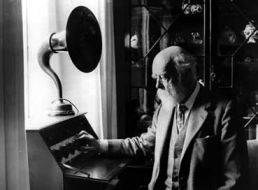
Branley’s pipe, as they began to call this simple device, were repeatedly improved, but in principle it did not change (its action understood much later-the resistance falls due to sinsing of the powder particles under the influence of high frequency currents excited by electromagnetic waves). In 1894, the British physicist Oliver Lodge read two public lectures in London and Oxford, during which for the first time demonstrated that the combination of the Branly and Halvanometer tube allows you to register short and long (like dash and dash of the Morse ABC) Impuls of the radio waves from the Hertsev Rygraz at a distance of about 50 m. In the way, a word, otherwise the invention of the radio would be dated 1894 (much later Lodge wrote that due to employment by teaching at the University College, he simply did not think about the prospects of radio telegraphy). It is worth noting that in his experiments, the Branly tube periodically shook with the help of special devices - either electrical or working from the clock mechanism.
Radio wave detectors, based on the effect of changes in the conductivity of the touch block under the influence of radio capuls, are called Cogerers. This term again came up with a log, as a derivative of Cohere-to adapt. In those days, it was believed that the first coherent invented Branly, although in fairness priority should be given to Hughes.
Almost simultaneously with Kogerer Lodge, a prototype of another radio wave detector appeared, the idea of which dates back to Joseph Henry's works. He was invented by the future father of nuclear physics Ernest Rutherford, who at the beginning of his scientific career (first in New Zealand and then in Cambridge) studied the magnetic effect of radio waves. He complemented the resonator Hertz with a thin wire with a magnetized steel needle inside. Under the influence of radio wave impulses, the needle was demagnetized, which was shown by a magnetometer. Using this device, Rutherford detect radio waves at a distance of three quarters of a mile from the source, which he wrote in an article published in 1895. This work was destined to play a significant role for the progress of radio engineering.
Thus, in the middle of the last decade of the XIX century, there were already quite reliable devices for generating and receiving radio signals. But it was necessary that someone counts that with the help of these devices you can create a new technology for transmitting messages and ensure its commercial success. Such a man turned out to be Gulelmo Marconi.
Gulelmo Marconi was born in Bologna on the morning of April 25, 1874. He was the second son to the best of the wealthy landowner Giuseppe Marconi and his wife Annie. Annie was the youngest daughter Andrew Jameson , the prosperous owner of the Irish distillery, who produced a well -known Brand of Viski (therefore Gulelmo since childhood owned both English and Italian). Until 12 years old, he studied at home under the leadership of his mother and coming mentors. Among his favorite books was the Benjamen Franklin biography dug in the paternal library and the popular lectures of Faradei in electricity.
Due to the obvious tendency to natural sciences and the equally obvious lack of humanitarian interests in 1886, Marconi sent to a technical school in Florence, and a year later they transferred to a similar institution to Livorno. Despite the enthusiastic classes of physics under the guidance of an excellent teacher Giotto Biztsarrini and additional lessons of electrical engineering, which was given by the teacher of the lyceum Niccolini Vincenzo Rosa, did not receive the diploma, and therefore could not fulfill his dream-to enter the Naval Academy. In Livorno, young Marconi brought friendship with the retired telegraph operator Nello Marschatti, who taught his alphabet Morse and work on the vein.
The lack of school certificate closed Gulelmo and the possibility of formal university education. However, his parents were familiar with Augusto Riga, who had a house near their family Villa Griffon in the town of Pontecio near Bologna. Riga allowed the young man to work in his laboratory and in the library of the Physical Institute of Bologna University, and Gulelmo learned a lot there.
And then he was not up to class. On January 1, 1894, in Bonn he died of Sepsis , Herz Hertz, who did not reach his 37th anniversary. Gulelmo found out about this only in the summer, having read a newspaper article on the discoveries of the deceased at the alpine resort. It was then that he first thought whether it was possible to use radio waves for wireless telegraphy. In the fall, he began experiences in the attic of Villa Griffon, with the permission of his father turned into a laboratory. He worked both day and night, leaving no time for rest and not reckoning with fatigue. Gulelmo, who by this time knew about the experiments of Lodge, had no doubt that the idea of wireless communication could have occurred not only to him, and wanted to stake the championship.