
Translated material
Gorky period
Now there is a museum
"The next stop is Sakharov." It is difficult to miss the Museum of Andrei Dmitrievich in Nizhny Novgorod. Unless specially set up such a task. It is enough to go to the Shcherbinka microdistrict to the Sakharov Museum, cross the road, and now it is a twelve-story building, on the first floor of which the academician lived from January 1980 to December 1986 with his wife Elena Bonner
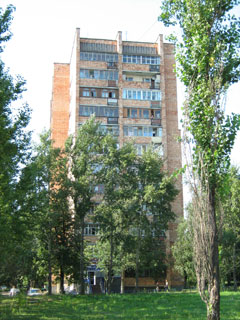 |
| The house in which the Sakharov Museum is located |
Nizhny Novgorod residents are still alive (then - Gorky residents), who tried to see Sakharov at one time, get acquainted with him. The name of Andrei Dmitrievich lives in city legends and traditions, often diverging with official history. There are people who claim that Sakharov could be seen with a walking day near the house, as if he sometimes worked at the neighboring research institute of the Sedakov measuring systems and even went to Arzamas-16 for a while (now Sarov where the nuclear center is located).
The exposition is deployed in the Museum’s apartment, telling about Sakharov’s work in the 50s over nuclear weapons, a hydrogen bomb precisely in Arzamas-16. The atmosphere of the time was recreated when Sakharov was instilled in it, where there was not even a phone (the link ended with the advent of the Monter that installed the device. The next day, Mikhail Gorbachev called Sakharov). Unless the operational employee of state security does not sit on the chair near the front door, as it was then. At the entrance is a bas -relief, at the house itself - a memorial plaque. So do not miss. Although in fairness it is worth recognizing: the museum’s attendance is not the highest. Local democrats of all ages come, school excursions come. In addition to expositions, traditional educational events are held here: lectures and conversations “A.D. Sakharov is the father of the Soviet hydrogen bomb ”,“ Gorky link ”,“ Save human in a person ” - at Sakharov’s work“ Peace in half a century ”; Scientific and practical conference "Sakharov Readings"; The competition "Me and my rights" for the Day of Memory of the Academician; The competition of theoretical and journalistic works "Free-thinking: its past, present, future."
The museum in Nizhny Novgorod, perhaps, does not reach the Sakharov Center in Moscow with its exhibitions and loud scandals, but lives its measured, quite noticeable on the scale of the millionaire city. Since 1991, when the museum was discovered by the efforts of Governor Boris Nemtsov, it is contained in state money.
Nemtsov blessed another undertaking associated with the name of Andrei Dmitrievich, - the International Festival of Arts named after Sakharov “Russian Art and Peace”. The initiative of the festival belonged to the head of the Nizhny Novgorod Philharmonic Olga Tomina and the cellist Valentin Berlinsky. They have become the artistic leaders of the festival and until today prevent the project to die. Elena Bonner addressed the first festival with a welcoming letter. The great cellist Mstislav Rostropovich, who has repeatedly performed at the festival, wrote: “I am happy because I am dedicated to the greatest person and citizen of our era, I am dedicated to the international festival, happy that he will happen in Nizhny Novgorod - the city historically connected with the name of the Academician of Sakharov, in the city, in which the first was held in the USSR in the USSR. The festival of modern music in 1962, in the city with such long and glorious musical traditions ... The bitter period of our glorious city, which was made "closed" not only for foreigners, but also for world culture, as I hope, passed. "
It is worth adding that at the humanitarian faculties of Nizhny Novgorod universities they study the legacy of Sakharov. Here, an academician is still perceived as a contemporary, not a historical character.