
Translated material
And parasites - never ...
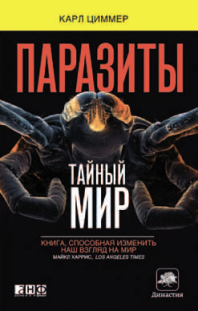
Parasites possess the world. On the ground, in water and in the air, their eggs ripen, larvae scurry, crawl, swim and fly. In an arbitrarily taken individual of any spinal - from fish and frogs to birds and mammals - a dozen species of various parasites lives. They affect not only physiology, but also on the behavior and the evolution of their owners. Parasical species make up the majority of animals.
About the amazing and instructive world of parasites is described in the book of the American scientific journalist Karl Zimmer, published as part of the project “Library of Dynasty” in the publishing house “Alpina Nonfikshn”. The author managed to state an incredible number of facts and stories, organizing them so that instead of boring transfer, they develop into an integral, rather unexpected and paradoxical picture. Key chapters talk about the life cycles of parasites, their travels between the owners and inside the hosts, about interaction with the immune system, the impact on environmental interactions and evolution. As is customary in Western scientific journalism, the presentation is often tied to specific people, but this does not irritate superficiality - as a rule, we are talking about working researchers, which makes it possible to reflect their views on the studied objects. The book as a whole is well published, important - and, unfortunately, rare - a complement to the main text is a glossary, a subject index and an extensive bibliography. Unfortunately, not very clear black and white photographs (made on the basis of color in the original?) Were used as illustrations: parasites deserve more, and sometimes the color is simply necessary for understanding what is happening, as in the case of a snail in which the trematode imitating the caterpillar settles. In addition, the drawings are torn from the main text - they are collected at the end, and there are no links to them in the test.
More serious claims can be expressed to the quality of translation and scientific editing. Unfortunately, the author allows substantial errors, and it would be worth correcting them. The passage is strange about the fact that malarial plasmodies need not only hemoglobin, but also amino acids: like any protein, hemoglobin consists of amino acids. Apparently, this blunder is not accidental, because after a few pages it is said: “Plasmodia has to make a lot of efforts to compensate for the absence of genes and proteins in blood cells,” but hemoglobin, which is not protein? Contrary to the written, genes, even in toxoplasm, are not placed in the apparatus of Golgi. In vain, the author offends viruses, saying that this is “nothing more than protein shells”: after all, the main thing in the virus is not a shell, but nucleic acid, which makes it a successful “genetic parasite”. In general, the author has difficult relationships with molecular biology - and stories about mitochondria and sporen chloroplasts, and a discussion of the mobile elements of the genome, and the history of the origin of Eukaryotes are very approximate. “Father's genes are attached to the maternal and suppress them,” - this passage is generally beyond good and evil. Opestr is not a “primitive cystera” of fish: the only modern cysterae fish is the famous Latimeria. The story of how Babuins avoid places infected with nematodes is very interesting, but it would be good to find out how they learn about infection?
In addition, the translation is replete with inaccuracies, visible even to a non -specialist without a comparison with the original. It is unclear why, instead of generally accepted proteins and enzymes, existing in the language, but secondary and pretentious proteins and enzymes are used. Mountain lions are apparently Mountain Lions, that is, the pums (they are kuguars); About this could be found out in the dictionary or Wikipedia. Chlorokin is chlorochine. For parasitic OS in the Russian -speaking literature there is a term rider (this could suggest a scientific editor; however, there is a subject for discussion, since parasitic Osami is sometimes called the web -winged, not related to riders, should be carefully checked in each particular case). No need to confuse beetles with bugs, even if the author writes Bug in both cases; This looks especially crooked within the limits of one sentence: a phrase in which a certain bug is first mentioned, and then a “other beetle” is very bad. Rutgers University was first called the University of Rutgers, and then Ratders (the locals usually say Ratgers). “The parasite forces the cell of the cell to secrete collagen,” - I don’t know at whose expense it is to be attributed to anyone: DNA does not “distinguish” proteins, but only encodes their amino acid sequences (apparently, the effect of the parasite consists in increasing the expression of genes encoding collagen, which in itself is completely surprising - and, therefore, in increasing the concentration of the latter); After two pages, it is said about “genes producing protein” - the same trouble.
As is customary to say in the reviews on the dissertation, "editorial comments do not reduce the overall highlight." Highly assessing the book - yes, they do not reduce. But it is also true that these and similar trifles are not harmless: they force them to doubt how well the author reproduced what he heard from scientists, and how adequate the translation of substantive statements is.
Returning to the discussion of the book in general, I also want to note that I did not have enough attempt to generalize and/or classifying life strategies for parasites. For example, it seems from the text that the intermediate host of parasites is often invertebrate, and the main is the vertebral animals. Is it always like that? Is it the other way around? In general, what is the definition of an intermediate and main owner? Can not it turn out that the vertebral (person) is called the main master simply due to traditional anthropocentrism? For parasites having the stage of sexual reproduction, apparently the main host is the one in the body of which this happens. But why can’t you look at the malaria plasmodium from the point of view of a mosquito and count a person with a vector through which the unfortunate mosquitoes infect each other with malaria?
Nevertheless, I repeat, the book is absolutely wonderful, interesting, instructive and read easily. I advise you very much.
Mikhail Gelfand