
Translated material
The second president
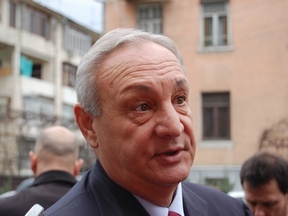
On the morning of May 29, 2011, the President of Abkhazia Sergey Bagapsh was in Moscow. Today it is difficult to imagine that a man who left a deep mark in the recent history of not only his republic, but the entire Caucasus, spoke objectively and impartially. Sergeybagapsh was one of the central figures in the process of forming a new status kwon of the Great Caucasus. It was during his legislature that Abkhazia received a partial recognition of independence. Starting from August 26, 2008, the republic was recognized as states, one of which was a permanent member of the Security Council, a member of the Big Eight and Twenty, as well as the owner of a nuclear steel. Today, with one hundred percent confidence, it is impossible to say whether anyone else will join this four countries, or if the list of recognized people will not replenish for many years. But in any case, in 2008 a political and legal precedent was created. And in the history of Abkhazia, he will be connected by Siem by Sergei Bagapsha.
What is Jogging Georgia, the name of the second Abkhaz president there will cause unprofitable associations. After the end of the Five Day War, in August 2008, the Georgian consultation introduced the concept of “occupied territories” into circulation. However, the Russian recognition of the Abkhaz and South Ossetian independence of the Georgian authorities began the campaign for the international recognition of the fact of the “occupation” of the two former autonomies of the Georgian SSR. Therefore, for the official Tbilisi, the late Liber of Abkhazia will remain a symbol of collaboration and “occupation policy” of the Russian Federation, in which the republic fell into a closer dependence on Moscow than it was before the “hot August”.
However, the activity of this politician was not limited by geopolitical plots only. The knowledge of the second president of Abkhazia in the republican internal politickens is possible to underestimate. Whoever replaces him,
Bagapsha, first of all, will be compared with the “founding father” of post-Soviet Abkhazia Vladislav Ardzinboa.
The biographies of these politicians are very different from one another. And the role of everyone in the latter-ABCHAZ history is unique in their own way. Ardzinba (like many Humanitarians) did not enter, but burst into public policy on the wave of perestroika of publicity. As a matter of fact, such personalities as Ardzinba (each on their own), and made the Soviet policy a public policy closed from prying eyes.
Unlike a detachable predecessor as president of Abkhazia, Sergey Bagapsh rose the Napolithic Olympus gradually, moving from one step to another of the conference of the Komsomol-party ladder. First, the instructor of the Abkhazian regional committee, then the head of the information sector, and then the department of the working and agriculture of the Central Committee of the Komsomol of Georgia. During the stagnation, the Abkhaz Komsomol and Party Yucadres in Tbilisi were not so frequent. Subsequently, this “Georgian Etap” of the biography of Sergei Vasilievich (and at that time the first secretary of the Central Committee of the Communist Party of Georgia was the future president of the independent Georgian state Eduard Shevardnadze) will become the basis for high expectations about a possible compromise of the intermediament and Tbilisi. And, of course, some “black” political technologists will speculate on this subject, discussing the “Besweight orientation” of the presidential candidate of Bagapsha. Be that as it may, and for the Abkhaz Komsomol figure, the experience of working in the Center of the Union Republic opened up more -haired bureaucratic horizons, and introduced to secrets and an administrative intrigue. In the year of the Moscow Olympiad, Bagapsh occupies the post -final secretary of the Abkhaz regional committee of the Komsomol. Two years later, he still takes an OODOD step up, taking the position of the first secretary of the Ochamchir district party committee.
Probably, not at perestroika, Bagapsha’s career could not go beyond the nomenclature activity within the Abkhaz Autonomous Soviet Socialist Republic. However, the political liberalization of the Second-Popolovin of the 1980s opened new horizons for him (as well as many of his other comrades). During this period, the most pragmatic representatives of the representative and economic nomenclature united with bright public agents in order to occupy new, only emerging political rally, on which other games were played out, in no way related to “proletarian internationalism”. The nationalist discourse of various manifestations came to the fore. In order not to be on the sidelines, it was necessary to master the language and new rules. However, running ahead, let's say that Sergey Bagapshv did not difference from Vladislav Ardzinba. The past good school of the Brezhnev era, he, unlike his predecessor, watched the intrigues more mundanely. Without external emotions and tears. These qualities in the period of the presidency were not superfluous at all. The main skate of Bagapsha was the ability to find compromises and coordinate various interests in order to avoid open conflicts and anti -combinations.
For a long time, the background of Vladislav Ardzinba Sergey Bagapsh remained in the shade. In the post-war period, he held the posts of the Prime Minister of the Republic and the head of the Energy Company Chernomorenergo. In fact, the authority of the intellectual (the future of the age of the age of the future, the future president of Abkhazia, successfully defender dissertation and had experience at the Moscow Academic Comic Institute), who became a politician, recognized as an expert in the interests of the Abkhaz -naval movement through the scale of the entire Soviet Union, turned Ardzinba into a violently adultery leader. It was he who became the personification of the struggle of autonomy for exit from Georgia, including armed conflict1992-1993. However, the time of nationalist romanticism could not continue. And the winnings in the military conflict with Tbilisi did not mean the “end of history” for Abkhazia. The victory of the separatist movement posed multi -faced issues to the republic. How to prevent a new armed confrontation with Tbilisi? How to avoid the dictatorship of the "field commanders"? How to build working institutions to avoid total chaos? How to prevent the reproduction of ethnic conflicts - despite the fact that Abkhazia and after the expulsion of the Georgian reservation remained a multi -ethnic education? How to be able to break through an international level in the absence of recognition and membership in the UN? How to make economic activity? And, in the end, how, breaking away the rumor, not turn into the Russian province?
And today, all these issues were not completely fully resolved by their decision. In the 90s, when the military phase of the ethno-political conflict ended, it very soon became clear: one intellectual absorption and charisma of the first president is not enough. Moreover, Ardzinba, like all other politicians ascended to Olympus, was prone to weaknesses characteristic of the nature of their kinds. In this case, the speech does not make exclusively the outlines of the case. The problem is much more complicated. Here is the unpreparedness to take a different opinion, and a tendency to simplify, and hypertrophied assessment of personal achievements. Be that as it may, and by the middle - the end of the 90s of the manual sole control, it ceased to correspond to the needs of the time. The agenda, in which there was only one question: "Are you for freeAbhazia or against?" - No longer covered all the problems of the republic. First of all, we are talking about complicating the perception of the prospects of independence. Gradually, another question began to come out at the first place: "What quality is independence much?"
And it was this issue that became central when the departure of the First President of the Republic from business became obvious injured. It was then that the “star hour” of Sergei Bagapsha came.
In 2004, Abkhazia solved the most difficult problem for the “transitional state” (extra dependence on international legitimacy) the problem of the transfer of the power of the fading leader to the successor.
Until 2004, it could be said about the post -Soviet abhase that it is Vladislav Ardzinba, its creator and first president. In 2004, a real domestic policy appeared in Abkhazia, that is, a public dispute between various leaders for the right to lead their republic to recognize and form actual statehood. The struggle with the external threat was not only a foreign policy, but an illegal issue number one. To “turn off” the opponent from the game, it was enough to publicly hint at his sympathy for Tbilisi. Even if such strokes did not take place.
Elections of 2004 opened the possibility of complicating the Abkhaz agenda. At the same time, in 2004, the task of recognition was not not only solved, it did not even stand on the agenda. At that time, Russia supported the principle of the territorial integrity of Georgia, Moscow was still involved in the possibility of searching for compromises with the Georgian leadership (today the Kremlin defiantly does not want to have business). During the 2004 campaign, Sergei Bagapsh showed his fighting qualities, managing to confront the pressure of not only the successor of the first president of the republic (at that time he was a hadjimba), but also the Kremlin, who supported the choice of Vladislav Ardzinba Jehovah. But the point is not only in the manifestation of will and character. In 2004, he managed to get away from a frontal clash with opponents.
After the first voting results were announced, a tense situation was in Sukhumi, fraught with Nunurabhaz confrontation. When in November 2004 the supporting Bagapsha captured and took control of the complex of government agencies, Nodar Hashba, at that time the prime minister, the translated apparatus into one of their Sukhumian sanatoriums. Then, during the incident, Tamara Shakkll died from a random shot (famous philologist, human rights activist, author of appeals to various Soviet instances by the Popovod of the Abkhaz Autonomous Soviet Socialist Republic from Georgia). However, Bagapsh was able not to only use his supporters, to keep them from further violent actions, but also to come into contact with his chief opponent and Moscow in order to find a relatively new configuration of the authorities. As a result, it was found: in January 2005, new elections were held in which Bagapsh will be balled up to the presidency, and Khadimba - to the vice presidents (the government was headed by Alexander Ankvab, who then supported the “Bagapshists”). Vitoga of Abkhazia managed to avoid the repetition of Georgian scenarios, when power was exclusively through forceful actions (coups or “revolutions”), and to transmit the highest power from one person to another peacefully.
After 5 years, the-2009 challenge was already in the new conditions. This was the first electoral campaign in which the “Georgian factor” was minimal. There was no longer a Georgian military-police group in Kodori, and there was nothing to expect that the Excetus Mikhail Saakashvili would throw out some kind of focus like the personal inspectorate of Russian peacekeeping forces with the statements that Sukhumi is such a Zhegorod of Georgia as Kutaisi or Rustavi. In 2009, no one seriously played the “Bastard politicians”, which was accepted in the Ardzinba era. After 5 years of the 2004 campaign, the statements of the opponents of Sergei Bagapsha about his ties with tbils were already unscientific fantastic. In general, the threat from Tbilisi during the campaign was not the main “bearing structure”.
The elections were not built by the station of the past (although these images did not go anywhere, but they very much lost weight), but around the images of the future. Applicants for the presidential post tried to present their prospects for the development of Abkhaz statehood. The issue of citizenship of the republic and the problems of integration of the Georgian (Migrelsky) population of the Galsky district was discovered, and factors and the possibility of diversification of external relations were discussed. Thus, for the “five -year plan” Bagapsha Abkhazia overcame an important line in its development. All his political opponents (both those who fought against Neyv in 2004, and those who opposed in 2009) remained Wabhaz politics and were not repressed. Despite the fact that one of the studies of the “historical compromise” of 2004, Raul Hajimba, subsequently altered the post of vice president and moved to the category of critics of the current government. The same goes for the media.
Opportunities for public controversy and criticism of the president and his team, probably, can be attributed to the most positive results of the presidency of the Bagapsha.
Naturally, the years of the Government of the Second President of the Republic should not be idealized. Many reproached Bagapsha VTU that he could not achieve a qualitative breakthrough in the fight against corruption and modernization of the political system. On the contrary, his supporters noted that in the social consequences of present -day Abkhazia (with its “clan” factor and informal principle of the authorities), Bagapsh did everything to maintain the balance of forces and interests.
The “Georgian factor” was replaced by the first place in the republican agenda by the “factor of Russia”. More precisely, the problem of the “price of the issue” of the Russian-Russian-political patronage over Abkhazia.
As in 1993, in 2008 it was clear: the recognition of Moscow’s independence completes one and opens the other head of the latest Abkhaz history. Inside the republic there were many those who opposed the bugapsha for too large and unjustified (from the point of view of opponents) concessile large business and the Kremlin (often these two phenomena go in Abkhazia in the hand in hand). The penetration of Rosneft and oil developments in Chernomor, the transition to Russia of the elite summer cottages of the Soviet period, the military capacity of the Russian Federation, the intervention of the Russian Orthodox Church in religious life, copying the Russian political “fashion” - all these are the topics that are perceived in the Republic of Krainene item. And all over this spectrum of issues, the Abkhazian authorities in general willing the President of the Republic in particular often became objects of vicinetry. The truth is that the discussion itself around the designated plots was carried out and is continued to be carried out, in which the undoubted merit of the second president of Abkhazia.
Be that as it may, ahead of the Ures public elections and the definition of the successor of the deceased leader. Today, the entry of the main applicants for the post of president can be considered by Alexander (as the Vice President, he is now fulfilling the obligation of the head of the publication) and Sergey Shamba. Both one and the second have their own serious advantages and disadvantages. Ankvab is known for his “heavy character” inquisitive (survived several attempts on his life). At the same time, it is precisely because of these reasons for many residents of the Republic of Ankaba that the “strong man” and a fighter for justice. And, on the contrary, Moscow with such a partner will not be easy. Sergei Shamba, probably, like no other in Abkhazia, is a rich diplomatic experience. For many years, he stood at the head of the Midress, negotiations with Georgia, European diplomats, US ambassadors VTLISI, took part in international formats (Geneva negotiations by the UN Pohygide and Geneva consultations on stability and security in the Caucasus). Having prime minister, Shamba took an important step in his career and his positioning as a “internal policy”. However, in any case, who would navigate Abkhazia after Bagapsh, for successful activities in the future, will be relying on many “milestones” indicated by this politician.
The author is an invited researcher at strategic and international research, USA, Washington. Sergei Markedonov’s articles about Abkhazia were published on Polit.ru: “ Nosypical Report ”, “founding the founding-founding of realism ”, “ Requirements of realism ”, “ Warmal projects ”, “ German plan for the Zavkazkaz ”, “ Historical Fronts of the Georgian-Abkhaz Conflict ”, “Correction of Names” in Georgian ”and others.