
Translated material
How much is Gaddafi for Russia?
How a foreign policy line hesitates after the interests of a large business
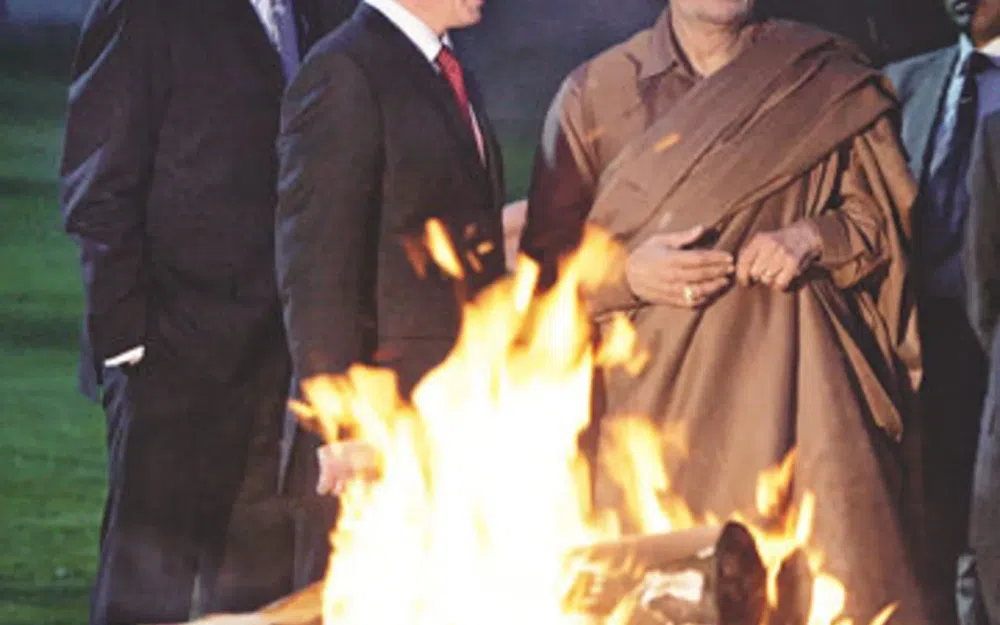
The March verbal skirmish on the Libyan issue between the president and the prime minister gave a reason to many “experts” to diagnose disagreements in the ruling tandem. If Medvedev connected the Libyan armed conflict with the “ugly behavior” of the leadership of Libya, then Putin compared the UN prezolution, which allowed the foreign military to apply force, calling for a crusade ...
The March verbal skirmish on the Libyan question between President D. Medvedev and Prime Minister V. Putin gave a reason to many “experts” to diagnose disagreements in the ruling tandem. If D. Medvedev associated the Libyan armed conflict with the “ugly behavior that was carried out by the leadership of Libya and the crimes that were committed against his own people,” then V. Putin called the UN 1973 resolution adopted on March 19, which allowed the foreign military to apply force, “flawed” and compared with a call to the crusader.
Split? By no means. The positions of Russian leaders were verified and, most likely, in advance. The President was preoccupied with the preservation of the foreign policy reputation of our country, and the prime minister was to save Russian economic interests, the solution of the problem of Libyan debt $ 4.5 billion and ensuring employment at many Russian enterprises. Today it is possible to confidently predict a quick resolution of the Libyan confrontation for Russia, and then, in March, the largest Russian companies were engaged in the calculation of possible billions of losses.
OJSC "Russian Railways"
The history of the relationship between Russian railway workers with Libya began back in 2006-2007, when preliminary agreements were concluded on the participation of Russian Railways in the modernization of the Libyan railway infrastructure. So, in July-August in 2007, Russian Railways prepared a feasibility study for the construction of a two-way railway line of the SIRT-Bengrais with a length of 554 km on the coast of the Mediterranean Sea, which is an integral part of the Transarat railway line and actually connecting Egypt and Tunisia.
The project consisted in the construction of a modern high -speed (250 km/h) railway line with a rut width of 1435 mm, 30 railway and 23 vehicles, 6 large stations and 23 passenger, cargo -passenger, freight and operating stations. (The standard rut width in Russia is 1520 mm. For the construction of the Sirt -Benghazi railway line, with a rut width of 1435 mm, engineers from China were attracted, where the track is just 1435 mm.)
On April 17, 2008, during the visit of the President of Russia V. Putin to Tripoli Zheleznodorozhny, the contract No. 5/731 in the amount of € 2.2 billion was signed. Then Russian Railways was able to get ahead of several recognized railway leaders: Italian companies Cooperativa Muratori Cementisi Ravenna and Astaldi, French Alstom and Seco-Rail, as well as German DB International and Siemens.
At the end of 2008, the Russian Railways accounts received the first advance funds in the amount of 14.4 billion rubles, or more than € 360 million. The main works led by the subsidiary of Russian Railways OJSC Zarubezhstrotyhnology. In 2009, Zarubezh Stralyotychnology laid the first 14 km of tracks, collected 110 turnouts, and also erected a central construction laboratory and a shift village in Ras-Lanuf. About 3,500 builders were involved in the construction of the highway, including 289 engineers, as well as more than 1734 units of equipment, including heavy earthmoving and specialized travel equipment.
“Abroad,” is far from the only Russian participant in the project, since up to 70% of equipment, equipment and metal products was supposed to be purchased in Russia. It was planned to purchase some of the specialized mechanisms from Russian manufacturers: Kalugaputmash OJSC, Kaluga Plant Rempotmash, OJSC Yaroslavl Car Reported Plant Rempotmash, Tulazhelezheledromash CJSC, Kirovsky Mashzavod OJSC. In 2009, the receivables of Zarubezhsteletchnology due to advance payments to Russian enterprises for the Libyan project increased by 8.9 times (from 217.8 million rubles to 1934.6 million rubles), and in 2010 the total amount of concluded agreements exceeded 20 billion rubles.
The mass riots that began on February 15, 2011 led to the suspension of work and evacuation of employees of the Libyan branch of Russian Railways. Stop building has become a focus of several problems at once. Firstly, it has become an urgent problem of resolving Libyan debt. Secondly, the likely loss of tens of billions of rubles invested in the implementation of the project, both in Russia and in Libya. Thirdly, the need for further financing of contracts with numerous Russian enterprises.
FSUE "Rosoboronexport"
Another Russian company, which suffered from the events in Libya, whose possible losses, albeit lower, are generally comparable to the alleged losses of Russian Railways, can become FSUE Rosoboronexport. Under the threat of non -fulfillment were contracts for the supply of weapons and ammunition to a total of € 1.3 billion (more than $ 1.8 billion).
During the first official visit to Russia, M. Gaddafi on October 31 - November 2, 2008, the leader of the Libyan Revolution noted that Libya has a large armament park that has long demanded repair and re -equipment. In January 2010, in order to resolve Libyan state debt according to the “contracts in exchange for debiting”, Russia and Libya signed an agreement for the supply of Russian weapons to Libya € 1.3 billion. According to the document, Russia was supposed to put approximately 12 Su-35 fighters, at least 2 divisions of anti-aircraft missile systems of S-300PMU2 Favorit,, Several dozen T-90C tanks, as well as helicopters and small arms. Libya showed interest in procurement and other types of Russian weapons.
The listed types of weapons are not the latest or specific, and in case of refusal of the Libyan side of the fulfillment of the obligations of Rosoboronexport, whose total portfolio of orders currently exceeds $ 38.5 billion, will be able to sell products to third customers. At the same time, in the case of a change in power in Libya, the problem of Libyan debt may arise again.
If you summarize the prices of two contracts - Russian Railways (€ 2.2 billion) and Rosoboronexport (€ 1.3 billion), the final result will be € 3.5 billion, or about $ 5 billion, while the Libyan debt was recorded in the amount of $ 4.5 billion. Thus, through the conclusion and execution of contracts with Russian Railways, cancer export, as well as the implementation of several Protocols about intentions with other Russian companies for a total of up to $ 5 billion additionally, the problem of the debt could be completely resolved.
Gazprom OJSC
The first contacts of Gazprom OJSC with representatives of the Libyan oil and gas industry took place back in 2004, when on September 29–30, 2004, a working visit to the Libyan of the Gazprom delegation was led by the chairman of the board A. Miller. Then meetings were held with the Prime Minister of Libya S. Ganem, as well as with the President of the National Oil Corporation (NOC) A. Al-Badri.
On December 20, 2006, Gazprom won the tender for reconnaissance and development of Bloc No. 19 hydrocarbons at the Mediterranean Sea of Libya (more than 45 companies participated in the tender). Gazprom received the rights to develop a field for up to 30 years, and investments should amount to more than $ 200 million.
In March 2007, an agreement on exploration and division of products (EPSA) with NOC was signed. We add that in December 2007 another tender was won to develop hydrocarbons at land plot No. 64, located in the Gadamis area of the Libyan desert, investments in which were planned at $ 100 million. In addition, on April 27, Gazprom signed with the German concern BAS, the RAMO exchange agreement on which the Russian company received 49% of the company received 49% The company "Wintershall AG" (Wintershall AG), which annually produced about 6 million tons of oil in the C96 and C97 sections.
In April 2010, Gazprom (through Gazpromneft OJSC) and the Italian company ENI coordinated the conditions for the Russian company entering the high-cost ElePhant project in Libya with oil reserves about 210 million tons. Another possible area of cooperation could be the construction of the Benghaili-Sicily gas pipeline, which shows the interests of the Business Empire of the Prime Minister of Italy S. Berlusconi. Currently, there is only a terminal for the liquefaction of natural gas in Benghazi, and the gas is transported through the Tripoli - Sicily gas pipeline.
As Gazprom itself states, operations in Libya were mainly carried out through the associate company WinterShall Ag. As of December 31, 2010, WinterShall AG revenue amounted to 65.4 billion rubles ($ 2.1 billion), Gazprom investments - 11.0 billion rubles ($ 361.0 million), net profit - 4.1 billion rubles ($ 135.5 million), including the share of Gazprom - 2.0 billion rubles ($ 66.4 million). Thus, the possible losses of Gazprom, calculated on the basis of public reporting, can be about $ 361 million.
Tatneft OJSC
The Libyan conflict put the interests of not only the largest Russian companies, but also a number of other Russian enterprises. Their likely losses in the event of a change in the Libyan regime can be compiled by many hundreds of millions of dollars. One of these organizations is Tatneft OJSC.
In October 2005, Tatneft won the auction to receive an exploration and development of the first block (section No. 82-4), and in December 2006, three more units of oil fields (plots No. 69, 82, 98) in the Gadamis region, as well as in the area of the native city of M. Gaddafi Sirta. As of the end of 2010, Tatneft carried out activities in Libya in a total area of 18.2 thousand square meters. km.
Seismic research and exploration work, as in the case of Gazprom, were conducted on the basis of agreements on exploration and division of products (EPSA) concluded with NOC for a period of 30 years. It should be noted that in December 2006, Tatneft received the right to reconnaissance and development of oil fields of the Tatneft according to the results of an open international tender with the participation of 46 oil companies in the world. In 2009-2010 The first oil was obtained on several oil wells.
According to the results of 2010, the total amount of expenses of future periods of Tatneft related to the implementation of the Libyan investment project reached 5884.2 million rubles (44.7% of all expenses of future periods of the company), or about $ 193 million. Moreover, only during 2010 the Tatneft branch in Libya was carried out in the amount of 2290.5 million rubles and exploration drilling in the amount of 1793.5 million rubles.
In February 2011, the majority of companies operating on a contract at Tatneft suspended production activities, and foreign experts began to leave the country. In the current conditions, Tatneft was forced to evacuate staff and suspend the effect of previously signed contracts. By the end of February 2011, all the wells, which were in the stage of exploration drilling or development, were mothballed.
Currently, Tatneft hopes that since all EPSA contracts were signed with the state NOC and ratified by the People’s Committee, after normalizing the situation (in the best option, the maintenance of the M. Gaddafi regime in power) will be able to continue work begun. Otherwise, Tatneft losses will amount to at least $ 193 million.
The assumption that Tatneft losses can be significantly higher than the amounts reflected in financial reports, on March 23, 2011, the head of Tatarstan and the chairman of the board of directors of Tatneft OJSC R. Minnikhanov (quote for Tatar-Inform) indirectly confirmed: “Events in Libya can very negatively affect Tatneft-it has four sites there, we invested in our projects. There are $ 260 million, it was really very promising sites ... There is Allah, he should help us ... Gaddafi was supportive of Russia. Let's hope that the coalition forces will not finalize. ”
OK "Rusal"
In previous sections, we analyzed the financial and economic activities of Russian enterprises in the territory of Libya and calculated possible material damage in case of overthrowing the M. Gaddafi regime. In this paragraph, we will talk about reputation risks and possible image losses for Russia. Here is an indisputable "favorite" - O. Rusal O. Deripaska.
On September 22, 2008, Rusal signed a memorandum of understanding to create a joint venture (SP) with the State Fund for Economic and Social Development of Libya (ESDF) to the development of the agreements reached during the visit of V. Putin to Libya in April 2008 for the implementation of the project for the construction of an energy -metalurgical complex in Libya. It was assumed that the complex would include an aluminum plant with a capacity of up to 600 thousand tons per year and a gas power station with a capacity of 1,500 MW. The parties agreed that 60% of the joint venture will belong to Rusal, 40% - the Libyan side. It was also planned that the supply of natural gas to provide electricity to the future aluminum plant will be carried out by NOC. The memorandum provided for the signing of final documents to create a joint venture in 2009 and the beginning of the construction of a gas power plant and the aluminum plant in 2010
As you know, one of the main competitive advantages of Rusal is cheap electricity consumed in aluminum production: at European enterprises, the proportion of electricity in the cost of aluminum reaches 42–44%, at the enterprises of Rusal (as follows from the annual reporting of the company) according to the results of 2009 - 28.0%, 2010 - 26.3%. If Rusal worked in conditions of fair pricing for electricity, its products would be uncompetitive. That is why in the Libyan project priority was given to the construction of a power plant operating on local (cheap) natural gas.
The Libyan plant was supposed to be the third in terms of production by the aluminum enterprise O. Deripaska after Krasnoyarsk (979 thousand tons according to the results of 2010) and fraternal (978 thousand tons) of aluminum plants. However, the financial and economic crisis, the deterioration of the global situation and the aggravated debt problems of Rusal pushed the implementation of the project to the background, which began in 2008, and then in Russia.
Another event in the history of the relationship between Rusal and the Caddafi clan was the IPO Rusal, which was in early 2010. The sale of 10.6% of Rusal shares brought $ 2.2 billion, and the largest investors were vneseconobank, which bought 3.2% of the shares for $ 663 million, and the Libyan Libyan Investment Libyan Investment Fund Authority (LIA), which has become the owner of 1.4% of shares for $ 300 million. According to many sources, the decision to buy Lia papers was made with the personal consent of the M. Gaddafi family, as well as the highest representatives of Russia.
During the IPO, the weighty shares in Rusal acquired the NR Rothschild investment fund NR Investments Limited (0.48% of the shares for $ 101 million), the hedge-form of the American investor and the long-term partner of N. Rothschild J. Paulson & Co. (0.47% of shares for $ 99 million), as well as the structure of the Chinese businessman R. Nyen (0.09% for $ 19 million). In total, according to the results of the IPO, Rusal had 233 new shareholders, and the funds raised were aimed at a partial repayment of obligations to creditors.
Another even more evidence argument is the British political scandal of 2008, called the Battle of Corfu. Then the public publicity received a secret meeting with the participation of O. Deripaska himself, N. Rothschild, the current Minister of Finance of Great Britain Conservative J. Osborne, as well as the then trade representative of Great Britain in the European Union, the European Commissioner for the trading of the Labor P. Mandelson, who controlled tariffs for supplies to the EU EU. In those days, the British The Sunday Times published the story of J. Osborn that O. Deripaska had repeatedly provided P. Mandelson “Some Services”. In response, N. Rothschild published an open letter in The Times, in which, in particular, he said that O. Deripaska was proposed to finance conservatives through the British company LDV Group Ltd.
You can not discount the version of the management of the Rothschild investment fund and personally by N. Rothschild, part of the capital of the Caddafi clan. It is likely that in the summer of 2010, the N. Rothschilda fund was ready to provide its own or joint funds with the Caddafi clan for redemption of the Interros holding Package of shares of Norilsk Nickel GMC OJSC. We clarify: the right to buy the Norilsk Nickel shares will arise from Rusal no earlier than 2012, when the ratio of net debt/EBITDA will decrease below the level of 3.0 (according to the results of 2010 4.4).
Events in Libya put O. Deripaska almost in a dead end. On the one hand, personal relations with Saif El Islam Gaddafi, Libyan Money, invested in Rusal shares, and other non-related joint projects dictate the need to comply with at least neutrality, but in no case do not condemn the Libyan regime. On the other hand, the likelihood of the arrest of the Lia shares of Rusal and the possible incorporation of O. Deripaska of accusations of financial awarding the obedient in the death of thousands of people by the Libyan leadership determines the “refusal” of friendship with Saif El-Islam Gaddafi and the support of the actions of the pro-Western coalition. Отметим, что второй сценарий в настоящее время предпочитает Н. Ротшильд, демонстративно дистанцировавшийся от ливийского «наследника».
Затянувшееся противостояние между режимом М. Каддафи и силами повстанцев, обладающее многими признаками межплеменного конфликта, заставляет силы прозападной коалиции искать приемлемый выход из сложившейся ситуации. Успешное выполнение предложенных России на саммите G8 посреднических функций в урегулировании ливийского конфликта, без сомнения, станет очевидным внешнеполитическим и макроэкономическим успехом нашей страны. Позволившим прекратить кровопролитие и избежать убытков в $5,5 млрд. Что же до высочайших ливийских «разногласий» — они вскоре забудутся. The winners are not judged.
**Application
Отдельные социально-экономические показатели России и Ливии в 2010 г.
_*На 31 декабря 2008 г.
На 31 декабря 2007 г.
***На 31 декабря 2009 г.
Источники: Росстат, ФТС России, Банк России, ОПЕК, www.cia.gov ._