
Translated material
Leading Internet companies in Russia again write to the public about liability for user content
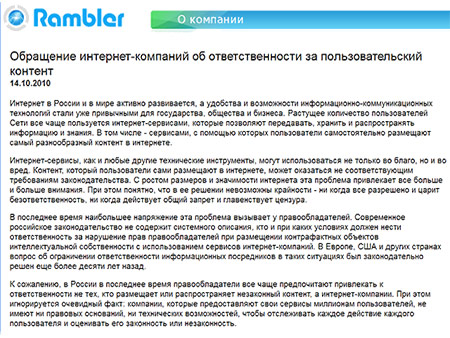
Leading Internet companies in Russia - Google Russia, Mail.ru, VKontakte and Rambler - published an official statement of responsibility for user content.
In this document it is noted that recently this problem causes the greatest stress among copyright holders. Modern Russian legislation does not contain a systemic description of who and under what conditions should be liable for violation of the rights of copyright holders when placing counterfeit objects of intellectual property using Internet companies.
In Europe, the USA and other countries, the issue of limiting the liability of information intermediaries in such situations was legally resolved more than ten years ago.
Unfortunately, in Russia recently, copyright holders are increasingly preferring to bring to justice not those who place or distribute illegal content, but of the Internet company.
At the same time, the obvious fact is ignored: companies that provide their services millions of users have neither legal grounds nor technical capabilities in order to track each user’s action and evaluate his legality or illegality.
Companies provide users with a technical opportunity to exchange information, store and look for it. To be able to place and store their content on our servers, users accept the terms of user agreements, in accordance with which they undertake not to create and not place illegal content.
At the same time, unscrupulous users violate both providers' rules and the law. Companies take measures to terminate the offenses that it becomes known.
Standard response schemes for complaints and statements about violations of the rights of third parties that users make using services have already been adopted. Upon receipt of a reasonable notification containing the exact address of the disputed material, the provider for a reasonable period suspenses access to it. The service operator can inform the user about the fact of calling for a violation of copyright and related rights.
If the user does not agree with the claims, he can send a counterclaim, stop being anonymous and report contact information. This information is reported to the copyright holder.
Thus, the copyright holder receives information about the defendant and may apply to the court. If it is decided not to notify the user or if there is no counterclaim from the user, the contrast content remains blocked or removed. With this approach, the owners of Internet services should not be responsible for the content posted by users.
The company signed the company appealed to the copyright holders with a proposal to use the existing mechanisms to terminate the violation of copyright and related rights. In their social and technological level, these mechanisms correspond to those decisions that are used in the global information space.
In addition, they turned to the Russian legislative bodies with a proposal to distinguish between liability for violations of intellectual property rights on the Internet as soon as possible, in particular, having fixed the current practice to apply the response procedure as a criterion for applying liability.
When taking legislative measures and in law enforcement practice, it is necessary to comply with the balance of the rights of all interested parties: users, copyright holders and operators of Internet services.
They also called on other companies and organizations separating this point of view to join this appeal. The document was signed by Vladimir Dolgov, General Director of Google Russia, Dmitry Grishin, General Director of Mail.ru, Pavel Durov, General Director, VKontakte, Nikolai Molibog, General Director of the United Company "Afisha" and Rambler.