
Translated material
Puppet house
Light boxes of Marina Alekseeva
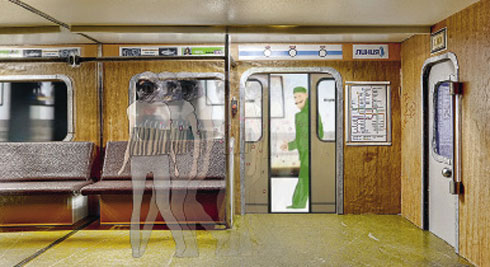
Lightbox "Metro". Take a look at the passengers, and the theme of the toy will not seem a puppet house. The works of the St. Petersburg artist Marina Alekseeva made a splash at the international exhibition-fair of contemporary art Viennafair. Light boxes with mysterious holographic characters in a real interior - what is their magic? - Learned The New Times
Lightbox is a memory of girlfriends of “secrets”, from the improvised means of the created beauty and secrets, and the love of the game with the usual concepts, when “far” suddenly gets close, and “outside” turns out to be inside. The first experiment was held in Germany. On a huge wheat field, Marina made many “secrets” with reproductions of Shishkin’s paintings, with dense forests and snowy Christmas trees. And hobby in small forms began with a chair, or rather, a chair. She cut it out of paper, glued, put in a box. At first, it was only fun-the objects, outwardly similar to a theater layout or a doll house of the most unexpected materials and means-either a large “secret”, or a small diorama.
Life in the box soon the interiors from toy fantasies turned into a place of event. The bedroom of the former hippie, homeless, secular cuisine, temples of all world religions, different museums, state institutions, from the Ministry of Defense to prison ...
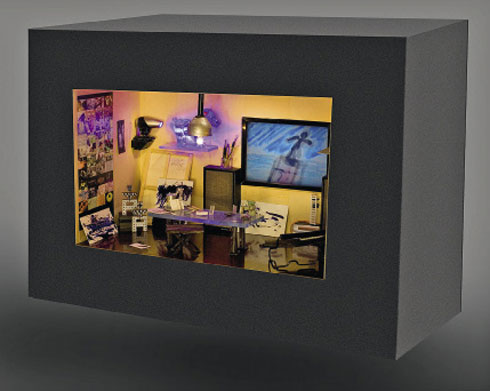
Lightbox “The Room of the Artist” and then her husband Boris Kazakov, a well -known underground cinema in St. Petersburg, joined Marina. A video crew appeared in the houses. He began to show the TV, in the train compartment a landscape flashed outside the windows. The new stage began when Marina met with engineer Sergei Karlov-he liked Alekseeva’s artistic ideas, and he came up with a special glass coating to which the image is transmitted by a mini-design. So in black strict boxes appeared a multiplier character with his voice and a melody, a ghost character that moves.
All this is done for a long and difficult. We need to come up with and create an interior, make a video, and the most difficult thing is the technical part, all these diodes and so on. Ready -made work - wonderful, luminous, “living” boxes - do not linger with Marina, leave immediately. In museums, private collections, to exhibitions. They are crazy popular. Alekseeva trusts the namesake-St. Petersburg galleryman Marina Gisich at the exhibition at exhibitions-fairies of Alekseeva. In February, at the famous ARCO Fair in Madrid, Alekseeva, the Barcelona Modern Art Fund, the Argentinean Fund of Modern Art, bought collectors from London and one Spanish artist. Before that, mysterious houses conquered Moscow. At the Art-Moscow Fair, long lines were lined up for Alekseeva objects. Elton John bought Lightbox based on Dostoevsky’s “Crimes and Punishment” - it was from him that President Medvedev, admiring the “high -tech art”, was delighted from him at the exhibition in the Multimedia Museum.
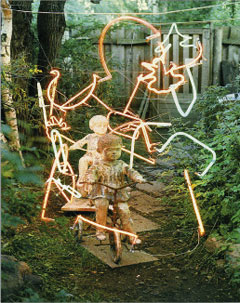 |
| "Girls". Installation |
The village of artists Marina is not only "boxes". In April, he and Boris Kazakov for the minibus project received the Sergey Kurekhin Prize “Pop-Mechanics” in the nomination “Art in Public Space”-for the search for new forms of art interaction, provocation, improvisation and unpredictability of the creative result. Many of her works - painting, sculpture (now here are lightboxes) - is in the Russian Museum, the Moscow Museum of Modern Art, in the Aivazovsky Gallery in Feodosia, in museums and private collections in Europe and America. Today's popularity, however, made it sacrifice it to many - temporarily postponing an exhibition in my hometown, its own gallery, a magazine. The house, in the end, is the famous house on 6 Novoselkovskaya Street, - the address of "Media Holding" "Rural Life".
This house is part of the villages of artists in Kolomyagi near St. Petersburg. In the 90s in several houses scattered around the former summer cottage, painters and sculptors settled. In 2010, in the Manege there was an exhibition “Villages of Artists”, where the green lawn, invented by Marina, became the main exhibit.
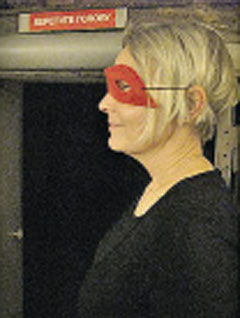 |
| Such an artist represents herself |
Today in Kolomyagi, there is less and less greenery, there is a large construction. But the hundred-year-old wooden house (by the way, the former house of the tomb) looks much more convincing than toy cottages of comfort class.
In the largest room with stucco molding and black piano, saved from the Titan cinema, re -profiled to the restaurant, the non -profit gallery "Rural Life" is located. Under the windows of the house - a constant exposition of works of different artists. Among the outlandish abstractions, red heads of roses are distinguished above human growth from epoxy resin - the work of the Berlin artist Sergey Alexander Dott.
The house is always full of people. Artists, filmmakers, musicians like to come here. In the summer, among oaks and lilacs, they arrange mini-festivals in the open air, film screenings on sheets.
Marina is also the publisher of the magazine "Rural Life". A stylish art magazine in which there is no editor column, but there are original author's texts, excellent reproductions, and even DVD. All numbers are thematic: about Moscow, about love, about animals ...
An animals in this house is a particularly reverent attitude. Once Boris repulsed the wounded squirrel from the raven and brought home - in general, die. But the little squirrel did not want to die, came to life and settled on the veranda under the name Tolik. A year later he was taken to the forest. And the squirrel became the totem of Marina - in the Hermitage, an exhibition of her monochrome work “Black Squirrel” took place.
So they live-in the rented territory, but in a businesslike way. And do not understand where they have life, and where is art.