
Translated material
The spirit of forgiveness
The Chekhov festival began "Storm"
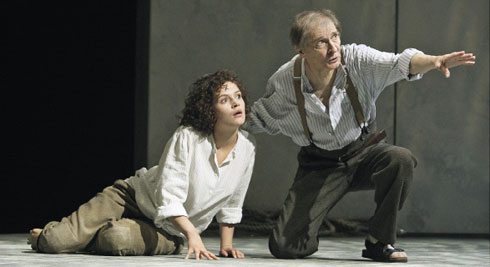
Prospero (Igor Yasulovich) and his daughter Miranda (Anna Khalilulina) The spirit of forgiveness. International Theater Festival named after A.P. Chekhov in Moscow was opened by a call for mercy: such was the main message of the Shakespearean “storm” that opened the British Declan Donnellan Chekhov Festival over the years of its existence (this year it is held the tenth) acquired its own traditions and talismans. The Englishman Declan Donnellan is the same constant as the Chekhov logo (hat and pince -nez), decorating all the festival posters. Over the years, Donnellan has formed his own Russian troupe with which he made four performances, and everyone became a real event: “Boris Godunov” (a brilliant duo: Godunov - Alexander Feklistov, Grishka Otrepyev - Evgeny Mironov), a hilarious “Twelve Night” (performed exclusively by men who played and female roles), and dramatic “three sisters” and three sisters and three sisters and three sisters and three sisters and three sisters and three sisters and three sisters and three sisters and three sisters ”and The current "storm". The path from the acute -social, explosive "Godunov" (the premiere went against the backdrop of a change of eras, when the aging king pointed us to the young successor) to the humanistic, all -precipitum "storm" "Our" Englishman passed with us.
The inhabited island is one of the most mysterious, incredibly complex for the production of Shakespeare's plays in the theater of plays, the director placed in an absolutely empty space, surrounded by white walls with three doors, and deprived acting undergrounds - no scenery, nor historical costumes (artist Nick Ormerod). Magic (after all, Prospero-a wizard!) In the play, organizes live music and video installations from bizarre panoramas of the raging ocean and mysterious forests.
Prospero (Igor Yasulovich) - quite earthly, burdened by the wisdom of the world, an old man, as if consciously chasing himself into a void of loneliness. Once upon a time, on a deserted island (Bermuda!) Together with the little daughter and pile of magic books, he has been cherishing the idea of revenge on his enemies-brother Antonino (Evgeny Samarin) and King Alonzo (Mikhail Zhigalov) for many years. But when the enemies are before his angry eyes, the dream of retaliation dissolves in the air, giving way to generosity and mercy. And these unfamiliar feelings that Prospero discover in his heart first surprise him, and then become his essence. Prospero, incorrigible romantic, tries to cure evil as a shameful disease - either with the help of music, then with the help of the theater, then with the help of exhortations, then with the help of psychoanalysis (immersing his enemies into the abyss of insanity). Having moved all possible means, Prospero comes to the conclusion that “mercy is stronger than revenge”, and removes magic spell from his offenders. Forgired, they gain human appearance and realize the entire degree of their villainy. So simply decides Shakespeare, and with him Donnellan, the question of a crime and punishment.
The living water of the concept of honor, justice, freedom, love, fidelity in the “storm” are brought to the Absolute - each of the heroes passes its own path of purification, it is no coincidence in the performance by one of the main characters. Water falls from the sky, pours from copper jugs and basins, splashes out of aluminum buckets, spilles on the floor, and the process of washing the young Ferdinand (Jan Ilves) even becomes a separate significant episode. Water does not concern only two characters - Ariel (Andrey Kuzichev) and Calibana (Alexander Feklistov). And in this selectivity, its metaphorical meaning is also laid: Ariel is the spirit of air, an incorporeal, unequal angel that is clean from birth, his soul does not need adjustment, his freedom does not tolerate restrictions. Caliban, on the contrary, is a genetic slave, a savage capable of exclusively to slave work, which does not represent his life without chains and iron bowls. Leaving, Prospero deprives the caliban of the tongue and articulate speech - the gift that he gave him at a meeting, hoping to make a person out of the monster with the help of knowledge and education. But this is the only miracle that he failed. The slave is not treated with freedom.
Half -horses, half -skins attempt to actualize a magical and terrible Shakespearean fairy tale causes a condescending smile rather - the signs of today are too obvious, too straightforward analogies. Male expensive costumes, brilliant ties, cigars and cigarettes once again recall that a person does not change - mods and habits are changing. The material temptations, with the help of which Prospero stops the conspirators, has not changed much since Shakespeare. Instead of the “beautiful dresses” mentioned in the play, we see store hangers with men's clothing “from coutur”, a jewelry counter, sparkling with diamonds and gold, sophisticated mobile phones and gold credit cards, which are so pleasant to spend on the food apparatus and reverently look at the crawling check with a fabulous sum.
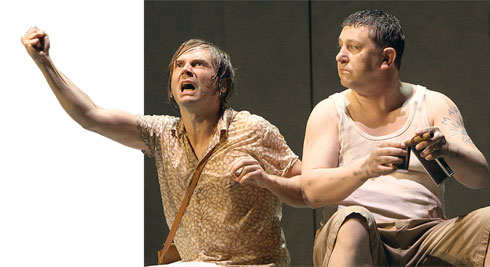
Vitriors-Glugs Trinkulo (Ilya Ilyin, left) and boatswain (Gela Meskhi) traditional for the Shakespeare's fairy tales, the villains-vilups, in contrast to the villains-intellectuals, the Donnellan act as carpet-a long shy Trinino (Ilya Ilyin) and brutal thunder with a “Marina” on the shoulder of the Botsman (gel ” Meskhi). The fools who imagined themselves to be the overlords of the islands, dressed in expensive clothes, hung with expensive tsatski and scaring away with their disgusted mud, are doomed to execution, which will inevitably follow. Since morality says: never trust the slave, even if he is ready to recognize you as his master.
Caliban at Alexander Feklistov is pure quasimodo, only devoid of mind and heart. But even in this subhuman, something similar to feeling wakes up in the final: suffering covers him when parting with Prospero and his daughter Miranda (Anna Khalilulina).
The roles of half-people, after the afternoon, play is incredibly difficult. Can the "spirit of the air" not fly? The role of Ariel in the production of “storms” is usually given to thin girls, trying to emphasize the infernicity of the image. Andrei Kuzichev at Donnellan Subonk, flexible and noispery, but with all the incorporeality of him, some hidden powerful force comes from him, capable of managing not a person-humanity.
For all the multi -ghostness (in the “storm”, the melodrama, and a fairy tale, and thriller, and vaudeville, and ancient tragedy, and social drama) are fit in Donnellan in “storm” turned out to be closed, as if fastened with all the buttons. This restraint, on the one hand, inhibits the action, and on the other, it allows you to accurately place accents and carefully listen to the main semantic episodes. As always accurately distributed artists according to functions and types, traditionally introducing several pop jokes into the plot fabric (people-dolls in the images of village women with ears of ears and dashing Russian men with sickles), Donnellan still sacrificed an acting ensemble and spectacularity. In the name of the important that Prospero tried to say:
Prayer, mental humility
Rushes condescending in judges.
All sinful, all forgiveness are waiting.
May your court will be merciful.
In today's Russia, these simple words sound more relevant than ever. But did the director know about this?