
Translated material
Brainstorming
On June 1, the participants in the international publication Scientific American almost the whole day were engaged in domestic affairs (conditionally internal, since their zone of responsibility is almost the whole world). Their meetings were held at the Haitt Hotel, in spacious security with tables placed square. The Americans performed the moderators in the discussions, but in fact no moderation was required. Coming out of the discussion began with a certain introductory performance, a short discussion of groups in an undertone with neighbors and, finally, who wanted to live in an undertone, but without apparent conflicts expressed considerations.
“Our meeting today was mainly brainstorming (Brainstorming),” said Michalvoss (USA). - We discussed different development options that our editors proposed. Everyone talked about how viable these options are; They promise to be the most successful; Which prevents the achievement of success. Brandsstorming is a very important part of the process. Some ideas are already ready to test them in the market. And other ideas have just appeared - and this is the first step in any undertaking. After that, we are coordinating with colleagues how to misery to business. ”
When asked about the question that it may act independently, without coordinating its own minibats with the rest of the group, the OSS replied: “We are completely inhibiting the editorial office of each edition. They all understand the significance of the Scientific American brand all over the world, but at the same time, they know better readers and their own market. And they know what to offer their audience, and so that the reputation of the brand does not suffer from this. And of course, if we hate that one publication successfully implemented the project, this can then be used for other publications. So the success of one edition can be divided by the whole group. And finally, the ideal option is when some initiative can bring to everyone at once. ”
“In general, today's Vrekhchi was very good,” he summed up. - In the morning, we discussed our strengths and weaknesses, opportunities and risks. This group of issues was versed in the publication. And this is important, because it often turns out that different editions are getting sick with the same problems. For example, these are questions related to the introduction of young readers and how to interest people of advanced growth. It also happens that, say, similar problems arise in the Spanish Nemetsky publications, and in Brazilian and Italian - completely different. And again, these are very useful discussions, because, like on any other forum, who can come up with a solution.
In the afternoon, we contributed to various innovations that have already entered into force in some kind of jack, while others are only going to apply them. And the final part is my beloved with your own braming. Four offers have already appeared there, which have been for new considerations. And most importantly, the result of these discussions may be very different from the original plan, but the process has gone. ”
Only Professor Adnan Khamui (mathematician, editor -law of the editor -in -chief publication) did not take part in a lively discussion. When asked why, he replied that when his collegial enthusiasm is discussed, he has nothing to say, since he is engaged in more the content side of the matter, and the business as such does not interest him.
By half -past six, the meeting fell, and representatives of the publications were divided. Four, led by Davidsuinbanks, were preparing to conduct a master class in “Pies on the Sretenka” (you can already find an online broadcast record at the link, soon the story of how the summit participants took this conversation, then-the styling and mounted discussion video). The rest began to gather in a man to go on an excursion to the Polytechnic Museum.
Taking advantage of this, we managed to talk with the representative of the Spanish edition - Lucia Ferreiros. Like the somewhat participants in the summit , she noted that this summit is significantly exhausted from the usual ones, because thanks to additional events, the editor -in -one was a more detailed idea of the country where the meeting takes place. The sentence about why, in her opinion, this time the meeting was chosen by Russia, she replied that for a variety - there were no meetings for a long time (previous in 1985). Mostly Lucia Ferreiros was pleased with good weather and friendly and adverse people. “And the first event seemed very interesting to me - the meeting in Rusnano. There we learned how Russia invests in worthy projects. Ima, of course, will make a review in our journal dedicated to what is happening in Russia. ”
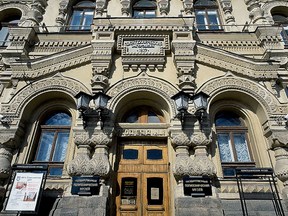
The Polytechnic Museum -Jacob was after the end of his official working day. Therefore, only a few halls were opened for the guests and offered to hold a blitz-excursion on them. They showed halls with microscopes, holograms, layouts of various power plants, as well as an astronautics hall and the “ Musical Casket ” exposition. The visitors clearly did not want to listen to visitors and were indisciplinedly scolded by the surrounding halls, trying to independently study the exposition using the anglaxic descriptions hanging near the exhibits.
The microscopes of the IElectual Power Position did not cause much enthusiasm, but the Cosmonautics Code attracted attention. The museum’s employee said that foreigners are always interested in the Hall, unlike Russian visitors who more like the exhibitory of the musical box. Of the current guests, only the most -energy ones got to the casket. The rest sat in the neighboring hall and resting the expectation of the next conversation - a meeting with the director of the Borissaltykov Museum.
Bogumil Bowze from the Czech Republic of the post -playing acquaintance with the museum said:
“A very good museum. Russia (USSR) is the first country that sent a person into space. And, of course, I was very glad to see here part of the exposition dedicated to the astronautics. By the way, it was very interesting to see the spacesuits of the Intersmos program there, because the third country in the world that sent a person into space was Cheroslovakia. The first foreign cosmonaut of the program was our cosmonavladmir Remek, who worked with your cosmonaut Gubarev.
Now in Prague, a passage dedicated to the anniversary of Gagarin's flight. And there, in the planetarium, there is a Masta-1m, an exact copy. You can climb there and get an idea of how Yuri Alekseevich felt. ”
He also liked the head of the head (“Whoever does not see, will not believe,” he said).
“To everyone who is interested in a woman, I would advise you to go there,” Bouise added. -Because in the last world this interest is not enough. But the more interest, the, I think, we will get more high -quality work. One thing is only upset. The museum is very beautiful, but few Moscow guests know about it. All tourists know about the Kremlin, about Swan Outoozero, about many other beautiful things that can be seen in Moscow. And the museum does not know. For example, I did not know about him. Therefore, I am especially glad that I managed to see him today. ”
Boris Saltykov immediately took up the tone and suggested holding a meeting in the format of questions and answers. Strongly, he presented the Polytechnic Museum as a significant discussion platform, and also said that in the period from 1991 to 1996. He was a Russian science in the team of Gaidar. “And, of course, I was the main enemy community, because I destroyed the Soviet approach to science. You will go to the Russian Academy of Sciences, they will tell you there that Saltykov ruined the Academy of Sciences. And my position was as follows: you, academicians, need reforms ”(a trip in the wounds of the summit of the summit is really planned - and the next day).
Saltykov also told the planned reconstruction of the museum. It should begin around 2013 and end by 2018. This project onnazed by provocative, because the topic causes a lot of disputes: some (includingasaltykov) want to carry out a capital modernization, while others want to be all over as it is. “Our actions,” he said, “often do not use popularity among people of old hardening.”
Saltykov’s questions were lively. They asked about the leak of the brain in the 1990s; About the modernization of the museum (it was the answer that now the uniforms of European museums are being considered, which could become a model); about which one is allocated for reconstruction; About how the budget of the museum will be planned and what it is now; About whether he is familiar with the current mini -construction and science. It was already about nine o’clock when Michael OSS said that the bug would have to move to the hotel. After that, everyone got up to leave, but all the same for some time they continued the conversation.
June 2 - the last day of this Sammit Scientific American. The guests will have a final event of the Slovy Wendular Company, but in the Russian Academy of Sciences. Some, however, have already begun to travel, because editorial work requires their appropriation. Claudia di Georgio (Italy), which should leave earlier, summed up her visit to Russia as follows: “The meeting that has just taken place is the most suitable completion of my trip. I will not be able to attend events. She was suitable, which was unusually interesting. You can’t come to someone else's country in a day and pretend that you understand everything. But now, perhaps, I had more tools to try to understand what is happening with the Russian -Nauka and what role it plays in the country or could play. And it was interesting. Honestly, much more interesting than I expected.
We saw different things, in Tomcyry participated in very official events, for example, in Moscow State University . And here we were the opportunity to ask questions, and we received answers. In the 1990s. The former stories about why scientists are leaving the country. And now it’s interesting to think about how the scientific tradition will survive. This is interesting to us, Italians, because because the state and the market are common problems for all Vevrop. This is not only a Russian problem. In Italy, for example, the question is very acute about who will pay for what; What kind of science do we need; what science we will finance. So it’s very interesting for us to learn more to the country in which such large -scale transformations occur. ”
About the first days of the Scientificamerican summit, see “Firsthags” and “News from Vorobyevogor” .