
Translated material
Timely murder
In the new article of the Russian-American sociologist, doctor of philosophical sciences, Boris Doctorov, the analysis of the presidential election campaign in the United States 2012 continues. In his previous articles [ 1 ], [ 2 ], he summed up the results of the February and March observations of the progress of the election process and concluded that US President Barack Obama retains quite high chances of the re -election. This article is dedicated to the results of April and May.
1. The worst month for Obama
Let's start with history ... January 2, 2011, half of the Americans (50%) approved the activities of the president (respectively, the trust index was 50%) and four out of ten (42%) did not approve. Until the beginning of April, the share of adults, positively evaluating Obama's work, ranged from 44%to 51%, but in general it was higher than 45%.
At the same time, a negative attitude to the activities of the head of the White House shared from 47% to 51%, although most of the three-month interval of the share of non-approved was below the 45 percent mark. And what is especially important, in all this time only in a few cases 1-2% was recorded an excess of the share of Obama critics by the percentage of his supporters.
On April 9, the picture of the dynamics of the index in question has changed qualitatively. From this day until April 29, the share of Obama who approved the activities of Obama was less than a share of those who did not approve. In the middle of the month, this difference for several days reached 7-9%. The similar behavior of the trajectory of this index was observed only in August 2010.
Experts unequivocally explain the incurred economy in April, a noticeable increase in prices for food and gasoline, and a general decrease in optimism in the vision of the near future.
For almost thirty years, Gallup has been studying the opinion of Americans regarding the priority of solving environmental and economic problems. In 1984, six out of ten respondents (61%) believed that for the sake of maintaining and improving the environment, some restraint of the country's economic growth was permissible. The opposite point of view: the development of the economy is priority, even due to a certain deterioration in the ecology, it was half the share of the respondents (28%). Over the next twenty years, the first indicator decreased, the second grew, but in general the Americans adhered to a pro -ecological installation. At the end of the first decade of the new century, the severity of economic problems led to a noticeable growth of pro -economic views. So, in early March of this year, over half of the Americans (54%) preferred the development of the economy and a little more than a third (36%) - ecology.
In January of this year, 41% of the Americans believed that the economic situation in the country was improving, at the end of March there were only a third (33%). A decrease in economic optimism was observed in all groups of the population, even among those whose income exceeds 90 thousand dollars a year. In January, every second of them (50%) noted an improvement in the economy, according to the results of March - only four out of ten (41%).
At the end of the first decade of April, in a long list of problems, the most exciting Americans, the first three positions were occupied by economic ones. A quarter of the population (26%) spoke of the country's economy as a whole, a fifth part (19%) - about the level of unemployment and another 17% - about budget deficit and public debt. Such a high share of people, concerned about the state of the budget and the amount of national debt, has not been observed since 1996.
In the 20s of April, several more than half (55%) adults stated in the country signs of recession or depression. It is not surprising that such an assessment is determined by the income of a person. In a group with income above 75 thousand dollars a year, such a depressed state of the economy records every second (52%), among earn from 30 to 75 thousand dollars of one 55%, and in a mass of poor (up to $ 30,000) - two -thirds (66%). It is less obvious, but the conclusions of many experts are consistent with the fact that the assessment of the state of economy in the country is determined by the political attitudes of people. In the camp of the Republicans and in the most conservative wing of this party, the supporters of the “tea party”, the presence of signs of recession and depression are noted by seven out of ten (68%). Independent voters are less critical, the suppressed state of the economy is recognized by 57% of them, among the democrats, there are four out of ten (43%).
The April dynamics of the approval index is characterized by the following “Record”. On April 13–15, were a period of the lowest value of the Obama approval index (41%) for the entire time of his presidency, i.e. from January 20, 2009.
2. Murder of Ben Laden
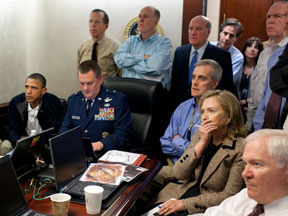
The attitude towards Obama changed dramatically after his speech on May 1, when he informed the nation about the successful military operation in Pakistan and the murder of terrorist No. 1 Osama Ben Laden. The very next day, 93% of Americans approved this action, and 79% recognized what happened important to increase the country's security. According to almost two -thirds of the respondents (60%), the murder of Ben Laden was preferable than the capture of it alive, but a third (33%) was the best outcome of the operation.
By May 4, Obama's activities approved 52% of the country's population and 40% did not approve, and a similar statistics of opinions were in surveys conducted on May 5-9. In general, these were the days of the highest in the last 52 weeks of recognizing the work of the current president.
First of all, I note that not all observers foresaw the positive impact of the successful military operation on the attitude to Obama, there were statements that the death of Ben Laden would not affect the perception of the president’s policy and the development of the election campaign. On the other hand, analysts had no reason to expect a significant and prolonged manifestation of the so -called “halo effect” (Halo Effect), when the achievements of the president in the same area (the fight against terrorism) would significantly affect the general assessment of his activities.
The appeal to the past shows that the strongest “Ore effect” was the result of the events of September 9, 2001, then the index of approval of the activities of the President Bush-ML took off by 35%, and its value returned to the original only after 105 weeks. If this unique case is excluded from general statistics, it turns out that on average the effect of the successful international action of the president is 13%, and it is observed within 22 weeks. For example, in the case of the capture of Saddam Hussein, an increase in the approval index was 15%, but after seven weeks the effect of this jump “melted”.
The winnings of Obama from the operation in Pakistan turned out to be noticeably lower than the average and, according to many, the approval index of his activity was to soon return to the mark of 45% and continue the fall. First of all, this was explained by the high level of polarization of the attitude towards Obama: the Democrats actively support him, and the Republicans - just as actively do not accept his initiatives. In addition, for almost 20 months, the value of the index remains in a narrow interval of 45-51%.
Rasmussen Reports analysts proposed his explanation for the “short echo of the success of the destruction of Ben Laden: we are talking about the increased sense of security from external threats. In the second half of May, only 8% of respondents attributed the issues of national security, such as the war against international terrorism, to the most important, determining them today's electoral attitudes. This is 20% lower than on the eve of the election day in 2008, when Obama won, and 41% lower than on the 2004 election day, when Bush ML was re-elected.
Nevertheless, the Silver Nila model analysis suggests that a single percent “supplement” to the Obama approval index, caused by the destruction of Ben Ladan, will be preserved until the election, respectively, and this “one percent” will not turn out to be its republican opponent. According to Silver estimates, an advantage of 1% in each state can provide a noticeable increase in Obama supporters in the electoral team. The study of electoral statistics allowed Silver to argue that after the Civil War (1861–1865) there were nine presidential elections in the USA, in which the loser of a candidate could win if he received 1% more in each state, and his opponent - 1% less. In modern times, this is exactly what happened in 1948, 1960, 1976 and 2000.
3. Democrats are tired of waiting ...
The heading of this section began one of the recent articles, which discusses the reasons for the slow entry of the Republicans into the 2012 election campaign. Among the reasons for this behavior of politicians who have to fight first with their one-party members, and then with Barack Obama, is not primarily noted by the presence of serious socio-political and economic problems experienced by the United States.
It seems that applicants for the leadership of the country have not yet found those instruments of their permission that could present to voters. There is a lack of many potential candidates for president of experience in international politics. The Republican Party is experiencing a shortage of ideas, slogans that could be cemented by their very heterogeneous electorate, it is not clear how to interest independent voters and, moreover, how to persuade the democrats who do not feel satisfaction from the activities of the president who have chosen. In addition, difficulties were clearly identified with the formation of the election fund; In the absence of a clear, outwardly attractive election program, it is difficult to find a sufficient number of wealthy donors. And apparently: no one wants to lose Obama. For elders, this is a departure from big policy, for the younger ones - a sharp decrease in the chances of winning the 2016 presidential election.
This year, the organization of Gallup, when tracking the relationship of a potential republican electorate to politicians who declared his intentions to participate in the struggle for the White House, uses two scales. The first is “knowledge of politics” (the share of the respondents who know his name) and the second is “the severity of a positive attitude”, i.e. The difference in the shares of a highly favorable and extremely unfavorable attitude to the policy of those who know him.
According to the results of a series of polls, in the first decade of April, the five most famous politicians formed: Sarah Paylin (its name was familiar with 95%of respondents), Newt Gingerich (86%), Mike Haccabi (85%), Mitt Romny (83%) and Ron Paul (70%). They were noticeably inferior: Michelle Bakhman (53%), Rick Santorum (42%), Haley Barbur and Tim Paulleti (40%each). The fame of other politicians was 12-31%in the range. As for the positive attitude (I repeat those who know the name of the politician), the obvious leader was Khakkabi (27%), followed by Bakhman (20%) and Romni (17%).
A month passed, Khakkabi retained the highest value of the index of a positive attitude (24%). Further, with a noticeable lag, the activist of the “tea movement” Bakhman (20%) and Payelin (18%) followed. Romny (13%) - occupied the average position among 13 politicians who attracted attention; The assessment of Gingrich (11%) was even more modest. But the least positive was the attitude of a pronounced electorate towards Donald Trump, whose name was known to almost everyone. Equal proportions of voters were very favorable and very critical to him, and therefore the average value of the index in question was for Trump equal to zero.
At the end of April, many of the republican politicians discussed did not enter the “path of the struggle”, but the group of leaders began to contract. On April 25, Haley Barbur, who was supported by the party elite and who could collect a solid election fund, “came off the path”. However, according to polls, he could count only 1-2% of the vote of future voters. Comments on Barbur's statement about non -participation in the elections were approximately like this: “Having figured out everything, he turned out to be smarter and more visionary than those who seriously“ put ”him.”
On May 16, Trump announced the termination of his participation in the election marathon. This did not cause surprise among the observers, some of which noted that Trump's statements about his intention to fight for the White House were nothing more than the PR action of an experienced businessman and showman.
Unexpected for a significant part of the electorate and a number of experts was the exit on May 14 from the election process of Khakkabi, according to the results of many probes and political science constructions, which had good chances of being nominated parties to struggle for the presidential chair. He accompanied his statement with the words: “Everything says -“ forward ”, but his heart tells -“ no ” . Of course, a lot is behind this decision: the lack of confidence in the support of the republican hystblishment, the understanding of the inability to propose in the final part of the election campaign something that “interrupts Obama’s pressure”, difficulties in the collection of money. Some suggest that not the last role in the decision of Hakkabi was played by fees, which he receives as a leading current show on Fox News Channel.
Late in the evening of May 21, Mitch Deniels announced his decision to participate in the elections, who, like Barbur, was part of a group of politicians who had the right to count on the help of the Washington Republicans. It was considered the strongest among the party candidates in matters of the economy and, possibly, the only capable of attracting a significant part of independent voters to their side. He commented on his decision with the words: "The interests and desires of my family were the most important when considering everything." The explanation is stencil for beautiful departure from the political scene, but - it is clear to everyone - masking the true causes, partly regarding his personal life. Robert Shram, a super expert in a political analysis: “Deniels would be more than a Hamlet than president, after his departure from the electoral scene.”
By mid -May, in the absence of Hakkabi, the situation with the premiere in the team of Republicans became even more vague. Three politicians had approximately equal reasons to consider themselves the first. Payelin knew 96% of the potential republican electorate, and the value of the index of a positive attitude towards it was 16%. For Romny, the corresponding indicators were 83% and 14%, for Gingrich - 84% and 13%.
At the beginning of the third decade of May, new turns in the discussion about the favorite in the republican political space were indicated. On May 21, African American Kane, a businessman, a supporter of extremely conservative views, who could count on the support of the “tea party” entered the presidential race. He never occupied elected positions and does not belong to the republican elite. According to surveys, it is known only less than a third of the republican electorate (29%), however, in this strategic, the index of a positive attitude towards it is quite high - 24%. So far, no one is considering him as a person who can win in the primary elections, especially - to prevent the re -election of Obama.
Two days later, Kane entered the struggle former Governor of Minnesota Tim Paulleti. This was done not very carefully: in the newspaper The ST . Paul Pioneer Press published in Minnesota, his statement was published on the Necrologists page. According to a number of experts, Paulenti is an ideal compromise in the camp of republican politicians, but the problem is the absence of a powerful, beautiful idea that can light the electorate. In addition, he is an invisible person, his fame (40%) and the value of the index of a positive attitude (13%) is small, but so far it is not critical. He has the opportunity to change this alignment and successfully go through the primary elections if he reaches his own goal: "... to collect a sufficient amount of money in order to have at least a Buyk-umbrella of the campaign, if not a grid."
Buik-Ural, which includes the use of strategists, consultants, half stars, people communicating with the press, is a minimum of $ 40-50 million. For comparison in 2008, Rudy Juliani, the then republican right -flank, raised $ 55 million, but after a loss in Florida, he was supposed to abandon his presidential intentions. In order to collect a worthy financial fund by the end of December, Paulleti must personally meet rich donors weekly, but now all his forces and all his time must be given preparations for the primary elections in the states of Ayov, New Hampshire and South Carolina, which should take place from February 6 to March 5, 2012. The loss in these states will block him further movement.
In the meantime, the survey in New Hampshire, conducted on May 18-22, showed that if the primary elections took place now, then Romny would be the winner, he would have voted a third (32%) of the republican electorate of state. Payilin would support 5% of voters, and Paullets - 4%. The national survey of Gallup takes Romny to the leaders one more criterion: voters, primarily concerned with political and economic problems, give him preference; Those for whom the most important - social and moral, “their” candidate rather see Payelin.
Payeline has not yet officially declared her participation in the presidential election, but she is being done a lot to maintain its high popularity. In June, the premiere of a two -hour film about her, called “Invincible”, will be held, it may be the basis of her advertising campaign. Although Payelin can count on a significant part of the conservative electorate, the heroes of which until recently were Khakkabi and Trump, specialists do not highly evaluate its chances of instilling in the White House. She does not have to count on victory in television battles with Obama.
A survey conducted by Gallp on May 20-24 revealed a small advantage of Romny: 17% of the electorate believe that it should become a nominee for the Republican Party to the presidency; 15% and 10% - respectively, preference to Peilin and Paul. They are followed by: Gingrich (9%), Kane (8%), Paulenti (6%) and Bakhman (5%). A similar distribution of respondents' votes regarding the preferred nominees was recorded in a survey conducted after two days by order of the Opinion Research Corporation: Romni (19%), Payelin (15%), Paul (13%).
It is difficult to say whether the leader, Mitt Romni, has decided in the camp of the Republicans, in any case, this is very likely. However, in fact, the expectations of the Democrats continue.
* * *
The successful counter -terrorist operation and the murder of Ben Laden updated Obama’s presidential presidential, transformed the spirit of the president, gave him new forces and increased his authority in society. Otherwise, it is difficult to explain the fact that the survey, completed by Gallp on May 22, 2011, revealed a noticeable growth in the “Economic Trust” index. In May, it was constantly growing and for the first time since mid -February reached 25%. Another fact: in the second half of April, several more than one quarter of Americans (27%) said that the economy was improving, in a month there were more than a third (37%).
By the end of May, the "echo of halo" did not dissolve. The average value of the Obama approval index for May 22-24 turned out to be 53%, this is the highest value of the index over the past 16 months.
In general, the May dynamics of the index in question has a fundamentally different configuration than in April. The share of the president approved the work constantly exceeded the share of those who did not approve, and within a third of the month this gap was 10% or more.
The average value of the encouragement index for May is 50%, according to the N. Silver model [1], this means that 17 months before the vote day the probability of re-election of Barack Obama is concluded in the range of 66-68%.