
Translated material
Female share of Australopitics
The fossil teeth of the ancient human ancestors made it possible to conclude that once females, and not males left their families after reaching adulthood.
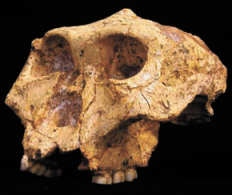
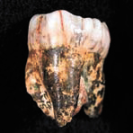
A group of European, American and Canadian anthropologists who published a new article in Nature magazine June 1, 2011 ( http://dx.doi.org/10.1038/nature10149 ) was based on the study of teeth 8 Australopitics (Australopithecus Africanus) and 11 paransic (Paranthropus Robustus), who lived 1.7-2.7 million years ago. The finds were made in two South African caves (in the north-west of Johannesburg) and are now stored in Museums of South Africa. The belonging of tooths to males or females was determined simply on the basis of their size, given that in those days the sexual dysmorphism of hominids was expressed even more clearly than now. The leading author of the study is Sandi Copland from the American Colorado University at Bowlder and the German Institute of Evolutionary Anthropology of the Max Planck Society in Leipzig.
Scientists analyzed the ratio of two isotopes of strontium (Strontia-86 and Strontia-87) contained in tooth enamel. These “signatures” allow with forensic accuracy to tie this or that animal to the area where it has grown, since the elements inevitably enter the body from the soil (through plants and further along the food chain) and are deposited in the bones during growth (in this case up to 8-11 years). For comparison, the researchers also studied the isotopic composition of 170 plants and animals (monkeys of the Babuins, antelopes, small rodents, etc.), living near the examined caves at present. It turned out that about 90% of large fossil teeth belonged to the local inhabitants, while more than 50% of small teeth can be attributed to the aliens (where exactly they came from before it was still clarified).
The "family behavior" of an ancient person has always remained the subject of speculation. To build plausible hypotheses, involuntarily, only indirect data are used, mainly the differences in the relative sizes of male and female fossil individuals, as well as the extrapolation of behaviors inherent in our distant relatives-primates. Females of chimpanzees and bonobo, for example, usually leave their social groups when reaching puberty, but in gorillas and other primates, everything happens exactly the opposite. Of course, modern people who are influenced by relatively recently formed cultural traditions (such as the Institute of Marriage and Private Property) are difficult to compare with our ancient ancestors. The opinion that the females became the prey of certain “clans” and therefore were led out of the house, most likely also erroneously, since millions of years ago it was not necessary to talk about any public organization. Most likely, “new” females were simply easier to incorporate into a new “family”, unlike more aggressive males.
In the future, anthropologists hope to expand the received statistics - to get at their disposal a larger number of Australopithecus remains from South Africa, to compare all this with finds from East Africa, as well as with the behavior of later species of hominids, such as erectus, Homo Erectus (a man is ease) and human ancestors themselves. However, the destructive nature of the tests (laser ablation) and the lack of fossils cause reasonable doubts about the success of this enterprise.
Maxim Borisov