
Translated material
Dialectics of principles
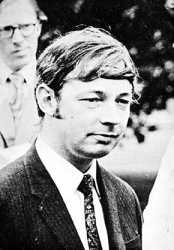
It is customary to think that the charms of scientific gerontocracy are associated only with the beyond the age of our bosses and that it is difficult for young talents to break through only with us. No, it happens “with them”. Less commonly, but it happens. The fate of David Clarke (1937-1976) is evidence. During his short life (did not live to forty), he released several thick volumes that turned world archaeology and became a sensation, but was just an assistant in Cambridge, worked as a tutor (a mentor obliged to regularly check individual classes of students) and died a day before the assignment of Rider (assistant professor). The department was in charge of the opponent of the new archeology Glin Daniel, whom Clark sarcastically criticized for his misfortune.
But a decade and a half after the death of David, in memory of him, memorial Clarkovsky lectures established him, for which archaeologists of Britain had to go on and to read the world's luminaries. I was honored to read the first such lecture, although due to the “bends” of my life, I then had no degree, nor title, nor position (and I was already more than sixty years old). Having received this invitation in 1990, I had two years to prepare. Of course, I decided to devote this lecture to the problem, which Clark was the most.
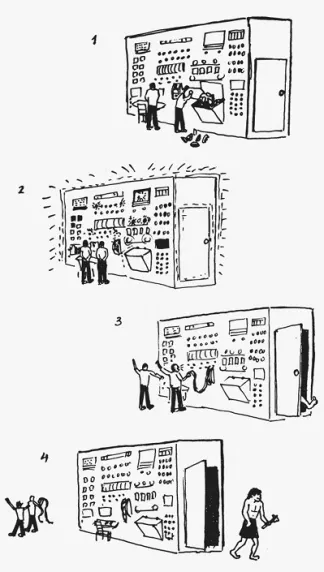
In the new archeology, Clark was considered the founder of the “analytical” wing. His main work of life was called “Analytical Archeology” (1968). Under the influence of new geography and analytical biology, Clark was carried away by the analytical philosophy of science - neopositivism. The idea of an “analytical machine” reigned there - a dream to create such a logical mechanism, such a set of methods that the material subjected to analyze automatically and inevitably leads anyone to the same conclusions. The idea itself is very attractive, well combined with the modern computerization of science, but, unfortunately, is poorly amenable to implementation and in its absolute embodiment, probably not realized at all. However, as a speculative ideal, this idea is quite productive, while trying to implement it, it was possible to improve the research methodology.
In the work on this "machine" you have to engage in the axiomatization of science (in particular, archeology), i.e. To search for those initial provisions, those principles, those axioms that underlie this science and from which all its theorems are logically displayed. So I entitled my lecture "Principles of Archeology." For archeology, of course, we can talk about the principles from which the rules of excavations are displayed, but archeology as such as the processing of material sources for history is primarily rested on the principles of interpretation. Ancient things need to be understood, interpreted their historical meaning.
There are two ways to identify such initial principles. One is philosophical: to build their system based on the general picture of the world, to logically substantiate this system, showing its necessity and completeness. The other is empirical: to identify in the real set of research those principles that propagate all others. Since I am not a philosopher, but an archaeologist and turn to archaeologists, I preferred the second way, more understandable to my colleagues.
But, sorting out a lot of archaeological studies and identifying these initial principles one after another, I suddenly noticed that for every principle, one can find another, exactly the opposite, from which much also follows in science. Take, say, the principle of actualism: now there are the same laws that acted in the deep past, which ensures the methodology of analogies - transferring modern explanations to the distant past. Without this principle, there is no archeology. “All archeology is an analogy,” said the subtle theorist of archeology Zhang Guanzhi. But no one canceled the principle of historicism: each era has its own laws, you cannot unconditionally transfer modern explanations to the deep past, you can fall into gross mistakes!
At the heart of archeology, I have built six such pairs. Determinism is opposed by indeterminism, and both can be supported by countless examples. Universalism is the opposite of partacularism, and both of these principles of organizing material and research are valid in archeology. The correlation of the material with intangible is also extremely important for archeology - otherwise archeology does not work outside the history of material culture, but after all, the polysemism of cultural objects acts and violates the desired correlation. The unity of the laws of the world (uniformism) determines the principle of actualism, and it, as already mentioned, contradicts historicism. Systemic ordering in cultural material is always sought and often located, but irregularity is characteristic of culture. Finally, archaeological material is usually enough for some conclusions, gaps can be compensated by related sources, but the archaeologist always recognizes the fundamental incompleteness of his material.
In this list, each of the fundamental principles is antinomic to another, also valid, also fair. I remembered Maxim Niels Bor, according to which the most important statements of science are so deep that the opposite are also true.
Apparently, this clarifies one of the reasons why the “analytical machine” in the absolute is not realized in science. On the other hand, this allows you to determine the main features of computerization to the extent that it is aimed at creating an “artificial intelligence” of a scientist. It is necessary to build it on the cooperation of two virtual machines, and to solve the contradictions underlying them, to provide a third car - to find the balance.
The analogy with the design of the human brain suggests, which has two different hemispheres, and the synthesis of their activity is carried out in an oblong brain.
I gave this lecture on January 26, 1993 at the Cambridge University Theater. The hall was full, everyone was in the mantles, I was alone without a mantle and just removing the bandages: our nineties were stormy, the bandits attacked me before leaving, beaten and robbed (they took a suitcase with things on the road and a computer). Nevertheless, I reported a lecture successfully, the hall noted it with long applause, the organizer of the entire event, Jan Hodder, a student of Clark, shone. It seemed to me then that he was happy that the event for which he was responsible was successful. Now I understand that his glee was also caused by the fact that he, even then the leader of post -processualism (postmodernism in archeology), was inspired by the main idea of my speech: after all, she questioned the renewment of the modernists to the direct logic of the explanation and the scentification of the study of culture. Based on this lecture in 2001, I published in Russia the book “The Principles of Archeology”.
This was probably my most successful day in science. After the lecture, there was a reception at the master (head) of Peterhaus - the oldest college of Cambridge University, but this is already material for memoirs (I describe it there - “It is difficult to be Klein”, 2010). And here I will end this story the same as I graduated and the lecture - a Jewish joke. A Jew came to the Rebbe and complained about a neighbor who took his son from him, announcing his boy. The rabbi listened and made a decision that the boy should be returned: "You are right, this is your son." Alarmed neighbor came running and outlined his claims. The boy was conceived in the first marriage of a woman, and it is enough to look at him to see who he looks like. The Rebbe said: "Yes, you are right, you can continue to raise a child." The student of the rabbi, who was present at this place, could not stand it and respectfully objected: “Rebbe, how so? Both are declared right, but this is impossible. The child can only have one father! " “And you are also right, my son,” there was an answer.