
Translated material
Communication with him was happiness
Memories of Professor Jacob Avadievich Birshtein
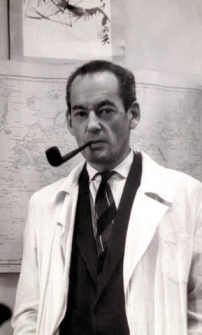
On April 7 of this year, a hundred years of the birth of Yakov Avadievich Birshtein (1911-1970)-an outstanding zoologist and no less outstanding university professor (Professor "should be written with a capital letter). Unfortunately, he died without living up to sixty. But in the memory of those who knew Jacob Avadievich, he remains alive forever. Narrow specialty Ya.A. Birstein was carcinology (the study of crustaceans), but the circle of his interests was much wider, covering many problems of zoology and biology in general. Its main works are devoted to the cave fauna (bio -spellology), the origin of the deep -sea fauna and zoogeography. As a carcinologist-systemic, he was primarily interested in crowned crustaceans-representatives of the ISOPODA detachment. This is one of the ancient groups of invertebrates, existing on Earth for at least 300 million years and has more than 5 thousand living species. The authority of Yakov Avadievich Birshtein as a specialist was unusually high. No wonder 57 species are named in his honor, and in addition - 5 new genera of different invertebrates. Such a list rarely boasts. This is a sign of special recognition of his merits by a community of professionals. Biography Ya.A. Birstein has not yet been written. Unfortunately, published memories are also few. Therefore, I try to write down what has preserved my memory.
I recall 1965. The biofac of Moscow State University, the room of a large workshop at the Department of Zoology of Invertebrates. Tables for students form two rows: one along the windows, the other - parallel to him, in the middle of the room. To the central row on the right, like the crossbar of the letter “T”, a table for the teacher is assigned. On it are open books and prints of articles. The course of lectures on zoogeography is read by Yakov Avadievich Birshtein. He is in a snow -white robe (then it was customary to conduct classes in a dressing gown), slender, lean, with chiseled facial features. During the lecture, he sometimes sits on the edge of the table, somehow cunningly twisting one leg around the other. I well remember this pose of him, it would seem uncomfortable, but very characteristic for him. Closer to the break from somewhere, pipe, pouch and a round box with tobacco are extracted from somewhere. Continuing to tell, Yakov Avadievich begins to perform incomprehensible for uninitiated manipulations with a tube. He wields some pieces of iron, fills the tube with tobacco, ramms it, prepares everything to smoke it. We, in turn, are fascinated, we observe all these movements, continuing, however, to listen carefully.
What Yakov Avadievich tells us is not in any textbooks. This is only in his head, and partly, apparently, in many articles and books read by him in different languages. Being 5th year students, we already understand this perfectly and try not to miss a word. Someone seeks to record everything, someone is completely given to the hearing. But there are no indifferent-for some reason everything told by Birshtein is always interesting.
The lecture manner of Yakov Avadievich was extremely simple, completely devoid of pathos, theatricality or any traditional oratory techniques. Yes, he does not need it. They listen to him and so. And they listen, because they feel with the guts: behind the simplicity of the form lies something deep, lurking unknown in itself and therefore not so simple. Sometimes Yakov Avadevich asked questions to which there was no answer, and this circumstance was specially emphasized by him. For example, in the zoogeography course, he talked about the works of L.S. Berg on the evolution of fish and other vertebrates, and from these works it followed that there was not enough time for evolution. Not enough, if we assume that evolution has gone at a constant speed - the same as for the last 500 million years, for which we have a paleontological chronicle.
In all conversations “for science”, Yakov Avadievich was never afraid to admit that he did not know or did not understand anything. “Damn him, why so!” This could be heard from him very often. Damn generally loved to remember. This was quite rightly written even in some article dedicated to the memory of Jacob Avadievich.
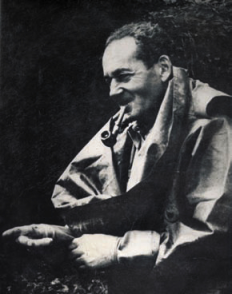
Speaking that Birshtein's lectures were devoid of theatricality, I am somewhat crafty. There was no theatricality as a kind of special form of behavior aimed at attracting the attention of the public, but there was natural artistry, and even what! Now I understand that Yakov Avadievich was damn beautiful, although then, in his youth, he did not recognize this. A model of male beauty was considered by Jacob Avadievich artist Robert Rafailovich Falk. This was said by the widow of the artist-Angelina Vasilievna Shchekin-Krotova. She accepted us, a small group of youth, in the workshop of Falk in the famous “Pertsov’s House”, the monument of modernity of the beginning of the twentieth century, not far from the Cathedral of Christ the Savior (though, then, in the late 1960s, there was no temple, and in its place was a public open swimming pool). Angelina Vasilievna studied with Yakov Avadievich in the same class - hence acquaintance. And the son Ya.A. brought us to the workshop Birstein - Vadim. He studied on a biofacment for a course younger than me, and we had many common friends. Knowing that Falk had a portrait of Yakov Avadievich, we asked Angelina Vasilievna to show him. The portrait was somewhat disappointed. Birshtein seemed not quite like himself. However, Vadim believes that this portrait, which is now in the Chelyabinsk regional art gallery, is not very successful.
Yakov Avadevich was an extremely sincere man, and did not hide his attitude to the environment at all. It is clear that this sincerity, inner honesty, combined with deep principles in all issues (both in science and simply in life), more than once interfered with his career. What is the story of the acclimatization of the multi -stroke worm Nereis (Nereis Succinea).
The idea of the resettlement of Nereis from the Sea of Azov to the Caspian Sea to improve the insufficient feed base of sturgeons spoke back in the early 1930s. In 1936, experimental work began, and in 1939-40. Under the leadership and with the direct participation of Ya.A. Birstein and L.A. Zenkevich was carried out by the transportation of worms. Nereis successfully took root in a new place, multiplied, and when, after the end of the war, the study at the Caspian resumed, it became clear that the results surpassed all the expectations - Nereis became one of the most massive fodder objects of sturgeon. In some places, intestines of caught sturgeons were simply stuffed with non -residents. Now, years later, we can fully consider that the introduction of Nereis, the newly new for the ecosystem of the species, was a rare example of the highest degree of successful large -scale experiment, moreover, with very important results in practical terms. The Ministry of Fisheries twice (in 1948 and 1953) nominated the work on the acclimatization of Nereis in the Caspian Sea at the Stalin Prize, which was then the most prestigious prize in the country.
However, there were spiteful people who were becoming by all means to denigrate researchers. The hydrobiologist N.V. was especially different. Lebedev, who sent real denunciations to the Stalin Prize Committee, which peremptorously stated that the Nereis seemed to eat in the Caspian of those invertebrates that were previously the main fodder objects of sturgeon. In fact, it was a direct accusation of sabotage. But in the yard, thank God, was still not the 37th year. And then Yakov Avadievich Zoogeography and other sciences would not have taught us. And although Lebedev’s arguments could not withstand any criticism, since they were not confirmed by real data, Birshtein and Zenkevich were forced to abandon all their affairs and defend themselves from unreasonable accusations. They wrote a detailed response to the department of science of the CPSU Central Committee (a copy of this document was kindly sent to me by Vadim Birshtein), and in 1956, Yakov Avadievich’s thorough article, where the results of a study of non-severe acclimatization in the Caspian Sea, was summed up in the “Bulletin of the Moscow Corporate Nature Treasury”. In the same article it was shown that the arguments of N.V. Lebedev, who by that time published an article in the “Bulletin of Moscow University”, are not based on real facts.
When they tell me that it is worthless to talk about the sins of people who are no longer alive (“about the dead - good or nothing”), I recall another statement that seems to me more fair. It belongs to the French poet and essayist Paul Valerie, and I heard him from George Georgievich Vinberg. It sounds like this: "We must be dead as alive, namely, the truth." It seems to me that the carriers of good and evil should be named. Yakov Avadevich suffered a lot in life. Fate was often unfair to him. But there were always those who really appreciated him and supported him. And this is not only the students who adored him, but also the senior colleagues. First of all, of course, you need to name Lev Aleksandrovich Zenkevich. When I studied at the department, one story was transmitted orally there. It was as if once for a long time Zenkevich and Birshtein were driving together on a tram and some type began to say something about the nationality of Yakov Avadievich. And then Lev Aleksandrovich (and he was a man of large addition and was distinguished by remarkable power) took the offender by the chest and simply put it out of the tram.
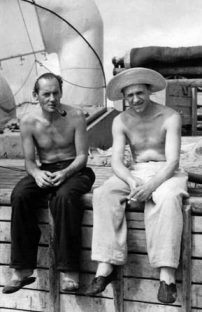
In the gloomy period of the Lysenkovschina, to which the “struggle against cosmopolitanism” (and simply put, the policy of survival of Jews from all significant positions), Yakov Avadievich was forced to leave the Moscow State University (more precisely, to remain only half a time), and the main place of work to choose the Yaroslavl Pedagogical Institute. The Yaroslavls, of course, were lucky, and Birstein is still remembered and honored there, but we must remember that he was not from a good life there. Then, thanks to the efforts of Zenkevich, he still managed to return to the department.
Of course, not only biology was interested in Yakov Avadievich. He was a highly educated person who is freely oriented in all world culture. I read a lot of fiction, I was well versed in architecture and visual arts (which was also facilitated by the fact that professional artists were his brother Max Avadievich and the wife of his brother-Nina Nikolaevna Voylina). In addition, Yakov Avadevich belonged to the, in fact, a little cohort of people who really love and understand poetry. He knew many verses by heart, and not only the most famous poets. He gave an epigraph from Leonid Martynov: the Publishing House of the Academy of Sciences of the USSR: the Academy of Sciences of the USSR, the north-wrapped crustacean (Crustacea, ISOPODA) of the northwestern part of the Pacific Ocean:
“I studied the sea bottom.
It is deserted and dark.
And it is embraced on it longing
Only a cockroach crawls sea. "
If you know that the “sea cockroach” is the official name of the large marine crustacean Mesidothea, the representative of the unit of equivalents (ISOPODA), then you understand how successful the epigraph is. True, the academic publishing house did not think so, and Yakov Avadievich had to convince the editors not to shoot the epigraph for a long time. But in the end it was possible to persuade, and the book came out with the epigraph.
The beginning of the summer of 1970 is the hardest for the department of zoology of invertebrates. In the hospital with diagnoses who do not leave hopes for recovery, are the head of the department Academician Lev Aleksandrovich Zenkevich and his deputy, leading professor of the department Yakov Avadievich Birshtein. Zenkevich dies on June 20, and it was decided not to tell Yakov Avadievich about this. I had to go on an expedition to the Lapland Reserve. Before leaving, I saw Yakov Avadievich for the last time in the hospital. He was lying under a dropper, strongly emaciated, overgrown with bristles. And the sharp features of the face were even more aggravated. When I looked at his profile, I was struck by the resemblance to the canonical image of Christ - this is how he was depicted on the canvases of the old Dutch and German masters. And the thought flashed - Christ was a Jew. Before that, I never thought about it.
Already in the reserve, he received a sad telegram from his parents: "Yesterday, Jacob Avadievich was buried." He died on July 8, 1970 many years later, in the memoirs of Yu.S. Selu (Veterinar, who knew well Ya. A. Birshtein), I read that Maria Veniaminovna Yudina played in the lobby of the Zoological Museum at the Panichid of Yakov Avadievich, who took place in the lobby of the Zoological Museum. When I found out, I felt some reassurance in my soul. It is good that farewell to the teacher was consecrated by musical genius. But M.V. Yudin was not only a great pianist, she was also one of those highly noble and absolutely uncompromising people, who were Yakov Avadievich.
Alexey Gilyarov,
doct. Biol.
Professor biological
Faculty of Moscow State University
All pictures are kindly provided by the son of Ya.A. Birstein - Vadim Yakovlevich Birshtein, now living in the USA, the author of several books on the history of Soviet science in the context of Tolitarism
(It is published in reduction. The full version is published on the website of the library of the Faculty of Biology of Moscow State University ( www.bio.msu.ru ) and will be printed in No. 8 of the journal "Nature" for 2011 together with other materials in memory of Ya.A. Birshtein.)