
Translated material
Sherche la lead
Business in French in the Lipetsk outback
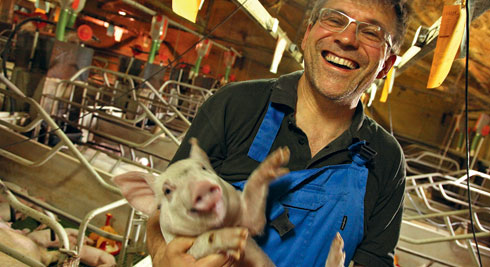
Patrick's love for pigs is purely commercial character by Sherche La lead. It is no secret that it is difficult to do business in Russia, especially to foreigners. But there are no rules without exception: 48-year-old Frenchman Patrick Hoffmann has been engaged in pig farming in the Lipetsk region for 6 years. How he succeeds - on the spot I found out The New Times, now you need to take a shower, ”Patrick warns The New Times, entering the passing pig -breeding complex. - Pigs smell badly, but need cleanliness. The biggest fear of the pig is the virus. " With the slightest infection, he explains, both pigs and farm are burned, as it happens either in the south of Russia, then in St. Petersburg, where a flash of African swine plate has recently occurred.
In the uterus - a room for sow and their offspring - it becomes clear for whom the shower was taken: dozens of elastic pink pigs with a desperate screech welcome the appearance of outsiders. Their parents, tiredly lying on their side, continue to feed newborn, not paying any attention to visitors. After 25 days, offspring will be taken away to grow up. Healthy piglets, oddly enough, are the result of artificial insemination. This process of the amazed correspondents of The New Times was demonstrated in the next room. In order for everything to work out, they carry out their beloved boars in front of the pigs, nicknamed the sufferer: he is never allowed to direct contact with pigs, using only as a pathogen. The rest is finished with zootechnics using catheter and bags with spermodosis. This method is much more effective than natural, Patrick claims: as a result, an average of 12 living piglets are born for one mark, which is very good according to international pig farming standards.
In the year, the company Patrick Hoffmann produces 26 thousand heads. Their fate, of course, is sad: animals go to massacre and meat processing plants throughout the Central Black Earth Region and to the Moscow region. Patrick, however, does not bother this: for him, pigs are not favorite pets, but just an object of business that allows you to make good money.
A large joy rise at 05.45, for breakfast - the French press and cottage cheese with salt and pepper: this is how it is accepted by Patrick in his homeland, in the town of Dal, on the border of Germany and France. The jeep is always ready, the daily route has long been verified: Lipetsk is the city of mud, where the office is located, and once a month - the village of Big Real. There is the French-Russian pig-breeding company Otrada Gen. Patrick came up with this name himself and believes that it sounds proudly. The word "gene" has a strategic meaning: females who are grown on the Hoffmann farm are tribal: a sowing of the landrass breed, crossed with a cartilage of the breed of large white, and then with a white durok.
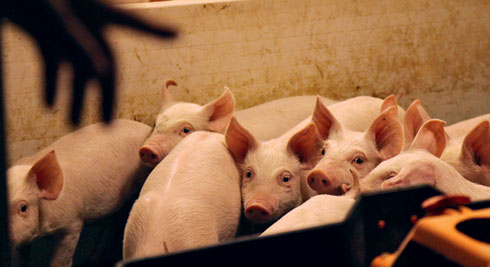
Piglets are susceptible to any infection and require round -the -clock care, but it is now the pigs are elite. Six years ago, in 2005, Patrick arrived in the Dobrinsky district of the Lipetsk region for the Otradny tribe and found 400 purebred sows, 80 boars and fifty workers: they did not receive salaries for a long time and took their slander, that is, pork. The workers were fired, the pigs were given to the massacre, the tribal was bought “for the ruble”, as Patrick says, and began almost from scratch. Patrika did not scare this: a former mechanical engineer, an atomic industry worker, then an investment banker, Hoffmann already knew from a familiar French businessman who sold sausages in Russia that it was profitable to invest in the breeding of pigs.
“Russia is a paradise for pig farming,” Patrick says confidently, sipping orange juice. “Here, pork costs twice as much as in France, and feed is two times cheaper.” In France, the entrepreneur explains, pork is produced on small farms - each, on average, for 200 sows. The farms are combined into cooperatives that take on the purchase of feed, veterinary supervision, slaughter, sales and logistics. The costs of all this are very high. In addition, European norms for the maintenance of animals are becoming tougher, which means that expenses increase.
“Since I have at home,” says Hoffmann, “there are too many manufacturers, and there are few buyers (5-6 large retail companies), then pork prices are low, and many farmers are ruined: the cost of production is too high.” A simple example: in France, 1 kg of pork carcass costs about € 1.3 (about 50 rubles) without tax, in Russia 80–85 rubles, while in live weight and already with VAT. It is at such a price that Patrick and coacters - three Frenchmen and one Russian - are selling their pigs today.
 |
The game according to the rules in some ways Patrick was lucky: 2005, when he came to conquer our country, in Russia was declared a year of pig farming. Everyone who will develop it promised state support in the form of a subsidized loan rate as part of the national project for agricultural development. Patrick and partners took € 3.8 million in Sberbank at 10% per annum (of which 8% were subsidized by the state) and invested € 2.2 million of their own funds. The bulk of the money went to buy purebred tribal pigs and equipment. But most importantly, Patrick believes that the Russian authorities introduced a quota to import pork. “Your country at that time produced grain and at the same time imported imported meat,” the businessman notes. “This is absolutely irrational, and the authorities understood this.”
It is very important that the pig farm is where there is grain, Hoffmann explains: this avoids serious costs for transporting feed. Therefore, in Russia, most pig farms are located on the Black Earth Region - in the Belgorod, Voronezh, Lipetsk regions. One of the shareholders of Othada Gen, the French Sucden Sugar company, has huge sowing areas in the Dobrinsky district. Thanks to this, Patrick does not have a shortage in the grain for the preparation of feed, and the grain has a lack of fertilizers: manure from the pig farm goes straight to the fields.
And the French counted: the largest costs during the construction of the pig farm - two -thirds - for the construction of the buildings. Therefore, it is easier to produce their elements themselves than to import from afar. So, 40 km from the big reflect, on the basis of the local dilapidated cultivator plant, in 2006 the Euro Slat plant appeared: it began to produce concrete-base floors for the pig farm according to French technology. Such floors are a strategic thing: without them, any pig farm will drown in manure. And with them, manure through special cracks flows into the tanks, where it settles to the desired condition. For domestic pig farms, where instead of floors there were always cast -iron lattices, a new and extremely useful product. Therefore, at the factory 130 people work in two shifts, 7 days a week, says Joseph Varen, General Director of Euro Slavts. 29-year-old Varen speaks perfectly in Russian: in 6 years that have passed since Patrick Hoffmann called him to Russia, he found a Russian wife, gave birth to a child and did not intend to return to his homeland.
The only thing that grieves is Russian lever. “The fact that in France can be solved in one day, a week is being decided here,” Joseph complains. - For example, we can verbally agree with suppliers, and you definitely need a document, and even in the original. This is annoying. " Patrick is more restrained in assessments. No matter how much ask him about Russian bureaucracy and corruption - you can’t promote complaints about. “My philosophy is as follows: accept local rules of the game,” says Hoffmann. “And to work within their framework constructively.” At the same time, the Frenchman vouges for the transparency of his business: “We pay“ in a penny ”to a penny.
The businessman has two big claims to Russia. The first is absurd and always changeable legislation. Take, for example, manure. Before taking it to the fields, according to the law, it needs to be settled for 6 months. But according to another law, which has been in force since January 2010, if someone keeps waste, including manure, for more than 6 months, he must pay a very large amount for this. “It turns out a contradiction,” says Patrick. “And in 1 day, it’s difficult to take out several dozen cubic meters of manure into the fields.” So his company is forced to pay tremendous money for legislative absurdity.
The second - and the main claim is personnel. For five years, a thousand people were fired at the Euro Slats factory - for drunkenness. “We have a rule: a drunk came to work - dismissed. He washed down and did not come - he was also fired, - says Patrick. “We need to plow.” The average salary of the worker at the Euro Slats plant by local standards is not bad: 14 thousand rubles clean. The pig on the farm receives from 20–25 thousand and above. But even with such money, many local money cannot be torn from the bottle. “Perhaps the collective farm mentality is difficult to transform into capitalist,” Hoffmann suggests. In some citizens of Ukraine, this transformation apparently passed faster: they willingly go to work to the French. “To begin with, they put $ 800 per month for us, pay for housing and meals,” says Alexey Mikhailov, a technologist from Zhytomyr, who has passed more than one Western internship. Now he works in the feed workshop, but he can do everything on the pig farm - and hopes to “grow” along with the household.
"
Here, “no” and “impossible” immediately respond to any proposal. The whole buzz is to turn it into “yes” and “you can”
"
Such shots for the French are very helpful. “We have been looking for a manager for a very long time, but never found,” Patrick complains. “Not a single agricultural machine in Russia is preparing specialists of the desired level: they are taught there according to textbooks 30 years ago.” As a result, the production manager was found miraculously here: “I came here as a translator,” says 28-year-old resident of Lipetsk Alina Khumkovskaya, “but it was just boring to translate. It became interesting to understand the details. " Alina worked side by side with a French specialist for two days - and remained in the new quality: “I watched how Thiery works on the mother liquor (where the pigs with pigs are located): it was so beautiful as if Paganini played on the violin, and I wanted the same.”
Napoleonic plans today in the former collective farm corps trimmed with siding are 1,200 sowing, 15 boars and only 12 people serving them. Previously, the pigsty was three times less here, and the service staff - five times more. “This is the difference between the dead and effective production,” Patrick proudly says. The annual turnover of Otrada Gen LLC is € 5 million and even the 2008 crisis did not affect the company: they managed to take a loan before it, and the demand for meat did not fall - even against the backdrop of price growth. Therefore, today, Hoffmann and Companion is Napoleonic plans: to build 8 modern pig farms in the Lipetsk region for 4-5 years. The foundation of a new farm has just been laid down for the production of 5.5 thousand pigs per year: € 3 million of its own funds and € 22 million, taken on credit from Sberbank, will be invested in it. Patrick hopes to finish the construction in 1.5 years. This farm will increase the company's turnover three times - to € 15 million.
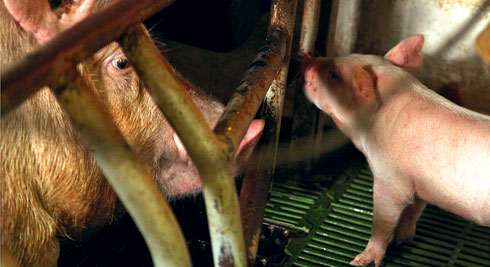
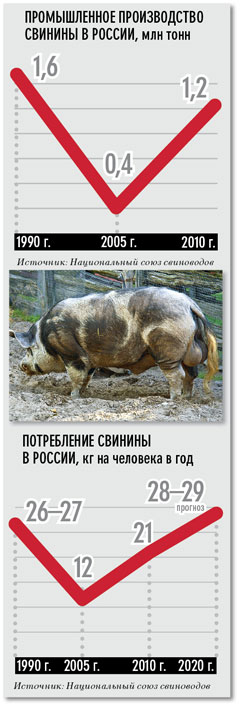
The posterity is taken away from the pig on the 25th day after birth by the local authorities at Hoffmann and his colleagues are not happy: “French investors are reliable partners,” says Yuri Bozhko, acting Head of the Administration of the Lipetsk Region. “I personally attended the bookmark of the foundation of the new pig farm, which, I hope, will bring the industry in the region to a higher level.” Five years ago, pig farming was practically destroyed, says Yuri Kovalev, General Director of the National Union of Pigovodov: from 1990 to 2005, its volumes fell four times - from 1.6 to 0.4 million tons of pork. “The industry was pulled out of the state standards on the national project and such investors as“ Otrada Gene, ”says Kovalev. According to him, over the past 5 years, pig breeding in the country tripled its volumes-up to 1.2 million tons and, most importantly, will continue to grow: the population consumes less and less beef due to its high cost, replacing it with chicken and pork.
For the sake of such a prospect, Patrick Hoffmann pushed his personal life to the background: for six years he spends three weeks in Russia and only a week with his family in France, where his wife, 16-year-old son and 22-year-old daughter remained. And so - every month. His colleague, the commercial director of the Euro Slats company Antoine Mendelovich, went further: in 2005 he sold a house in France, took his wife and three children (7, 4 years and 8 months) and moved to Moscow. Today, Antoine is dangling in Russia and offers farmers floors for pig farm. He is crazy about his work: “Here,“ no ”and“ impossible, ”says Antoine in excellent Russian to any proposal. - The whole buzz is to turn it into “yes” and “you can”.