Translated material
The economy of promises
The economy of promises, or how much populism costs. The less time it remains before the elections, the more the shaft of election promises - the military, teachers, doctors, students. Everything is fine. One thing is bad: the hole in the budget grows before our eyes. Runs and pennies counted The New Times new budget promises are distributed by the authorities almost daily: either the Prime Minister at a meeting in Togliatti declares an unprecedented increase in military expenses, the president after visiting the children's hospital promises a sharp increase in salaries to doctors ... The experts directly call the "economy of promises", which was formed in the "economy of promises", which was formed in Russia on the eve of the election. Moreover, these promises look more and more impossible against the background of the President’s requirements to reduce the rate of insurance premiums from the current 34% to at least 26%. The last meeting with the government on this occasion was held in the Kremlin on June 8, but the final scheme was never found - the final solution was postponed for another two weeks. Obviously, the authorities can’t decide how to cross the horse and trembling storm: to satisfy the electorate and the business in the black schemes can not be finally dragged.
They tried to find a trillion FBK analysts to isolate specific promises regarding the social sphere from the speeches of the Duumvir, and to calculate what they would pour into. Result: the authorities will have to additionally find 1.796 trillion rubles. This amount is almost 19% of all budget expenditures of 2011 - despite the fact that according to the government plans, economic growth this year should be a little more than 4%.
Perhaps, on such wide gestures of power, the fact that in the first quarter of this year the budget was executed with a surplus due to ultra-high oil prices
* * The average price of the Urals brand in the first quarter of 2011 was $ 102. . But the price of oil is changeable, and what dynamics of the cost of the barrel we will see in the coming months - no analyst knows. Meanwhile, other sources of coverage of election costs are not visible.
A characteristic example is a promise in two years to additionally invest 460 billion rubles in the healthcare system. It was based on the fact that this money would be obtained as a result of increasing the total rate of insurance premiums in extra -budgetary funds (including the compulsory medical insurance fund) to 34%. According to calculations
Igor Nikolaev, head of the Department of Strategic Analysis of the FBK, in the first quarter, the amount of additional revenues from insurance premiums amounted to 200 billion rubles, and by the end of the year it can increase to 1-1.5 trillion rubles. “But now it is decided to reduce the rates of insurance premiums,” exclaims Nikolaev. “And where to get the falling trillion - the authorities do not say, because they themselves do not know this.”
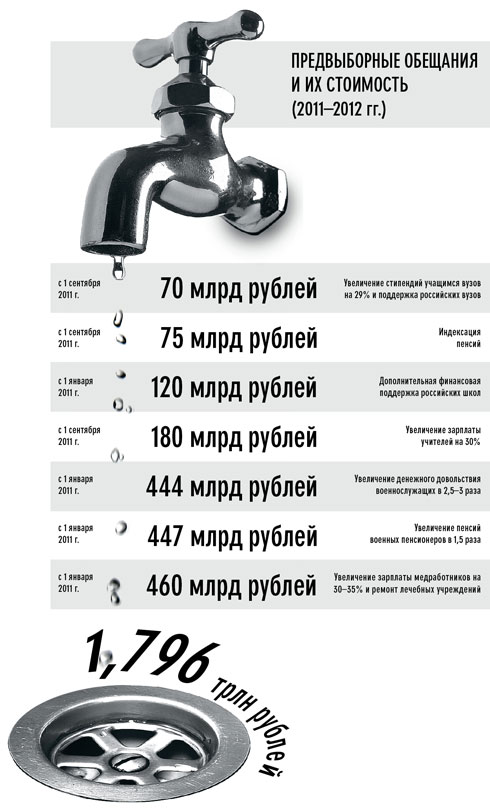
A record deficit amount of 1.796 trillion rubles of additional expenses calculated by experts is not far from the truth, a source close to the Ministry of Finance told The New Times. Currently, the department of Alexei Kudrin is a mirror of the budget for 2012-2014, the project of which should be ready by June 22. According to the source, the total amount of applications for increasing expenditure obligations for the next year, which entered the Ministry of Finance from other departments, pulled as much as 2.3 trillion rubles.
So far, according to The New Times, the Ministry of Finance has found additionally only a little more than 900 billion rubles: 413 billion rubles - due to the receipt of Neneftegas income. 500 billion - if you reduce budget investments, cut subsidies to legal entities and other “measures to support the economy”, reduce defense orders and the number of employees of law enforcement agencies (by 15% for three years), as well as increase the load on the gas industry. However, so far the government was determined only on the last paragraph: in early June, at a meeting of Vladimir Putin, it was decided that the tax on mining (NPPs) for Gazprom will double for the next year, which would bring an additional 150 billion rubles to the treasury.
According to the calculations made by the Ministry of Finance itself, if all 2.3 trillion of expenses are approved and not compensated by anything, the budget deficit in 2012 will approach 5% of GDP
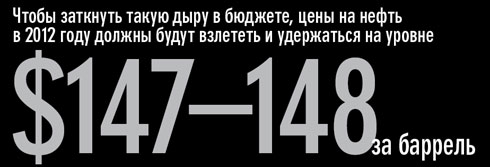
* The budget deficit of the Russian Federation according to the results of 2009 amounted to 5.9%, 2010 - 4.1%. . To close such a hole, oil prices in 2012 will have to fly up and stay at the level of $ 147-148 per barrel. “This is a completely fantastic price,” says former adviser to Prime Minister Mikhail Kasyanov, now
Chief analyst of MK-Analytica Oleg Buklevshev. “There is no reason to believe that in the medium term, the price of oil will be higher than $ 100 per barrel.”
Moreover, according to Igor Nikolaev, the real budget deficit may be even higher than the one that the Ministry of Finance counted. “Given the inertiality of an increase in budget deficit, which will necessarily be when increasing expenses and reducing oil prices, by 2014 it may amount to 7-8% of GDP,” the expert said.
Oleg Buklevshev also agrees with this assessment: “A thoughtless increase in social obligations on the eve of the elections, including increasing salaries, pensions, scholarships, benefits, is a kind of budget trap: these obligations are indexed and cannot be reduced.”
However, the leadership of the Ministry of Finance believes that the storm of election applications will be able to enter into the hard budget shores: “As is usually the case, the proposals of ministries and departments do not fit into the possibilities. Now we will consider proposals for federal targeted programs and gradually cut off everything unnecessary, ”says
Deputy Minister of Finance Anton Siluanov. A number of experts believe that the agency will be able to achieve the desired: “Given the sufficiently conservative policy of the Ministry of Finance, a deficiency of 5–7% of GDP will never be allowed there,” says
Head of the Economic Expert Group Evsey Gurvich. “Therefore, obviously, they will cut expenses.” But which ones will depend on the election conditions, the expert adds.
In the meantime, the authorities easily give out more and more promises. “It is already clear that the cargo of these social obligations will be very difficult,” Igor Nikolaev believes and adds: “In the form it is populism, and, as a rule, cheap, and in terms of economic content, which is still expensive.”