
Translated material
Pipe smell
New disagreement between Moscow and Kyiv
Pipe smell. Ukraine will not receive cheap Russian gas - it will most likely only get drunk. At the end of the last round of negotiations in Moscow, Vladimir Putin and his Ukrainian colleague Nikolai Azarov tried to make a good mine, but everyone could see: they once again did not converge in price, not only for gas. How and why there was a new disagreement between Moscow and Kyiv - learned The New Times
“Is it true that the total gas price for Ukraine is higher than for European countries that are from Russia further?” - Putin asked the Ukrainian journalist. “You have distorted information. For almost all European consumers, gas is more expensive than for Ukraine ... ”Azarov was silent. Although on the eve of negotiations he publicly approved the opposite: the Germans pay fewer Ukrainians. “But Russia pays less for the gas transit to Ukraine than it pays for imports,” the journalist did not let up. “Here you are really right,” the Azarov decided on the replica. “No, not right,” Putin intervened, finally embarrassing his colleague. “We pay you for the transit of the European price ...” Who is still right?
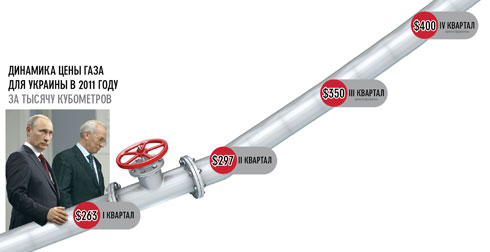
Germany, Poland and Slovakia pay for Russian gas a little more than $ 300 per thousand cubic meters. Ukraine - $ 297 (taking into account the discount $ 100), but at the end of the year it will pay $ 400: Gazprom complains about the growing costs and volatility of the energy products market. Kyiv considers the price of $ 220–230-still neighbors. Putin - not in any. Dot? No. “The puck is on the Ukrainian side,” Putin says. Settings of the phrase: Kyiv should be more accommodating throughout the complex of a two -way agenda, then options are possible along the pipe.
“Let's discuss” during the signing of the Kharkov agreements on the Black Sea Fleet in April 2010
* * The parties agreed on the extension of the base for 25 years of rental in Sevastopol in exchange for a 30 percent discount on gas. Viktor Yanukovych unexpectedly raised the question: the basic gas price - $ 450 per thousand cubic meters - is unrealistically high. “Let's discuss,” Yanukovych suggested. It was clear that Kyiv wanted a revision of Putin -Timoshenko’s agreements (from January 2009), which were very proud of the environment, but Tymoshenko in her homeland was actually blamed as extremely unprofitable for Ukraine. It is clear, of course, that Tymoshenko today is the only real threat to the ruling team, and she has nothing more to “sew”. Nevertheless, Moscow did not expect such a demarche from Yanukovych-a man, for which it was during the “Orange Revolution” and after breaking so many copies in political and diolomatic disputes. As a result, in Kharkov, a 30 percent discount on the gas side of the Ukrainian side “managed to bargain thanks to Medvedev’s desire to not leave empty-handed: Gazpromov did not want to give in,” the informed source in Kyiv told The New Times. -At the same time, both presidents agreed: the base price for Russian gas will still be revised. But a month passed - and it turned out: Putin - against. The last word was behind him. "
Click to increase the oncoming moves after a heavy pause has come, Putin made a counter offer to Kiev: let's unite our gas transportation systems, then you can receive cheap gas. “This meant a merger, and in fact, the absorption of Gazprom of the Ukrainian“ Naftogaz ”, for which no more than 12% of the shares of the Russian giant will be given on the market,” explains The New Times, the director of energy programs of the Nomos (Kyiv) Mikhail Gonchar. “But Yanukovych judged here differently: the era of cheap gas would not last long-two or three years, and then, under the pretext of changing the situation in the foreign market, Moscow will again impose its payment scheme, while already a complete hostess in the Ukrainian oil and gas sector.” The Ukrainian president made it clear that he had other plans for Naftogaz - partial privatization. “Putin is used to the formula: I said - you did. Yanukovych "did not". The disagreement was programmed, ”said The New Times, Kyiv interlocutor. Against this background, all attempts to resolve the situation in Putin -Azarov format were a priori doomed to failure: “Putin makes all decisions, we have Yanukovych. Azarov does not solve anything at all. ”

The Stop team but most of all Putin angered the refusal of the Yanukovych team to be controlled by varnish pieces of Ukrainian industry close to the Kremlin of oligarchic circles. Now about 30% of the Ukrainian corporate sector - chemistry, metallurgy, gas transport, banks, land, including in Crimea - is under the control of Russian capital. But when Vnesheconombank and the financial structures of the Kovalchuk brothers aimed at the Ukrainian middle engineering - the Dnepropetrovsk "Yuzhmash", Kharkov "Turboatom" and the Lugansk "Zarya" - Yanukovych said "Stop". Surrounded by Putin, they did not take into account that Yanukovych people have their own types of these and other assets. Even in the days of Yushchenko, Viktor Yanukovych boasted before his main opponent by the fact that "in my area (Donetsk) nothing was sold to foreigners - so which of us is a patriot." Now it is clear who, first of all, the leader of the Party of Regions did not want to let into the region.
The failure ended and the initiative of Moscow to tie Ukraine through the Customs Union: formally, Kyiv does not refuse to participate in it, but still considers the creation of a common free trade zone (ZST) with the EU. “Putin has already threatened Kyiv with tariff barriers for Ukrainian goods, but not only,” says Vadim Karasev, director of the Institute of Global Strategies. “Russia allegedly has already promised to reduce quotas for the import of Ukrainian pipes, which primarily paralyzes the work of metallurgical plants of the influential oligarch Rinat Akhmetov, the main sponsor of the Party of Regions.”
Farewell, illusions! On June 7, after Moscow negotiations, Putin -Azarov, both countries finally parted with illusions: Russia - that the hated “orange” replaced the more accommodating audience; Ukraine is that someone else makes key decisions in the ruling Russian tandem except the prime minister. Now Kyiv, in order to compensate for the inevitable increase in gas prices, will most likely apply for a loan at the IMF. “Take $ 1-2 billion maximum,” Azarov said. “Today's mood Yanukovych: Do not retreat,” says Ukrainian analyst Julia Mostovaya, the New Times. “And in this the president enjoys support throughout the Ukrainian political spectrum.” The inconsistency and inflexibility of Moscow, the interlocutor of the magazine believes, only helps Yanukovych in the eyes of public opinion: against the background of the Bidnian with Russia on gas, economic and social reforms retreat to the background, with the implementation of which the ruling team has so far difficulties. “This is a huge mistake of the Kremlin strategists and their advisers: they were so passionate about the attack on the“ orange ”that they did not understand the real attitudes of the Yanukovych team,” explains Julia Mostovaya. “But in Ukraine they remember: back in 2003, when Yanukovych was the prime minister, the fraction of the Party of Regions in full force voted for the draft law on national security, where Ukraine joined NATO.” But what about the entire anti -Native hype of the "regionals"? “Yanukovych’s election program was deliberately stuffed with rudiments close to the Ukrainian“ Gomo Zavoditiku ” - for the official status of the Russian language, against NATO, etc. But then the time for real politics came. ”
Putin's formula
The price of Russian gas for Ukraine is attached to the global price of oil and oil products (Mazut and Gasyol)-Putin pushed this formula during gas negotiations with the then Ukrainian Prime Minister Yulia Tymoshenko at the very beginning of 2009, when the crisis raged and oil prices fell. Then they agreed on the basic price for gas: $ 450 per thousand cubic meters until 2020. At the same time, the price for transit was set depending on the much less volatile things - such as, for example, the level of inflation in Europe. At the basic price since 2010, $ 2.04 per thousand cubic meters per 100 km for transit in the first quarter of 2011 increased compared to the IV quarter of 2010 by only 2.2 %-to $ 2.84 per thousand cubic meters per 100 km. Kyiv is outraged that the price with this formula is constantly growing, and the transit rates remain at about the same level.
Ksenia Stepanova took part in the preparation of the material