
Translated material
Petrik against academicians
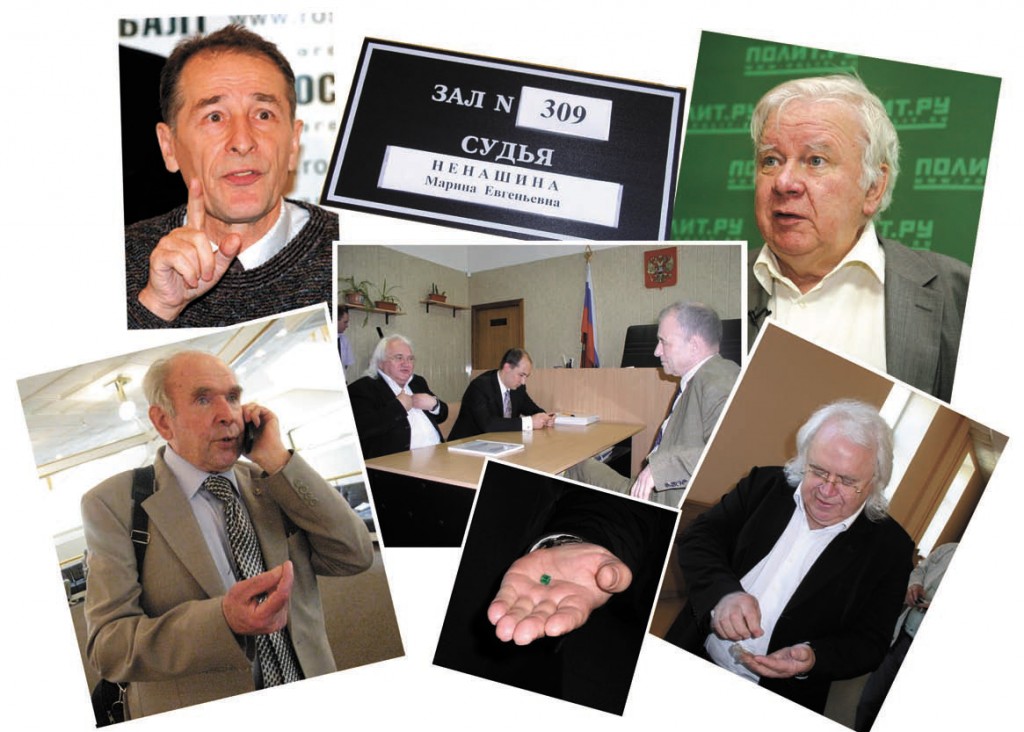
On June 17, 2011, a court hearing was held in the Kirovsky District Court of St. Petersburg on the claim of Viktor Petrik against the Academicians of the Russian Academy of Sciences Evgeny Aleksandrov, Vladimir Zakharov, Eduard Kruglyakov, journalist Nikolai Ahayan and director of the research and technological institute of optical material science (nitia) Konstantin Dukelsky. Petrik claims that members of the commission to combat pseudoscience slandered him, and demands to recover from each defendant the amount of more than one and a half billion rubles. The plaintiff caused a special outrage that he was refused a priority for the manufacture of Spinels, which Petrik already offered to sell the Russian Ministry of Defense, and in case of refusal, any country, ready to pay $ 50 million.
The process was open, journalists were present at it (including sympathetically writing about Petrika), however, the court did not cause a big resonance (the topic, as they say, “blessed”).
This was the second court hearing adopted for production on October 7, 2010 at the first meeting on May 26, 2011. Judge Marina Nenshina issued a ruling on the suspension of the case due to failure to appear in the court of the defendants.
The second hearing was attended by Viktor Petrik, his lawyer Andrei Mikonin and the representative of the defendants - lawyer Andrei Rakhmilovich, who submitted documents confirming the validity of the reason for the absence of academicians at the meeting on May 26.
Then Rakhmilovich petitioned for the transfer of the case to the St. Petersburg City Court. It turns out that the consideration of civil cases related to the state secret belongs to the competence of the court of the city of federal subordination. A letter was attached to the application of the State Optical Institute. S.I. Vavilova (GOI), confirming that we are talking about information that “revealing the direction of development, the content of the development of weapons and military equipment, as well as information that revealing the physical and chemical properties of materials in the development of armored ceramics of alumormagnesy spinel, monocrystalline sapphire and aluminum grenade used in the military field.” All this "refers to the information constituting a state secret."
The debate at the request of academicians and their protection took more than half an hour. Judge Marina Nenshina gave Viktor Petrik and his lawyer several times. It was clear that for them such a procedural obstacle to considering the claim in the Kirov court was a complete surprise. Petrik’s arguments came down to the fact that the application presented demonstrates “the ability to insinimate this group”. Petrik said that “Never sapphire, a way of its production and its characteristics were classified, that it has been produced since 1892 by the most backward countries such as Taiwan”, that “the spinel and its properties under the USSR were also not secret, the object itself is the object itself, the head of the guidance itself”. The entrepreneur “in a life”, as he put it, began to explain to the court that he had never fallen to any questions of secrecy, would not have received his patents in his hands and could not publish his “first monograph by spinel”, where absolutely all the characteristics of this material (both patents and monographs he showed the court) if they were related to state secrets. “How can it be said that the properties of materials are secret? We repeat nature and grow exactly the same crystal. Spinel is a precious stone, it stands in the center of the Crown of English, in the center of the Russian crown. How can it be stated that its properties are secret? The materials themselves are not secret. These are the products from them are secret. ” And the academicians, according to Petrik, should "file such statements to the prosecutor's office and the FSB, and not to the district court." The court needs to focus not on the application to this request from GOI, but to “request the secrecy of these materials by the Military-Technical Commission under the Ministry of Defense and the leading Institute of Shubnikov. And they would answer that this is an open topic. ” And in general, "what has now sounded is another slander."
Judge Marina Nenashina tried to explain to Petrica that the court was discussing not the subject of the claim itself, but the process. And in any case, he, the plaintiff, should not prove to the court that he was slandered; On the contrary, this side of the defendant must present evidence of the lack of slander in his statements. “The transfer to the highest instance court does not limit you in the lawsuit, but rather,” the plaintiff judged Judge Nenashin convinces. Petrik partially agreed that he did not understand the essence of the discussions: “But I know that they want to win time. It will take two years again - the reason is only in this. ”
The judge retired to the deliberation room without interrupting the meetings. An hour later, the parties were issued and issued to the parties to satisfy the petition of the lawyer Andrei Rakhmilovich and the transfer of the case to the city court of St. Petersburg.
Petrik could not have an affirmative answer whether he would appeal this decision: "We must consult with lawyers." At the same time, his lawyer believes that the decision to transfer the case to a city court should be appealed with non -worship.
Tatyana Kosinova,
Kogita editor! Ru,
Especially for the "Trinity Option-Haw"
Petrik tried to give every journalist a green crystal. “This is an artificial emerald, I called it“ Dimantoid ”,” he told the Fontanka.ru correspondent.