
Translated material
Dotature of the language
Our newspaper calls for readers to join the discussion of books that have fallen on the long list of the Enlightener Prize of this year. If you want to express your opinion about one of the books, then send them to the editor's address: info@trvscience.ru . Successful reviews and comments, both critical and positive, will certainly be published. The Maxim Borisov published below the essay is dedicated to one of the books of the Long List of the Enlightener 2011.
The answer to the question “Why are the languages so different?”, The book of the famous linguist, corresponding member of the Russian Academy of Sciences, professor of the philological faculty of Moscow State University, the Corps Methods of Language Research Vladimir Plungyan, we will not wait. You can find the answer to the question "How do languages become different?" Or to be imbued with the logic of language changes (and, of course, they will fully demonstrate us how different languages are), but the answer to the question “why?”, According to the author himself, is reliably hidden inside that “thing in itself”, which appears on the pages of his book any language.
“Language is a huge written book ... Everything that we pronounce and say is already written in this book ... The most talented - or the most successful - speakers and writers better see and hear more acutely than others. They know how to look for new sources; They know how to turn over new pages, ” Plungyan said in the essay“ O (Bes) of the limbs of the language ”, published in 1999 in the“ Russian Journal ”.
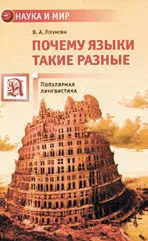
However, in the title there are the energy and even gleam of the throwing of the mind, which is trying to comprehend the incomprehensible sacred essence of this newly -minted logos, which was in a very ironic way in the cover of a multi -valued Babylonian tower in a very ironic way.
Surely Plungyan himself is well aware of the such innocent cunning, bringing another similar example in his articles - with the article “In search of the essence of the language” of the eminent Russian and American linguist Roman Jacobson (in which there was everything, except for the “essence of the language”, which, alas, is incomprehensible).
The most amazing those invariable cheerfulness, condescension and goodwill, which are pouring from the pages of this book. And the willingness to share even with schoolchildren (who are quite on the teeth of these notes) by all pearls found in long mysterious travels in language jungle.
At the same time, the linguist’s heart invariably fills immense despair at the thought of all this annual loss of irreparable “elements of a single book” - extinct languages. It seems that such losses are akin to our losses of relatives - the awareness of which is no longer related to mercantile impulses, there is only a pure longing for the inability to talk and ask those questions that did not come to mind earlier, in life, in a hurry ...
In essence, the author himself does not argue with the fact that each of the people living on Earth wears his own unique sole “version” of the language, male, female, professional, owned by one company or just personal (because the language hunes in the backs of a slightly executed brain and unfolds with new paths at the slightest possibility).
Reader! We do not know how much this book will help you in learning, whether the knowledge of all kinds of “little things” will entertain you with which the doctor of sciences so diligently sprinkles your text (even an erudite adult can be unknown about the existence of languages, genera, time, without a grammatical number, as well as a language in which you can say “it” in more than 20 ways), but that you are without you) Honest prejudices, more tolerant and wiser will be more of magnificent cacophony and kaleidoscope of the replacement of each other language phenomena - this is undoubted.
For more information about the book, see www.abroad.ru/library/plung/ (content, individual chapters)