
Translated material
Black holes from "Chandra"
Astrophysicists from the University of Hawaii, Yale, the University of Michigan and the University of Ratgers first discovered traces of many black holes that arose during the first billion years after the Big Bang [1]. Until now, it was possible to register only individual black holes of this generation, which showed themselves by the radiation of the quasar they born. The authors of the new work found the opportunity to identify X -ray signatures of a large number of not so active (and therefore more typical) holes that appeared in the same era.
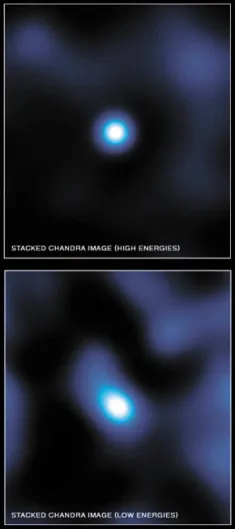
All holes were found in galaxies with a red displacement of 8> z> 6 (which corresponds to the age of the universe from 700 to 950 million years). To identify them, researchers studied X -ray signals of 197 stellar clusters, photographed in different years with a wide -angle camera of the Hubble orbital telescope. All of them separately were exclusively weak (on average less than five quanta per galaxy), which is why not a single black hole could be found individually. However, the summation and averaging of the signals emanating from each galaxy made it possible to assess the complete X-ray luminosity of individual holes, which mainly lay in the range 1042-1043 ERG/s (for comparison: X-ray luminosity of the individual observed quasars exceeds 3x1044 erg/s). It also turned out that signals with quanta energies from 0.5 to 2 KEV are about 9 times weaker than signals recorded in the 2-8 KEV strip. This indicates that the black holes were surrounded by dense clusters of cold gas (mainly hydrogen), which absorbed a soft X -ray much more compared to the hard one.
The same gas clouds almost completely shielded the ultraviolet and optical radiation of black holes and thereby almost canceled their contribution to the process of cosmic hydrogen reionization. On the other hand, the authors of the article note, the presence of gas cocoons provided intensive gas accretion on black holes and thereby allowed them to grow much faster than it was still thought. Details of this growth so far serve as the subject of disputes, however, the analysis of the radiation of the first quasars allows us to argue that after 800-900 million years after the large explosion in the universe there were already holes of the order of order of a billion solar masses.
The authors of the article in Nature also came to the conclusion that the oldest black holes evolved in parallel with their galaxies and approximately the same pace. Scientists believe that already in that era, from 30 to 100% of the galaxies, they had black holes located in their cores. It follows that the universe of that time contained at least 30 million ultra -massive black holes, which is several thousand times higher than the theoretical assessment of the total number of quasars of that time.
True, these conclusions should be treated with known caution. They pose on the assumption that black holes acclaimed matter at about the same speed for hundreds of millions of years. However, this hypothesis may not be justified, since accretion (capture by the cosmic body of a substance falling from the surrounding space) does not have to be stable. For example, from model calculations it follows that when the galaxies merge, black holes form double systems that generate powerful gravitational waves that carry gas from their environs. This and other similar difficulties can be allowed only after the appearance of telescopes of the new generation that can distinguish between individual super -weed sources of x -ray radiation.
Alexey Levin
1. Ezequiel Treister et al, Black Hole Growth in the Early University Is Self-Regaleded and Largly Hidden from View , 474, 16 June 2011, 356-358, www.nature.com/nature/journal/v474/n7351/full/nature10103.html . The article is available in the Arxiv E-Print archive: 1106.3069 .