
Translated material
Gulliver vs Alice
When Jonathan Swift composed “Gulliver’s travels”, he could not know about future experiments in the field of vision neuropsychology. Lewis Carroll, author of Alice in Wonderland, had no idea about this. Of course, no one knows their heroes better than writers, but one cannot but notice that similar situations in books, transmitted through the perception of Alice and Gulliver, differ dramatically.
Both Alice and Gulliver at some moments are in the role of giants, and in other episodes they are dwarfs. If you remember, Alice changed several times in size, including right during the court session, she began to grow rapidly. Her sensations are described in this way: the building with all its inhabitants remained a constant size, Alice changed. Gulliver, after a shipwreck, woke up on the shore and saw ... Liliputov. The traveler interpreted the situation definitely not like Alice. He did not conclude that during sleep he suddenly grew up and became a giant. On the contrary, the world around him, and he himself seemed to Gulliver unnatural sizes.
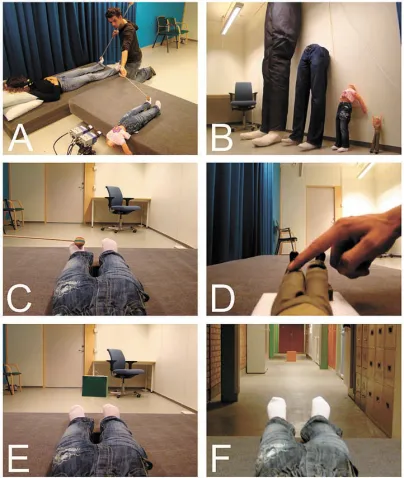
Imagine now that during sleep you were reduced to the size of the Barbie doll. What conclusion will your brain come when you wake up: what has the body has changed and has become miniature or that you are of the previous height, but found yourself in a world inhabited by giants? This question was asked by scientists from the Swedish Caroline Institute (Karolinska Institute) in Stockholm. Unfortunately, funds have not yet been invented fundamentally to change the dimensions of a person in one night, so I had to resort to cunning. But the answer was received, and the certificate of this is a recent publication in the journal Plos One. The conclusion is that Swift correctly guessed the reaction of the brain to changes in the relative scale of the body. We look at the world through the eyes of Gulliver, not Alice.
The study participated in 198 volunteers, each of whom was offered to lie on their backs so that their own legs were visible. Then, a special headset was fixed on the subject’s head, which broadcast the ZD-Video signal, coming from two chambers aimed at lying legs. In essence, a person through the headset saw the same thing that he would observe in the usual way, simply located horizontally. The trick was that in reality the cameras did not take off his legs, but the mannequin legs, and they could be arbitrary.
First of all, it should be enshrined in ensuring that the participant in the experiment perceives the mannequin that he apparently perceives as part of his body. To do this is relatively simple due to the fact that the brain constantly updates its ideas about the boundaries of its own body, based on the incoming visual and tactile information. With a competently selected combination of touch and the image presented, you can create the illusion that, say, the rubber hand actually belongs to a person and is part of his body.
It is important to emphasize that this sensation is stronger than the arguments of reason. If the mind is clearly aware of the impossibility for the rubber hand to be part of the body, then somatic reactions unequivocally show the opposite: if you swing over the rubber hand with a knife, a person will experience excitement, his sweating will increase, pulse will become more frequent. This is a classic experiment repeated many times. Anyone can reproduce it at home to make sure how actually the so-called “body pattern” seems to be mobile, which seems to be something stable and unshakable.
Professor Henrik Ehrsson , who headed the study, did something similar with colleagues. With special long sticks, the experimenters touched the subject’s leg, synchronously touching the same place on the mannequin leg. As a result, a person not only felt tactile stimulation, but also saw how it was produced. This was enough to create a complete impression that he was looking at his own legs. The application of the knife to them, respectively, caused increased sweating among volunteers.
In the experiment, the “legs” of three types involved. They looked the same, differing only in size, and corresponded to the growth of the mannequin of 400, 80 and 30 cm. A person lay on their backs, watching through the headset the same thing that he would see without a headset: a room and their legs in front of them. Finally, a cube settled on the rope on top appeared in the field of vision. By preliminary agreement, the subject had to assess his size, showing his hands to how much the subject seems to him.
Volunteers, of course, did not know about the real length of the mannequin, or about the real size of the cube.
The experiment showed that in the case when a person looked through the headset at the feet of a small doll, the cube descented seemed to him excessively large; If giant legs were placed for him, then the size of the cube, on the contrary, was significantly underestimated. The deviation from reality could reach 40%. In other words, the brain of subjects from two possible interpretations chose the one in which the distortion underwent the outside world, but not his own body.
It could be assumed that such a choice occurs at the level of elementary logic, since the transformation of the body is much less likely than the existence of enlarged or reduced objects. The matter, however, is somewhat more complicated, since the experimenters sometimes had to touch the mannequin with their fingers (in the case of a small doll), and the subject directly saw a human hand near their feet. She seemed to him a giant with his hand. “Despite the fact that we know the usual size of a person, the illusion created by us forced us to perceive other people as giants; This is a very bizarre experience, ” says Ersson, who tried the experiment on himself and watched his colleagues walking around the room through the headset.
In the field of view of the subjects, scientists placed various subjects, including fragments of other mannequins, and also checked their judgments with actions. In particular, they were asked to get up and with closed eyes to approach the object. People whose body with the help of the illusion was “reduced” took more steps than necessary, and vice versa. Apparently, the basis of perception is something more fundamental than the logical conclusions that occur in real time. A variety of experiments conducted by the Ersson team, requiring sizes and distances from the tested assessments, allowed to come to the conclusion that their own body acts for a person with a kind of standard, according to which a size scale is built for all other observed objects, including other people. In this sense, our perception is egocentric. It does not recognize the possibility of changes in the size of its own body, leaving it to the outside world.
A group from the Caroline Institute is not going to stop there. Since during the experiment it was possible to create the illusion of a person’s movement into a very small or very large body, this, according to Ersson, can be used in practical applications, for example, to control microscopic or, conversely, giant androide robots. The first author of the publication Bjorn Van Der Hoort also intends to scan the brain of people at the moment when they are under the influence of illusion.
Denis Tulinov
B. Van Der HOORT, A. GUTerstam, HH EHRSSON. Being barbie: The Size of One's Own Body Determines the Perceived Size of the World. - PLOS ONE (2011), http://dx.doi.org/10.1371/Journal.pone.0020195
Press Release: http://ki.se/ki/jsp/polopoly.jsp?l=en&d=130&a=122789&newsDep=130
Henrik Ehrsson Lab of Henrik Ehrsson: www.ehrssonlab.se