
Translated material
The onset of poverty
The income of Russians rolled down
 |
The onset of poverty. Rosstat calculated: the real income of Russians for the year-from May 2010 to May 2011-decreased by 7%. This is drawn to a sensation: even in a crisis, according to official estimates, the income did not fall, but grew. Why the population is poor-asked The New Times
The average income of Russian citizens in May amounted to 18 thousand 183 rubles, which is 3.2% more than a year earlier, Rosstat said. But prices are rising much faster: over the year, inflation increased by more than 10%. As a result, real incomes of the population (adjusted for inflation) decreased by 7%.
So much the income of Russian citizens in the 21st century had not yet fallen. Even in the crisis years, according to official statistics, the real disposable incomes, contrary to economic reality, grew: in 2008-by 2.7%, in 2009-by 2.3%, in 2010-by 4.3%. And when, it would seem, the worst was left behind, the growth was replaced by a decline.
The “shadow” of The New Times was supervised by analysts that the combination of two main causes - traditional (high inflation) and new (growth growth) led to a fall in income. With regard to inflation, nothing has changed in the country for many years - it remains high. “The government is not just not able to stop the increase in prices,” he says
Director of the Department of Strategic Analysis of the FBC Igor Nikolaev - it seems that it does everything to disperse them even more. ” As an example, the expert cites prices for tariffs of natural monopolies, which this year has already amounted to an average of 15%, that is, twice as high as the official inflation planned by the government at the end of 2011.
Dear oil also works to increase inflation, which brings another stream of shallow oil oils to the country. “As a result, gasoline, food, trips in transport are getting more expensive,” transfers
Elena Matrosova, head of the Center for Macroeconomic Research "BDO Unicon". “This row can be continued indefinitely, it is more difficult to name goods and services that have not grown in price since the beginning of the year.” For five months of 2011, inflation amounted to 4.8%, the government promises to keep it by December at 7%. However, independent experts are confident that the increase in prices by the results of the year will be at least 8.5–9%. “The least protected - state employees and pensioners from consumer inflation,” explains Igor Nikolaev. “The government has fewer opportunities every year in a timely manner, and even more so in full to compensate these categories of people in prices.” According to the June survey of the Public Opinion, the increase in prices is the most exciting theme topic. 84% of respondents talk about it.
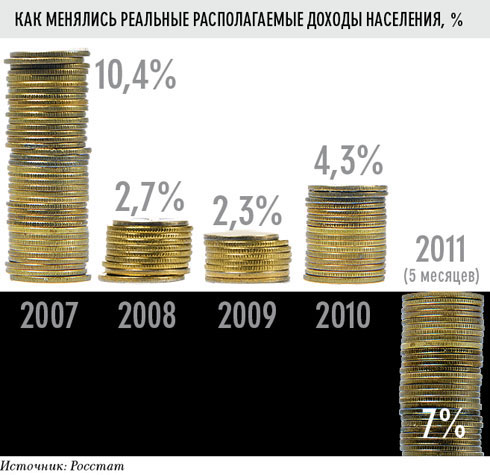
However, you can’t explain the income drop in prices alone: in the end, in 2007, inflation was 11.9%, nevertheless, real disposable income increased by 10.4%. But this year, coupled with inflation, a new factor has worked - the growth of the tax load associated with the increase in the increase in compulsory insurance premiums from 26% to 34% (from 16% to 26% for small businesses), as well as the departure of small and medium -sized businesses caused by this. The unconditional pattern is traced here: starting in 2001, the tax burden in the country has decreased, and the income has grown. In 2011, taxes increased for the first time in 10 years, and income immediately fell.
“Raising insurance payments was a bad idea. The authorities were told by everyone - both experts and business, but they insisted on their own. Now even Rosstat saw the result, ”says Igor Nikolaev. “A rash, sharp increase in social taxes is the main reason for reducing the incomes of the population,” agrees
Head of the Analytical Department of Alpari Group of Companies Egor Susin. - The latest decisions of the authorities to reduce contribution rates since 2012
* * See more The New Times No. 21 of June 20, 2011. They talk about recognizing the erroneousness of previous steps. ”
The business responded quite naturally to an increase in the fiscal load on the salary - the departure of these salaries in the shadow, explains
Expert of 2K Audit - Business Consultations Petr Klyuyev. At the same time, he refers to a survey of “Business Russia”, which showed that in the first five months of the year the volume of shadow salaries in the country doubled.
At the same time, according to
Anna Bodrova’s analytics of Investkafafafa, many of those companies that did not go into the shadow were forced to elementarily go to reduce wages - for financial optimization. “After the crisis, it became obvious that the bloated states and high salaries slow down the development of companies. Today, many companies are not ready to pay employees in the same way as in pre -crisis times, ”the expert says. The mass reduction of salaries and their leaning into the shadows, Bodrov believes, has become the factor that led to a noticeable fall in the population’s incomes.
Mushrooms and berries, paradoxically, with negative income dynamics, Russians did not buy less, on the contrary, they left more money in stores than last year. According to Rosstat, the retail turnover in January-May of this year amounted to 7.18 trillion rubles, which is 5.2% more compared to the same last year's period
* In the structure of retail turnover in May 2011, 51.7% were non -food, 48.3% - food products. .
However, such data do not surprise experts. “Only at first glance these figures look paradoxical. In fact, the population is afraid of further prices and prefers to stock up for the future, ”says Igor Nikolaev. Elena Matrosova adds another reason: people do not know how to protect their funds from inflation. After crisis cataclysms, they are not ready to trust either banks, nor PEFAS, or even the dollar with the euro. In these conditions, most citizens prefer not to save money, but to make it quickly.
Such consumer behavior characterizes the uncertainty of people in tomorrow, explains
Marina Krasilnikova, head of the study and consumption of the Levada Center: “For the most part, citizens feel that their income does not grow, but are reduced, and do not understand whether the situation for the better will change tomorrow.” The May study of Levada Center shows that 84% of respondents complain about the lack of money about food.
Meanwhile, the unexpected fall in the incomes of the population was seriously alarmed by the leadership of Rosstat. The head of the department, Alexander Surinov, announced that in the second quarter of 2012 an in -depth examination of the income of the population will be carried out, during which it is supposed to interview 20 thousand families in all subjects of Russia
* The last time Rosstat conducted such an examination in 1996. The head of Rosstat explained that all kinds of sources of receiving the money of respondents will be clarified - not only salary. “For example, income from the collection of berries, mushrooms, and medicinal herbs will be taken into account,” he said. Alexander Surinov complained that the study would be difficult: "People, of course, do not want to talk about their finances." However, the main statistics on an optimistic note finished his performance. “I am sure that the real incomes of the population of the Russian Federation are higher than now we evaluate them,” he said. Is it not in order to confirm this bold assumption, and the study is started? Since official numbers have ceased to radiate the usual optimism, you need to urgently find a way to correct them.