
Translated material
Communal wiring
Communal wiring. “Common Hotages” - the name of the new line in the utility bills that we have to pay. For what else will they take money - I found out The New Times
The canopy of 2010, residents of a five-story building in the 15th microdistrict of Zelenograd, suddenly found that they were accrued twice as much as for lighting enters and stairwells than for the consumption of electricity in their own apartments. When they began to understand, it turned out that it was to blame for everything ... a vegetable car standing next to the house. So that there were constantly light and warmth in the stall, its owners, father and son, connected to the house of the electric distribution shield, throwing the cable directly from the window of the nearest entrance. “And we rejoiced that we could buy vegetables right next to the house,” Svetlana Shcherbachenko, a resident of the ill-fated house, told The New Times. Svetlana is a lawyer, and she used her professional knowledge when, together with two neighbors, she took up the clarification of the truth. The “traces” brought activists to their management company - the former DEZ. “Of course, we didn’t catch anyone by the hand, but it is absolutely clear that the management company gave merchants good to connect to our power grid,” says Svetlana. “Moreover, one of the sellers admitted that the management company took money from them for electricity for six months ahead: that is, it withdrew“ cream ”from both merchants and residents.” When Svetlana threatened to sue, the management company played back: overpaid amounts were returned to all residents. But vegetables near the house no longer trade.
For themselves and for a neighbor, surprises in utility bills are constantly found. Hoping to save and succumbed to advertising, The New Times correspondent installed a water meter in his apartment. When the receipt came, there was no limit to amazement: a strange column “recalculation” appeared in it, where 913 rubles were charged for water instead of 391 rubles (as it should be according to the meter’s readings). To the question, where, in the engineering service of the Nagatinsky Zaton district, not embarrassed, they answered: the recalculation was made due to the fact that some of the inhabitants of the house presented certificates that they were absent and did not use water during the indicated period. Thus, the New Times correspondent paid for himself and for that guy, that is, for his neighbors.
New Decree of the Government
* * Dated May 6, 2011 No. 354 “On the provision of utilities to owners and users of premises in apartment buildings and residential buildings”. , which entered into force in June, in fact, legitimized such a practice. Now the owners of individual meters will receive rent receipts, including two points. The first is a fee for individual consumption of water and electricity. The second is the expenses for the so -called common house needs (ONE): this includes porch lighting, technological flushing of the water supply system, water plum during repairs, the work of pumps, elevators. “Previously, it was almost impossible to count the costs of maintaining the house, since there was no collective metering device in the houses,” explains Dmitry Gordeev, the leading legal adviser of the Institute of the City Economics of the city. “Utilities overstated the costs, in particular, to water and electricity, since they had nowhere to take money from except from the pockets of the residents.” In addition, the cost of water, light and heat was included in one “unstable” figure. Now, for each of the parameters, the board will be installed separately. “It should not exceed 10–20% of the total utility bill,” Gordeev believes. However, this maximum has yet to be approved by local authorities.
Galina Khovanskaya, a State Duma deputy, believes that thanks to the new rules, the expenses of housing and communal services for each family will become more transparent: “We will understand how much we spend on the maintenance of our own home and how much - on the general needs.” If the residents see that ONEN exceeds the costs of the apartment, they will have a reason to raise the alarm, Khovanskaya believes: “Everyone understands perfectly well that to wash the entrance or pour flowers on the windows is far from crazy numbers.”
Read the payment, however, it is not always possible to withstand communal workers. “We got here last September,” the capital's entrepreneur Dmitry Zhdanov shows at the 17-story house on the corner of Izmailovsky Boulevard. -We have a three-room apartment on the 6th floor. When the first time they received an account, they thought: something is expensive-7500 rubles. We read the fat and found that we were charged 560 rubles for major repairs of the house. "He is only handed over, and they are already taken from us for overhaul!" - Dmitry is indignant. The management company, the entrepreneur explained: the money will be accumulated in a special fund, until the repair becomes relevant. However, it turned out: the overhaul in the plans of the management company is not listed. And even more so, the tenants did not order him. But the line in the receipt is present - and people pay.
Unfortunately, this is a typical picture of the relationship of the tenant and the management company, says Dmitry Yanin, head of Confop. The first pays, not particularly imagining what exactly, the second does everything so that this board is mainly for the “air”. Although, Galina Khovanskaya recalls, the legislation allows tenants to demand a report on all work done from the management company. Moreover, we can ask the level of salaries of managers and demand a reduction in the maintenance fee. But in practice, corrosive tenants rarely come across. Businessmen from housing and communal services use this. According to the Institute of Economics of the city, real expenses make up 30-50% of all “mastered” amounts. The rest settles in the form of profit on the accounts of companies.
Nevertheless, the council can be found on them, the ex-deputy of the Moscow City Duma and the leader of the Yabloko party, Sergei Mitrokhin, is convinced. According to him, homeowners must start by obliging the management company to install common house metering devices: then everyone will understand how much resources are spent. “The counters must be controlled by the residents themselves, their self -government bodies,” adds Anatoly Golov, co -chairman of the Russian consumer Union. The managers today accept complaints about the unlawful actions of the managers in municipalities, housing inspections, and even the prosecutor's office
* In 2010, the Prosecutor General’s Office revealed 94 thousand violations in the housing sector, 140 criminal cases were instituted. .
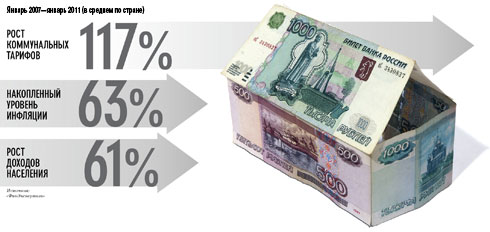
Black hole the appearance of a new payment - for ONE - occurs against the background of a constant increase in tariffs for housing and communal services. Only in 2011 they rose by 15%, in the past - by 20%. “In terms of the growth rate of the tariffs of natural monopolies, we are ahead of all the CIS countries,” says Sergey Mitrokhin. Experts could not find a reasonable reason for the abnormal growth of tariffs: according to the general director of the “Finexpertiza” Agnian Michaelyan, he is not explained either by increasing costs or concern for high profitability. The housing and communal services remains a black hole where the huge money of ordinary consumers flow.