
Translated material
Arabian gold
Rare exhibition in the Hermitage
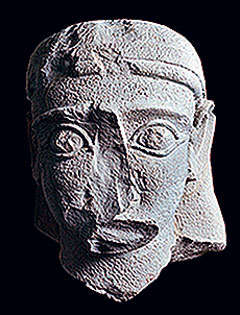 |
| Many of the sandstone statues have to be restored as this head of the ruler of the Lichean dynasty. |
Case of chance. An exhibition of unique art objects from Saudi Arabia in the Hermitage is an event from the category of rare. Why did it not cause excitement - wondered the New Times
The statue of a man from limestone, modestly dated "around the 3rd millennium BC." The cylindrical vessel of an unclear purpose from diatomite - sedimentary rock - about the same time, would envy any modern designer. Silver strainer and bronze leg of a chair in the form of a human leg ... Exhibition "Path of Arabia. Archaeological treasures of Saudi Arabia, which opened in the St. Petersburg Hermitage, collected more than 300 items, most of them first left their homeland for the sake of a world tour. The “ways of Arabia” has already been shown in the Paris Louvre, where it became one of the main events of the season. But the mass media noise around her in Russia turned out to be much more modest than in France. Although when you look at all these wealth, the most ancients of which are still related to the Neolithic, you easily believe the assessment of Mikhail Piotrovsky, the director of the museum: “The exhibition is the latest, unique discoveries, which are a world sensation.” Piotrovsky can be believed: he is one of the largest specialists in Islamic culture, and he himself worked on the catalog of the Arabian exhibition as a scientific editor (a rarity in the biography of a museum director of this level). But the first question that arises after Piotrovsky’s words: and where did all these treasures be before, why they didn’t truncate them before and the myth associated with them is not as great as, say, the Nefertiti myth?
Later the beginning
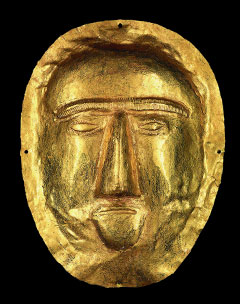 |
| A burial mask was found in a saja in a tomb of a 6-year-old girl. I V.N.E. |
Excavations in Saudi Arabia began later than excavations in neighboring countries. The main success falls out of the discoverers, and the criminal element only adds sharpness to what is happening. In this regard, there are no equal Egyptian antiquities with their numerous riddles, from hieroglyphs to the pyramids, and an abundance of mysterious deaths so brightly painted with entertainment novels and detectives of the 20s, including the stylish agate of Christie. A little later, the era of research in the Middle East began, those who would soon begin to extend the world history came here. As archaeologists - the famous English intelligence officer Lawrence Arabian and his German colleague Max von Oppenheim. Both will take part in the armed struggle in the region, the first will speak out on the side of the Arabs against the Ottoman Empire, the second will try to raise jihad already against the British. However, their personal meeting took place in a peaceful environment, during excavations on the border of Syria and Turkey.
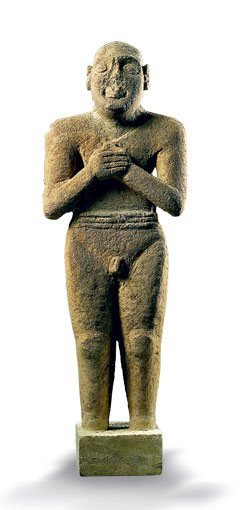 |
| The statue of a man is about the middle of the 3rd millennium BC. Made from limestone |
Studies in Saudi Arabia itself began much later, and this is the main reason for their unknown to the general public. The vast majority of items shown now in the Winter Palace were found only in the past half a century. So, the tomb in Tele-Az-Zayer in the vicinity of the settlement of Saj found in 1998-1999. The burial of a six -year -old girl turned out to be a lot of gold items, from a funeral mask to bracelets, a necklace and even gold gloves. It is amazing that he was not plundered in antiquity, as happened with the monumental tomb in Ain-Javan. Archaeologists investigated it in the early 50s, hence many jewelry of the 2nd century. AD, now brought to the banks of the Neva - earrings, a necklace, a round pendant with inserts from a grenade in the form of a tear and pearls.
Poverty and wealth
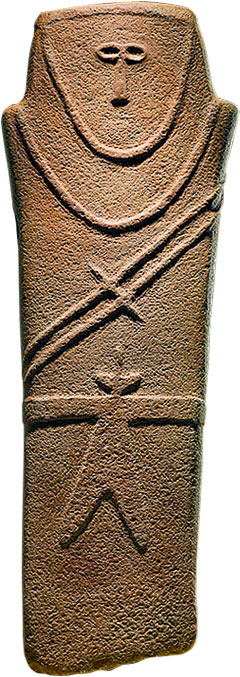 |
| Such sandstone steles were placed near burials and sanctuaries. IV thousand BC |
The main problem associated with the civilizations of Saudi Arabia is a lack of evidence, written sources that simplify their lives to historians. Sometimes the information has to be picked by grains from the texts of Greek and Latin authors, the Bible, from the scraps of inscriptions, preserved on funeral steels or sacrificial sculptures. It is believed that this is due to the peaceful nature of the tribes and peoples living here: the annals are primarily included in the annals, battle and all kinds of non -standard situations. And the Arabians were mainly engaged in trade, which is not surprising if you are at the intersection of trade routes. For example, at the time of the Middle Ages, in the caravan of pilgrims who went from Iraq to Mecca, there could be up to 20 thousand camels. Therefore, the Hermitage show many objects received from neighbors - Egyptian amulets or glass made in the Levant and Alexandria, ceramics from Mesopotamia and ancient Megan (now the territory of Oman and the UAE). Many of its samples made of chlorite and preserved traces of inlay in semiprecious stones and mother -of -pearl were found during the construction of a dam between the mainland and the island of Tarut in 1966.
Minus Russian its own history of Arabia is the history of oases inhabited by different tribes, which constantly showed interest in the Arabian lands of neighbors like Nabatytsy, and kingdoms, many of which are mentioned in the Bible. Therefore, today's influx of international expeditions in Arabia is not surprising: the French and the British, Germans and Australians, Italians and Americans work here. Their joint expeditions with the Saudis are proudly listed in the catalog. There are only Russians: apparently, budgets that are allocated for the development of science do not allow.
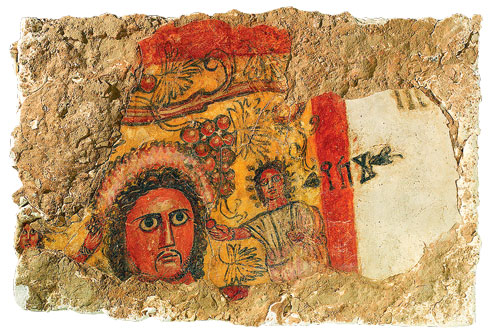
A fragment of a wall painting from Caria-al-Fau dates from the I-II V.N.E. Therefore, it does not seem strange that the unique exhibition in St. Petersburg does not feel increased attention. Today in Russia, archeology is not in fashion. We have no excitement around archaeological exhibitions comparable to the one that manifests itself in Europe during large archaeological expositions in the Louvre or, say, the Bonn exhibition hall of Germany. Those projects are built according to the schemes converted to the future, the most important place there is given to pedagogical work, they try to turn schoolchildren into regulars of museums. We have such a job looks more sporadic. Therefore, a visit to museums and exhibition halls for many is only a tribute to the politeness of their native culture.