
Translated material
Finita la comedy
Shakespeare spoke with Chekhov intonations
Finita la comedy. On the stage of the Moscow Drama Theater named after Pushkin, Shakespearean play “A lot of noise from nothing” changed into fashionable and sad about the eternal. Shakespeare spoke with Chekhov intonations
Some kind of hidden sadness peeps through the mask of one of the most successful directors of the cash register comedies. This is a good sign that gives Evgeny Pisarev a chance to expand the scope of the “theatrical and entertainer” role. “A lot of noise from nothing” is Pisarev's first performance as the chief director of the Pushkin Theater, where he was appointed after the death of Roman Kozak. No one doubted that the application of the new Glavrezh would be a comedy - and the comedy turned out. But something broke in her on the way. Starting vigorously, she rushed carelessly and rapidly along the rolled road, habitually having fun and amusing the audience, and then suddenly thought suddenly: "Am I comedy?"
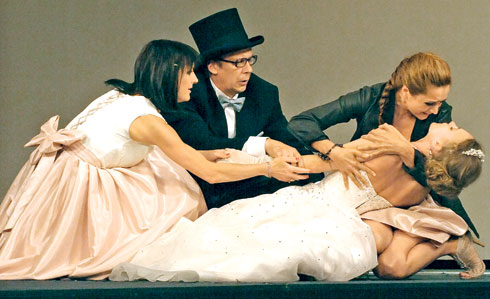
The hero’s wedding did not take place. Ursula - Maria Andreeva, Antonio - Konstantin Pokhmelov, Beatrice - Victoria Isakova, Her - Anna Begunova Association of Love all began with the station. The sounds of steam butt bundles, bored policemen on the platform, silhouettes of hurrying passengers behind the station windows, excited voices of those who meet-all this station vanity excites, languishes with the expectation of something important that will turn the life of this sun-poured city, which was accumulated by palm trees (artist Zinovy Margolin). Cities drowning in lazy idleness, leading his life from a party to a party, from a carnival to a carnival, to the sounds of a cheerful orchestric performing the favorite hits of the local public (musical “group W” with an amazing vocalist - an unconditional decoration of the play). The distant victorious war returned to their homeland a group of laughing tanned men in camouflage and high army boots. The white -toothed winners are noisily hugging with relatives and friends, flirt with playful girls. Closer to the night, everything is ready for love: ambiguous jokes, the ringing of glasses, crazy sounds of music and fireworks and a flattened radiant bedspread of the starry sky above his head.
In the troupe of the Pushkin Theater, heroes and heroines are distinguished by special chic, almost perfection - they are all outrageously beautiful. Not a single theater is able to withstand such a number of handsome men and beauties, the scene of the Pushkin Theater is almost unique in this sense. Young and not very young actors do not seem to have no flaws - all that nature has generously endowed with is actively supported by a magnificent physical form, which they are happy to demonstrate. You will not notice the difference in generations - there is no gap between “a little over twenty” and “far over thirty”, everyone moves perfectly, fight and dance. Apparently, Konstantin Stanislavsky once dreamed of such a theater, theater of physically healthy people. But the Russian theater would not be Russian if behind the puffing health of the guise would not be hidden by a painful and languid soul in doubt.
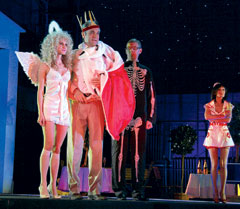 |
| The scene of the masquerade. In the foreground of Hero - Anna Begunova, her father Leonato - Andrey Bustayuk, Antonio - Konstantin Pokhmelov |
One step to hatred , the gentle, vulnerable and brutal -hearted Claudio (Vladimir Zherebtsov) chooses a thin, gullible, porcelain hero (Anna Begunova) in his companions. The spontaneous love of these Romeo and Juliet is broken by small fragments of the first obstacle - a vile gossip, offensive to an innocent girl and shameful for such a noble young man. The scene of the failed wedding, where the groom who whitened with anger arranges a public civil execution with his bride, publicly accusing her of infidelity and by the meanness of deception, becomes the culmination of the performance, its highest point. A humbled girl, crushed, crushed by a dirty abuse, a father, blinded by shame (Andrei Bustayuk), drags around the stage as a broken doll - a shocked silent, not a word that did not utter in his defense. Only tears pour and a white dress - a symbol of purity - shines with a meaningless spot.
This scene is set and played so dramatic and emotionally that it is impossible to imagine a happy finale after it. Why did the hero forgive Claudio? She forgave a person who raised her hand with such ease, with such a cold indifference to refused her love? There is something deeply Russian in this submissive woman, that which rhymes with the “husband’s wife” and “hits, means loves”. And Claudio is hard to believe in repentance. So, after a drunken brawl, a quiet husband with the eyes of a beaten dog returns to the family.
The love of Benedict (Alexander Arsentiev) and Beatrice (Victoria Isakova), designed by comic intrigues, also seems short -lived - this path was too rapid from mutual mockery to quiet love. Yes, they are certainly similar. Both are beautiful, smart, witty, both are used to light love victories, both loners, both obsessed with freedom and independence. The heightened sense of justice and civic duty knocks on their hearts, like “Claas's ashes”, and no golden chains are tied to a quiet family dodge of comfort and peace. And the quieter and more tender becomes the voice of Beatrice, the more often she incumes her violent head on the chest of the free -loving handsome Benedict, the less believe in their long happy life. And the flower in the hands of Benedict looks as absurd as in Beatrice's hands - a plush squeak of a toy with a red heart.
After laughter, lovers of laughing will get their portion of pleasures. The new modern translation of Ekaterina Rakitina and the traditional set of classic gags on which the director ate the dog, they will be given this opportunity. The comic pair of policemen (in which the average features of all the stupid police officers are guessed) with their interludes, the actors Sergey Miller and Igor Teplov “delay” from the heart, go beyond the laughter of the hall, as fascinated. The collective intrigue designed to unite Benedict and Beatrice, spins under the inexorable laughter, which spurred actors rushing along the chips of the sitcom (the term that came from television is a situational comedy) with the confidence of professional mass-stages. But along with plot revelations, the scene itself is exposed. Carnival tinsel and cardboard decorations seem to dissolve in the air, leaving figures of people on a silent circle, almost shadows - either the past, or the present. Looking back, the heroes themselves weakly believe in a happy finale. And he will not have time to measure the light, the hands of the lovers will open.