
Translated material
The secret of George Washington
Alexander Genis: At the end of this “American hour '', which is largely dedicated to the Independence Day celebrating today, I want to share my memories of the first July 4, which I was lucky to spend in deaf rural America. The parade in the Vermont city of Warren was the direct opposite of that sovereign bacchanalia, the memory of which I was still quite fresh. To start with the fact that the statue of freedom that opened the procession did not stand up to a proud monument, but modestly lay on some kind of Kolymag. Instead of a torch, she squeezed ice cream, and on her legs there were comfortable red shoes - so that she was elegant and without corns. For freedom, antique machines, tractors, scooters rode. A group symbolizing the original vermontian professions - a hunter, a fisherman and a lawyer, held apart. The latter, presumably, does not allow to fight the first two. Then, for some reason, the real and very soft to the touch the llama went. They did not symbolize anything, but the audience liked them - they were stroked. From the whole parade, undoubted amateur performances blew. It was clear that people who relate to the holiday without much excitement, but with a clear sympathy for the subject, came here. History for Americans is often an intimate business. In many families, especially the old, '' aristocratic '', it is customary to read the Declaration of Independence on July 4 aloud. And, of course, on this day everywhere and everywhere, starting, of course, with television advertisements, they recall the father of the nation - General Washington.
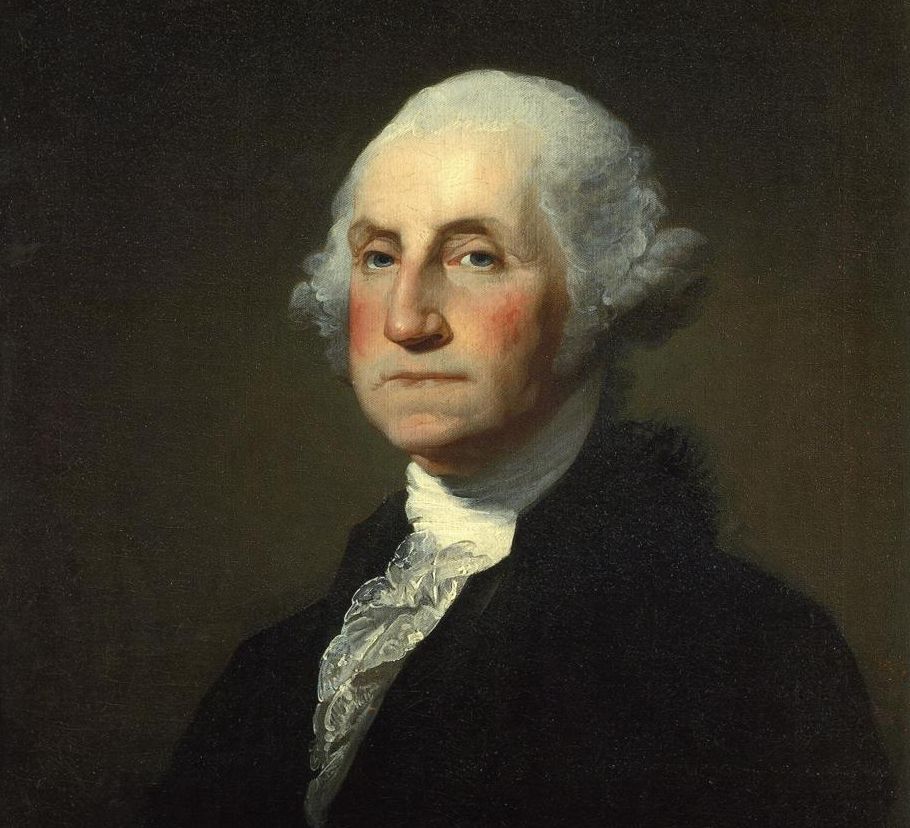
Today, Vladimir Gandelsman will tell our listeners about the new portrait of Washington, who increased to the mountain of books about the most important and, as it turns out, is still the most mysterious American. The recently released next biography of George Washington, written by Ron Chernov, will help us with this.
Volodya, all the biographers of George Washington note the mystery of his personality, each generation is trying to resolve this riddle, and starting from the first biographer, which, as history says, is Jerid Spark.
Vladimir Gandelsman: Yes, that's right. Jerid Sparks, when he was 37 and he was known as the editor, arrived at Mount Vernon at sunset on March 14, 1827. It was the inherited estate of George Washington, where he finished his life. Sparks was looking for George Washington's papers. The former Capellan of the Congress, Sparks was the editor and owner of the first literary magazine of America '' North American Revoy '', he was famous for his careful judgment. It was difficult to find a more suitable figure for working with George Washington's papers to write his biography. Sparks lived in a house in Mount-Vernon for more than a month. Diaries, notebooks, drafts, forty thousand letters - a harem for a biographer. Sparks wrote to a friend that he was in paradise. In the attic, he found Washington’s diary, which he led in 1748, at the age of 16. Everything was a find and everything was the first time. Nobody saw this then.
Alexander Genis: What was the result of this work?
Vladimir Gandelsman: Sparks, as a result, printed 11 volumes of Washington’s papers plus the volume of the biography. In 1893, Vorsington Ford made the last contribution to the publication of Washington’s works in the form of a set of 14 volumes. By 1940, the publication amounted to 39 volumes. Further - more. Now 62 volumes. But that's the matter - there is almost no George himself on these pages. Even those few letters to his wife who are preserved, completely formal and stretched. In the diaries - nothing interesting: with whom I had lunch and where ... In the new biography written by Ron Chernov, Washington is the most incomprehensible and elusive figure in the history of America. Washington's contemporaries saw in him what they wanted to see. Biographers, of which there were many, were often bores. Abigail Adams ranked him to the face of blessed, called him the Savior (with a capital letter). Mark Twain, mocking many fairy tales about Washington, once said that since Washington did not know how to lie, and he, Twain, knows how to, but does not lie, then he is better than Washington. They say that the first one who wrote a fake was William Woodworth, who printed it in 1923. He wrote that the father of our country was stupid, that he possessed remarkable self -confidence, which is characteristic only of those whose inner life is zero. '' Times' called the biography of Woodworth '' Chatter ''.
Alexander Genis: Probably, every generation should create its Washington. Our fate is to choose from dozens of already created.
Vladimir Gandelsman: Yes, you know, since 1990, the main American publishers have released at least 18 Washington biographies. The biography written by Chernov is the most voluminous, it has 928 pages.
Alexander Genis: How does Chernov’s book differ from others?
Vladimir Gandelsman: Exactly that not the beginning. Chernov begins, as expected, from birth. Namely: George Washington was born in Virginia in 1732. His father died when the boy was 11. When he turned 16, he went to a geodetic expedition, during which he kept the diary that Sparks found - and then, three years later, he visited the West Indies, on the islands between North and South America. At 12, he first commanded the military. His desperate and often failed, but certainly brave raids, in the 1750s brought him the laurels of invincible. Recall that in 1789, George Washington was unanimously elected the first president of the United States. In 1792 it was re -elected for a second term. He was tall and representative, strong and graceful, and he, of course, was a good rider. Chernov describes Washington with the help of such words: '' magnificent physique '', '' exclusively muscular and strong young man '', 'expressive and energetic face' ', etc. in the same way. Courage itself. Chernov even finds Washington’s records with muscular ... That's what spoiled his beauty was the teeth that were replaced, but not of high quality, with the help of a transplant operation and jaws made of iron and teeth of his slaves.
Alexander Genis: This jaw is no less than its owner, but we love him not only for this, right?
Vladimir Gandelsman: Of course. With his example, he brought into life such qualities as virtue, chastity, immaturity, and incompetence. His voluntary resignation at the end of the war with the British, long before the presidency, when he could take advantage of the seizure of unlimited power, the subject of admiration of the Americans, this saved the republic.
Alexander Genis: This is the most amazing moment in his biography. After all, to give power is much more difficult than taking it. Washington was offered an American crown. He could become Napoleon of the New World - long before Bonaparte, but Washington deliberately abandoned absolute power and thereby approved the republic for centuries. Moreover, it was he, his personality, saved the colonies from the war already among themselves, the rampant that tearing South America. The greatness of Washington is that by uniting the country, he returned to his fields. Truly an epic figure worthy of Libya is the second zincinate with which they loved to compare it.
Vladimir Gandelsman: Yes, Washington was a wonderful president, but not very happy, because he had to deal with factionism both within the administration and outside it. He was against embittered party competition, which is always obsessed with a revenge -free spirit and which led at different times and in different countries to despotism. Returning to Mount Vernon, he freed his slaves, believing that this would be a good example for the rest. Alas, the example did not become contagious.
Alexander Genis: But let's get back from Washington’s biography to his biographers.
Vladimir Gandelsman: In 1799, Mason VIMS, a wandering preacher and a bookseller, wrote to one publisher that he began the biography of Washington. He wrote that his narrative revives funny stories and that this is what is needed, because they grab it like seeds. Just at this moment, the hero of the narrative suddenly died, and the time for the publication was perfect. In 1800, the book was published and was sold out at the time. But at that time it was not yet clear how much the biographer had the right to invent something or build a story at rumors.
Alexander Genis: This is his pen belongs to the famous story about how Washington cut down a cherry tree.
Vladimir Gandelsman: Yes. VIMS referred to the story of some elderly lady, like a relative of Washington. To the question of George's father '' Who did this? '' - George allegedly answered: '' I do not know how to lie - I did it! 'It really was - God the news. Let's leave this on the conscience of the biographer (or elderly lady).
Alexander Genis: But this is exactly what the public needs: evidence of the one who was next to the celebrity, closer and more dinom. This is well sold - and remembered. The story with a tree was tortured by many generations of American schoolchildren. Now this is part of the national consciousness, like baseball and apple pie.
Vladimir Gandelsman: That's right. But today, a monumental biography is not what was once in the days of Spark: then greatness should be read at a distance, now-close. With one exception (just called the WIMS), the early biographers of Washington simply mentioned his childhood. Even the spell-Vims ignored George’s mother, who is known about little, calling her only “charming girl” ''. Another biographer Marshall cost one page. The third, Ramsay, wrote one phrase from 12 words about the first 19 years of Washington. When Sparks was in Virginia, he scoured wherever he could, he asked who he could, but did not find anything significant, except that Marie Washington was not very educated and very much cared about her ducks and chicken. In the press, he was examined, and wrote about its diligence, common sense, tenderness, about its vigilant ability to overcome obstacles.
Alexander Genis: But what about Chernov, from whom, in fact, we started?
Vladimir Gandelsman: Chernov builds her character using the mass of adjectives. His Marie Washington is pious, stubborn, decisive and indomitable - and this is only on one page. On the next - it is sharp and gall, restless, stubborn, like flint, lean, straight, rough and illiterate. After another four pages - another pack of definitions that completes the adjective: difficult to take out. In the second chapter, they remind us that Little George suffered from a quoted mother, from the fact that she imperiously dominated that she was not only selfish, but also strangely indifferent to the ambitions of the eldest son. Chernov concludes: '' The extravagant mother gave rise to a son, who was super -sensitive to criticism and needed his whole life in approval. It can be assumed that dealing with such a grumpy woman, George became too inclined to self -control, began to skillfully cope with his emotions and keep his mouth behind his teeth. He had to restrain strong emotions, and he was afraid of his own feelings if he could not pacify them. All that belonged to Marie Washington mixed in him in an emotional storm, which he suppressed in himself with difficulty. Never having the opportunity to express these forbidden feelings of anger, he balanced it with silence and courageous impassivity. This boyish struggle, in all likelihood, is the genesis of his individuality, which later manifested so convex and impressive. ''
Alexander Genis: How does he know all this? In other words, the diagnosis was replaced by the document.
Vladimir Gandelsman: This is the difference between today. Sparks thought that he knew how Washington wanted to capture himself, but he never considered himself knowing what it means to be Washington. Chernov knows. Not because he knows more than Sparks, no, but because he thinks differently than Sparks. Of course, the book '' Washington. Life '' is a grandiose biography told smartly, with remarkable details, but this is a psychological portrait of a man who lived and died long before a century of psychology, a romantic portrait of a man who was not a romantic. As we said at the beginning of this conversation: every generation creates its Washington. Therefore, our Washington lies on a psychoanalytic couch, his teeth are squeezed, he is tormented by his mother, a crazy woman with a moldy attic in a minnon.