
Translated material
Ordinary banana
Is it possible to deal with racism in football stands
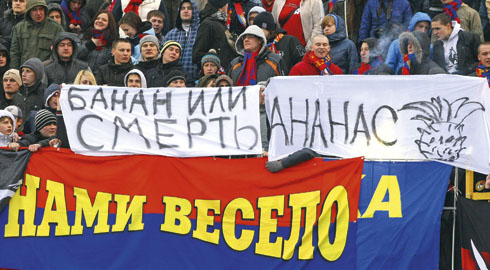
Ordinary banana. The theme of racism in Russian football is again in the first lanes of the European media. To turn a blind eye to the problem of xenophobia on the football arenas of the country of the 2018 World Cup, the 2018 World Cup has become completely indecent. Why fans throw dark -skinned legionnaires bananas and how to deal with it - the New Times sorted out
On June 27, fans sent to the match of the Moscow Torpedo with teammates from Vladimir, at the entrance to the Eduard Streltsov stadium, were searched not only in the search for weapons, alcohol and firechers - this is a common thing. We also looked for fruits. By the beginning of the match on the table near the metal detector, police gathered an impressive bunch of bananas, promising the owners that they would return after the game. “There were no instructions about bananas or oranges,” Aleksey Zaydinov, assistant to the president of the Torpedo, hurried to report to reporters. “Police officers seized fruits on their own initiative.”
The police initiative is easily explained: although there are no special instructions prohibiting the fruits to the stadium, but in the last weeks, near -football scandals have overshadowed the game itself. The cup of patience and football players and fans overwhelmed the scandalous incident in Samara, where the local hooligan threw Banana in the player of the Makhachkala club “Anji”, the legendary defender of Brazilian Roberto Carlos.
A terrible fruit
“These are symptoms of a strong disease. Here and there aggression breaks out. There was a “arena”, now a banana, and then what? ” -Sociologist Lev Gudkov, director of Levada Center, believes that racist sentiments are very strong in Russia, and even more so among football fans. “Ksenophobic and racist sentiments were especially strong during the reign of Putin,” Gudkov said in an interview with The New Times. -His desire for the “restoration of Russia” gave rise to the people a desire to oppose themselves to someone. And the Xenophobic slogan “Russia for Russians” began to actively spin. The middle of the zero, 2004-2006, became the worst in this regard. Now approximately 55% of the population according to the slogan "Russia for Russians." Until something radically changes, xenophobia will continue. ”
Alexander Verkhovsky, director of the Analytical Center “OVA”, agrees with the sociologist. “The tension in society has long been at the maximum,” the expert is sure. - Hence both bananas and so on. In society, disunity, rejection of “strangers”, and among fans this is even more expressed. Although I believe that the clashes of fans and Caucasians are a more terrible problem than banana. But in fact - all these are different sides of the same one and the same, people have aggression over the edge, and a banana may not limit himself. ”
Legionnaire syndrome
Even 20 years ago, there was no such thing as “football racism in Russia”. It is not a matter of the upbringing and active promotion of the friendship of peoples, just in the 70-80s in the Soviet Union there were no fans as such. And with the collapse of the USSR, the fan subculture was not formed immediately, its formation has passed a whole decade. For the most part, radical young people, hooligans, sometimes with neo -Nazi views that splated out energy in fights went into fans. But gradually the showdown of the “wall on the wall” in the style of dashing nineties began to lose popularity. Largely thanks to the work of police officers who learned to effectively stop clashes of fans of rival clubs before, after and during matches. But the radicals did not calm down, starting to demonstrate their aggression directly in the stadiums. They broke off chairs, arranged fireworks, invented the most insulting chants and banners. And as targets, players with a different skin color were increasingly chosen.
Darome legionnaires began to appear in the teams of the Russian championship in the second half of the nineties. At first, they were treated rather silently, as an exotic. For example, the first dark -skinned Spartak Robson was called Maxima, and he was not offended. He was more touched by the song “Killed a Negro” that sounded from the stands in those days. Although these "musical numbers" at that time were rather boorish pampering, flowers. The berries began somewhere in 2004. First in the lower leagues and cup meetings, and soon in the highest division. An indicative case occurred in March 2006 in the capital during the Moskvy and Torpedo match in the Luzhnikov small arena. Throughout the meeting, fans of car factory insulted the dark -skinned players of the opponent with racist cries and hugs, imitating the screams of the monkey. This hog soon became popular in other stadiums. Not only fans of the Torpedo began to cure, but also other teams - Spartak, Zenit. 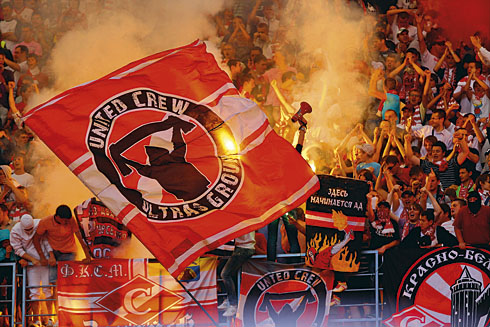
However, the fans of the St. Petersburg team behave equally during the matches of the internal championship and during European cups. Back in 2004, when Zenit played a match with the Austrian “Pagining” in the UEFA Cup, a fan in a T -shirt ran out on the field with the inscription “There is no black in the colors of Zenit”. The resonance in football Europe had a large but severe punishment. The then general director of the St. Petersburg club Ilya Cherkasov was justified: they say, the fan only wanted to say that in the colors of Zenit there is nothing dark and sad ... But at the beginning of 2008, the fans of Zenit repeated this trick during the home game with the French Marseille: first they chanted racist slogans, and then began to throw dark-brown players with bananas. oranges.
Banana country
Neither the players of foreign clubs, nor the legionnaires in the Russian championship do not like the behavior of fans-rods. Some dark-skinned football players, however, said that there were enough such woe in other countries, and continued to perform in our championship. The same Carlos admitted in an interview that he had to face racist manifestations, and when he played for the Madrid “Real”, and during the performance for the Turkish “Fenerbahce”. Others, on the contrary, could not stand the pressure. Niger's native of the ex-Armen Maaza left Russia, comparing life in Moscow with a real hell. The former Spartak Mozart, who called Russian fans, was in solidarity with him “terrible racists”, who, due to mistakes, can calmly call the legionnaire with their own club “Dirty Macaque”. The striker of the Moscow “Dynamo” Buffur Ghana from Ghana offended during one of the matches not even a fan, but a player player, an “Black Monkey” football player. The offender received in the face, Gyan - disqualification for 10 matches. Even the current leader of Spartak, Brazilian Velliton in 2007, the fans of the red-white were met with hostility and at the outbound match in Samara they hung out the banner “11th number only for Tikhonov. Monkey, Go Home ” ** ** The RFU Control and Disciplinary Committee fined“ Spartak ”for this incident for 500 thousand rubles .. In April 2009, fans of the same“ Spartak ”during the match with the Kazan“ Rubin ”were posted“ Happy Birthday, Grandpa! 120 ”, dedicated to the anniversary of Adolf Hitler.
The Minister of Sports Vitaly Mutko, when he was his president of the Russian Football Union in 2006, stated that for racist actions of fans from the teams can be removed, in accordance with the FIFA recommendations, six points (such a sanction is provided for in the 55th article of the FIFA disciplinary regulations). But not a single precedent in Russian football history was created. Football officials preferred either not to notice incidents (they say, bananas and not symbols of racism at all), or were limited to a fine. So, the Samara “Wings of the Soviets” after the incident with Carlos ordered to pay 300 thousand rubles.
The idea that racism in the stands can lead to serious international problems was first flashed in the heads of sports functionaries only a year ago, when Lokomotiv fans, saying goodbye to the striker Odemwyvy, who left for playing the English “West Bromwich”, was hung out the banner “Thank you, West Brom”. Stretching was decorated with the same banana. This story caused a shock in England, reporting the nerves of Russian football officials in the struggle for the right to adopt the 2018 World Cup.
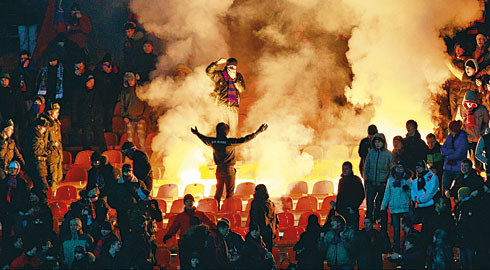 The sectors of the Russian arenas are so far in the entirely owned hooligans.
The championship was still given to us. And from the point of view of the fight against racism, maybe it is for the better. Now, being in the focus of world football, Russian football functionaries will no longer be able to just hush up the problem. Especially when racists as a target chose the living legend of Roberto Carlos. For the first time, banana was extended to the famous defender in March, in St. Petersburg at Petrovsky. Carlos, of course, was offended. At Zenit, they promised to figure it out and, according to the leadership of the club, found a “banana”, forbidding him to visit the stadium in the future.
At the end of June, during an Anji meeting with the Wings of the Soviets in Samara, the series continued - the Brazilian veteran was offended and left the field, and Russian football again disgraced the whole world.
No background
“The story of Carlos and Banana, of course, is terrible, but if you look at all this soberly, then there is no background of racism here,” said four -time champion of Russia, midfielder Vladimir Beschavy. “Just“ wings ”lost“ Anji ”, and when the fans see that their team is losing, they can behave extremely inappropriately,” he says. - Why did they throw a banana to Carlos? And he is the most titled from the opponent’s team, so the fans chose him. In football, it often happens: the team loses, and the fans begin to clean evil. You know, I heard this about myself from the stands that I would better choose a banana. But I'm not even black. ”
This point of view is shared by another famous football player, Spartak Fedor Cherenkov. “This is a single case. We have no racism among fans. The team lost, so they threw the fruit. And they could have a tomato. Of course, we must punish those who did it. But why is an extra hype? " The three -time champion of the USSR sees another problem, which now almost does not say: “There are a lot of foreign legionnaires. This is a trend. Arabs, blacks, Europeans go to play to us, they pay a lot of money, they get a job. But they could have learned their younger generation so that they play. There are few Russian football players in Europe, and they are far from leading players. And we have a lot of legionnaires, only no one teaches our own. ”
The fan of CSKA, the author of the hymns of army fans Andrei Salychev, is in solidarity with the veterans football players. “Such antics are rare, this happens in Europe more often. Our fans of one team hate fans of another, but everyone loves football players. You can’t judge one m ... to judge at once, ”he is convinced. According to the fan, you need to look at whom it is beneficial, but won in this story, says Salychev, Anji and Carlos, who received a large-scale PR campaign with the help of an unfortunate banana: “There is not racism. Here is the calculation. There is a game and money. ”
Racism is expensive *
“Of course, the problem of racism in stadiums is serious. She painfully hits not only the image of our football, but also on the image of the whole country, discrediting Russia in the eyes of the whole world. The saddest thing is that these disgusting antics occur in a country that has always been tolerant of people with a different skin color. Alas, in the fan environment, in recent years, a group of non -educated people with a low level of culture appeared, who believe that everything is allowed to them. Of course, clubs should try to work with fans, but since not everyone understands in a good way, we must fight the most rigid methods with racism. Clubs should not be punished, because any provocateur can dress in the colors of the favorite team and penetrate the fan sector. Personal responsibility of those who make such vile shares are needed, ”said Mikhail Gershkovich, member of the Executive Committee of the Russian Football Union, the chairman of the association of domestic coaches, in an interview with The New Times. - At the recent bureau of the RFU Executive Committee, we analyzed this issue in detail and came to a consensus: we should contact the competent authorities. There is an article in the Criminal Code that punishes a fine of 500 thousand rubles for racist antics in public places or even deprivation of liberty up to 5 years. Impunity gives rise to permissiveness. So let specific racists pay for their actions at a high price. If some scumbag gives away several hundred thousand rubles from his pocket or receives a deadline, albeit conditional, it will be disgraced to others. The main thing is not to be mistaken when determining the offender. To do this, you can equip the stadiums with even more video cameras. Clubs will cost cheaper than regularly paying fines. As for the new laws, first of all, I rattled for the law on professional football, where measures of responsibility will be clearly registered not only for the illegal actions of fans, but also for excess of powers by law enforcement officers, as well as for contractual matches and the bribery of judges. ” 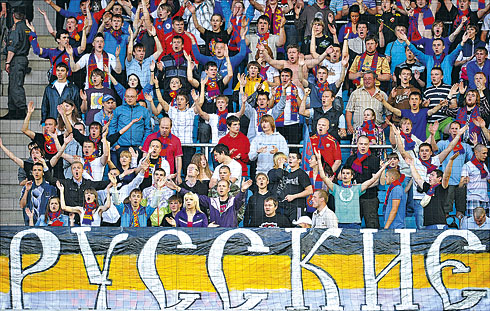
Indeed, the inevitability of punishment is the best prevention of crimes. But only now the Samara "banana" was not punished or even found. Rather, they found, but not that, I had to apologize. And if the current racist-meter leaves the answer, then his followers will move to new, possibly even more vile antics. The leaders of the RFU and the Premier League should not be limited to beautiful words. It is not necessary to even send racists to bars, it is necessary to at least just deprive the right to enter the stadiums for the egregious misconduct for the stadium forever or for a very long time, bringing them to the black list, as was done in England. And punish not only for bananas and hog, but also for Hitler's congratulations on his birthday, and for insulting the memory of Leo Yashin. Then the open forms of racism in our football will definitely die.
How do you fight racism in the stands? The New Times turned to the press service of the largest football clubs
| | | | --- | --- | |  | FC Dynamo (Moscow) We did not have a manifestation of Nazism or racism. But measures, of course, are taking. Now the number of surveillance cameras in the stadium is strictly regulated, and the Law on the fans, we hope, will be accepted in the fall. Once upon a time, all this together should work. Otherwise, stories will continue to happen, as with our teammates from Minsk (the Minsk FC Dynamo was fined $ 80 thousand per banner with the image of Rudolf Hess, hung out by the fans). It is strange that for the actions of fans, claims are presented precisely by the club. It is difficult for the leaders of the club to control the huge mass of fans. It seems to us that the responsibility for nationalist manifestations should be personal. | |
  | FC Zenit (St. Petersburg) must be determined by the concept of "nationalism". For some, the banana is nationalism. But prohibiting bananas, oranges and other fruits is unlawful for matches, there is no law that would allow the club to do this. The club also has no right to punish the fans. After the case with Roberto Carlos, we went to extreme measures - we deprived the culprit of the club’s subscription scandal and the right to go to matches, although there were no formal grounds for this. This step is the personal decision of FC Zenit. We are with understanding of the fines that the RFU appoints, but we believe that the law on the personal responsibility of the fans is acutely necessary. | |
  | FC Lokomotiv (Moscow) We did not have such incidents, because we do not take any special measures. We meet with fans, we are looking at the entrance to the stadium, but this is a common football practice. Of course, of course, there will be a sense from fines presented to clubs for the nationalist antics of fans in the stands. Indeed, for the club this is significant money: they will work more actively with the fan zone and carefully look so that they do not carry anything superfluous to the stadium. | |
  | FC "Spartak" (Moscow) We had cases, but for a long time. After that, the club began to work very tightly with fans. Our coach Valery Georgievich Karpin regularly meets with fans (even more often than other team members). Counters are often held with the official fan club "Spartak". More recently, Valery Karpin, Andrei Tikhonov and Spartak veterans signed an official appeal to the fans with an appeal to observe discipline in the stands. The club does not have the opportunity, or rather, official right to detain and search people - this is the prerogative of the police. Light the fire at the Bolshoi Theater - you will be arrested right away, right? Meanwhile, a football match is the same mass event. And while the clubs will send fines, and real culprits will remain unpunished, nothing will change. We need a law that would approve personal responsibility for nationalist tricks in the stands and generally for any riots. And then you can already equip the stadiums with cameras, calculate violators and punish them by law. | The material was prepared by Marina Levichva
The English football hooligans around the world are so known that this phenomenon is called in some places "English disease." It is quite logical that it was Britain that has accumulated the highest experience in the fight against this generation
The “hooligan movement” reached its peak in the 1960s and especially in the 1970s. Одна за другой стали появляться так называемые firms — «фирмы», организованные сообщества со своими вожаками, достаточно четкой дисциплиной, фактически — боевые отряды. Во имя «любви» к родной команде они вели жестокие войны против «чужих» болельщиков. Те в ответ организовывали свои «фирмы». Драки переросли в массовые побоища, регулярные сражения «стенка на стенку». По всей стране шла война «фирм» с многочисленными жертвами — ранеными, покалеченными и даже убитыми. Возникла новая субкультура, своего рода андеграунд, подпольное движение, засасывавшее в себя безработную молодежь и деклассированные элементы. Перед властями встала неожиданная проблема — ситуация выходила из-под контроля.
Придя к власти в мае 1979-го, правительство Маргарет Тэтчер решило не жалеть сил и средств, чтобы противостоять опасному социальному явлению. В полиции были созданы специальные отделы. Дело дошло до внедрения в «фирмы» тайной агентуры и даже офицеров-разведчиков, задачей которых было выявить законспирированных лидеров, получить доказательства криминальной деятельности для суда. Про «фирмы» и борьбу с ними написано множество документальных книг и романов, сняты фильмы, некоторые из них обрели культовый статус. Один из самых известных — ID («Удостоверение личности»), главный герой которого полицейский Джон внедрен в одну из «фирм». Но образ жизни отряда, острые ощущения, пьянящее чувство опасности и принадлежности к коллективу отчаянных, но преданных друг другу «мачо» находят резонанс в душе Джона, и он постепенно перерождается, превращается в «бойца». 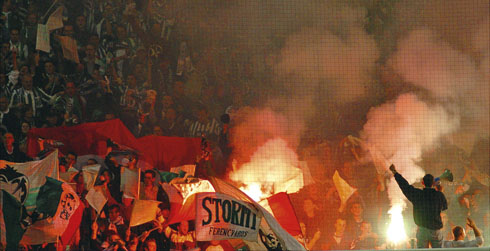
К концу 80-х движение «фирм» пошло на убыль, острота проблемы ослабла. Есть несколько объяснений, почему это произошло. Первое — возымели действие жесткие меры правительства. В 1989 году парламент принял Первый футбольный акт о зрителях, предусматривающий запрет на посещение стадионов для провинившихся болельщиков. Спустя два года — принятие Футбольного акта о правонарушениях, предусматривающего уголовную ответственность за бросание посторонних предметов на поле и скандирование кричалок расистского толка. Второе — миновала мода, старые бойцы притомились, обзавелись семьями, а новое поколение увлеклось другими формами молодежной субкультуры. Кто-то даже выковал афоризм: «Экстази победило хулиганов». Имеется в виду, что пассионарная молодежь ушла в ночные клубы, а главным методом разрядки гормональной напряженности стали так называемые рекреационные наркотики и танцы до упаду. Третья версия: на болельщиков огромное эмоциональное воздействие оказали несколько трагических эпизодов. В 1985 году в результате потасовок на бельгийском стадионе «Эйзель» погибли 39 болельщиков. Виновники — фанаты английского «Ливерпуля». В качестве наказания все английские клубы были дисквалифицированы УЕФА на пять лет. Еще больший шок вызвала трагедия 1989 года на стадионе «Хиллсборо», на матче с участием того же «Ливерпуля» (96 погибших). Главные ошибки были совершены полицией и службой безопасности стадиона, допустившими чудовищную давку. Так или иначе, но с конца 80-х накал футбольного хулиганства резко снизился.
Однако пусть и в ослабленном виде, но «фирмы» существуют до сих пор. Есть просто масса болельщиков, которых эмоции, помноженные на излишнее количество алкоголя, периодически превращают в хулиганов. Автору этих строк самому приходилось сталкиваться с крутыми, знаменитыми на всю Англию фанатами клуба «Миллуол». Когда их толпа вваливалась в вагон поезда, все находившиеся там пассажиры испуганно вжимались в сиденья и прятали глаза… 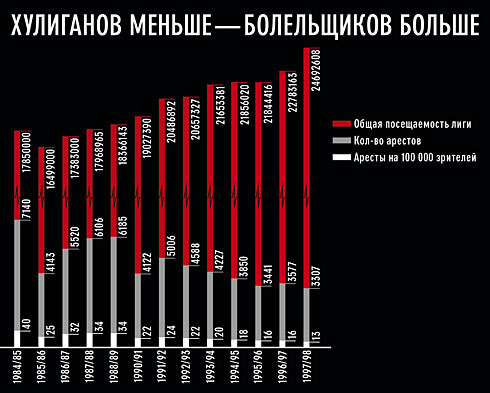
Сегодня главное орудие полиции — так называемые Football banning orders, юридические запреты на посещение отдельными лицами футбольных матчей. Запрет принимается судом по представлению полиции либо прокуратуры. Основанием должна быть доказанная причастность обвиняемого к актам околофутбольного насилия или беспорядков. Срок действия запрета — от трех до десяти лет. А добиться амнистии один раз оступившемуся крайне трудно.
Всего сегодня действует несколько тысяч запретов. Полиция перед матчами получает черные списки с фамилиями и фотографиями. Любопытно, как распределяются запреты по возрастным группам. Как и следовало ожидать, больше всего их приходится на категорию от 20 до 29 лет (1400 с лишним). Но по мере возрастного снижения уровня тестостерона резко падает и число подверженных запретам. В группе от 30 до 39 лет их уже в два раза меньше (700), среди лиц в возрасте от 40 до 49 — 600, в группе от 50 до 59 — уже меньше 100. Всего 4 — в категории от 60 до 69. И лишь один запрет действует в отношении человека старше 70 лет. Но есть, конечно, некоторый процент и профессиональных хулиганов, для которых насилие — самоцель. Такие «болельщики» легко переходят затем в националистические группировки, сражающиеся против «чужих», или анархистские отряды, устраивающие погромы и побоища во имя борьбы против капитализма и глобализации. Именно это происходит с бывшим полицейским Джоном в конце фильма «Удостоверение личности» — его замечают уже не на футбольном матче, а в боевом отряде скинхедов. Его трансформация достигает своего логического конца. И за кадром звучит как рефрен фраза: главное — не забыть, кто ты…
Борьба с футбольными хулиганами и расизмом на трибунах в Англии дала ощутимый результат: уже к концу 90-х годов количество арестов резко снизилось, а посещаемость матчей — выросла. Изгнав с арен маргиналов, властям удалось убедить добропорядочных граждан в том, что ходить на футбол — совсем не страшно.