
Translated material
Large -scale line of the universe
(Sakharov and Cosmology)
In the previous article dedicated to the contribution of Andrei Dmitrievich Sakharov to the cosmology (TRV No. 79), it was about the baronic asymmetry of the Universe and his pioneer work on this subject. Now we are talking about an earlier, also pioneering work, in which the effect was theoretically predicted, which later received the name “Sakharov oscillations”. Both work to some extent ahead of the time, both were partially based on the wrong assumptions, but nevertheless, in principle, both had far-reaching development in the next decades.
The distribution of matter in the modern universe is heterogeneous on a scale of up to about 100 megaparsk (300 million light years). It looks like a gigantic frozen foam type of installation used to install windows: almost empty bubbles (the so -called huders) and walls. Where did this structure come from? It is clear that it is the result of gravitational instability - the same that makes the clouds of space gas and dust thicken in the stars. Long before the opening of this structure, Ya.B. Zeldovich theoretically showed that gravitational instability in the early Universe should give just such a foam (intersecting “pancakes” in Zeldovich’s terminology with colleagues) as a result of the growth of initial disturbances in density, only its scale was unclear. The real picture was drawn only by the end of the 80s, when the “foam” was drawn on three-dimensional cards of the clusters of galaxies according to reviews. But the main question remained: from what initial disturbances did the “foam” of the large -scale structure of the universe have been fond of the “foam”?
Work A.D. Sakharov in question was made in the first half of the 60s and was published in 1965. Then they knew nothing about the large-scale structure. But still there was a question: how did the clusters of the galaxies and the galaxies themselves arise, where did the initial disturbances from which they thickened came from?
At that time, they did not know many other things: the concept of a swollen universe has not yet been formed, relict radiation has not yet been open. The latter circumstance made the theory of a hot universe an unproven hypothesis, which suggested that the Universe was born dense, but cold. The hot universe model was popular, but Ya.B. Zeldovich, whose authority in cosmology was undeniable, at that time promoted the model of the cold universe.
The initial assumptions A.D. In this work, these are:
1. The initial disturbances of density in the early universe have the nature of quantum fluctuations. This assumption is still in the foundation of cosmology.
2. The indignation arose at the very beginning of the large explosion, with a plank density, when the effects of quantum gravity are strong, and then evolved in accordance with the expansion of the universe. According to the most popular modern ideas, this is not so: the disturbances that determined the “face” of the universe arose later - at the stage of exponential inflating (inflation) of the Universe. There is no fundamental difference here, but the inflated universe allows you to solve other problems of cosmology, which A.D. I did not consider in his article.
3. Initially, the temperature of the universe is zero. This is an erroneous assumption, which, according to A.D. himself, greatly reduced the value of the work. It is made under the influence of Ya.B. Zeldovich, on whom A.D. Refers in his article on this subject. However, this error did not become fatal, since the equations of the state (the relationship between the density of energy and pressure) in hot and cold models coincide until some moment.
From physics of the first moments
What happens to primary disturbances when expanding the universe? They become acoustic waves moving at the speed of sound, participating in the general expansion. It is well known what is equal to the speed of sound in the earliest universe: s/7 (3), where C is the speed of light. This is the result of the so -called ultra -altitivistic equation of the state, when the pressure in the environment is one third of the energy density, p = e/3. The latter includes the energy of the rest of the particles, therefore, in a rarefied gas from cold, and therefore slow, particles, the pressure is much less than the density of energy, and the sound speed is much less than the speed of light. On the contrary, the ultra -relief equation of the state occurs when in the environment particles move at a speed close to the speed of light.
In the hot universe, the ultra -relief equation of the state lasts quite a long time - about 300 thousand years. The first lobes of a second, it is maintained due to the fact that all particles move almost at the speed of light due to high temperature. Then the temperature drops so much that the protons become non -chartic (moving significantly slower than the speed of light). However, they burn out, passing through with antiprotons, their number is reduced by nine orders of magnitude (see the previous article in the fault No. 79, http://trv-science.ru/2011/05/24/ ). Further for seconds in the Universe are dominated by massacre photons and light electrons with positrons. The latter are also annihilate with each other, when they become non -allegressing, while the electrons are also one billionth from their previous number. Further, photons dominate in the energy density of the universe. The protons, although they are heavy, but a billion times less - numerous photons support the ultra -recitivational state for another 300 thousand years. Then, 370 thousand years after the big explosion, another important event occurs, but more on this below.
A completely different physicist works in the cold universe, which also provides an ultra -altitivist equation of the state, but only the first fractions of a second. This is a purely quantomechanical effect, it is based on the principle of Pauli, which prohibits two protons or two electrons in one quantomechanical state.
The same principle does not allow all electrons in the atom to sit to the lower energy level. In dense gas, the Pauli principle also makes electrons be distributed according to different energies (more precisely, by impulses, where the direction also matters).
If the temperature is zero, the particles evenly fill the volume of the sphere in the space of pulses. Such a gas gas is called degenerate Fermi Gaz, and the maximum particle energy, below which the entire phase volume is filled with energy. The greater the density, the higher the energy of the Fermi. If Fermi energy is much larger than the energy of the particle, we have p = e/3 even at zero temperature.
After a fraction of a second after the start of the expansion of the cold universe, the energy of Fermi becomes less than the mass of the proton, and the sound speed drops almost to zero.
In general, from the point of view of acoustics, the initial stages of expansion in the cold and hot universe are qualitatively similar: the equation of the state is the same, the speed of sound is the same, and there and there there is a transition to a non -northern state equation, only at a very different time.
Standing waves
So, at first there were quantum primary disturbances in density. They began to spread through the universe, like sound waves, at a speed comparable to the speed of light.
Any fluctuations, obeying linear differential equations, whether it is sound or light, can be safely laid out on waves of different lengths and look separately what happens to each of them.
To begin with, let's say that a certain universe suddenly arose, being generally homogeneous, but with local disturbances in density? And it does not expand (this is an internally contradictory picture, but we use it only to illustrate). The initial heterogeneity, if they were chaotic (random), will turn into waves, which are different in a chaotic picture. The spectrum of these waves at an arbitrary point in time approximately repeats the range of initial disturbances, chaos remains chaos. But there may be a more interesting situation: waves can be standing.
An example of a standing wave is the fluctuations of the string on the guitar. The entire string is straightened at one point, after a quarter of the period it bends maximally, then it is completely straightened again, etc. In the case of the string of "stagnation" of the oscillations is ensured by the fixed ends. Another example: standing waves near the concrete wall of the pier in the port. In the same way, high waves arise in the same place, then the surface of the water is smoothed. There are no fixed ends, but there is a reflected wave, which, summing up with the runaway, gives standing waves.
Any map of initial disturbances can be put into a line of Fourier, whose members will have the form of flat waves: CK COS (XK + FC), where X is coordinate, k is the wave vector FC - phase. The solution of the wave equation for sound vibrations is well known: for each member of the decomposition, flat waves will correspond: with COS (xk - t+f.). Here V is the frequency of waves of the wave, which is associated with the wave vector through the speed of sound v: v = k v.
If the rate of substance is at first equal to zero, then the initial disturbances are static, i.e. They are not dependent on time. In this case, the waves can be grouped by symmetrical couples with opposite wave vectors: 0.5 CK COS ( XK -T V + φK) + 0.5 CK COS ( —xk -t V -φk) (i.e. ck = s -k, φk = –φk).
Indeed, by putting t = 0, we get the initial decomposition, and by dilating by time, we get zero at t = 0. Finally, by decomposing the mowing of the sum of the two angles, we get standing waves of the type CK COS (XK + FC) COS (TV), i.e. The amplitude of the waves with this frequency will be synchronously and periodically vary throughout the space.
It turns out that in the whole universe you can get standing sound waves. The simplest opportunity (although not the only one) is to demand that all the initial disturbances in the universe be static, i.e. The initial speeds of the substance in them were zero. Then all the waves that have arisen can be divided into opposite symmetrical pairs of flat waves - like waves against the wall of the pier, and their amount will give precisely standing waves, synchronously disappearing and growing in the entire space. To check it yourself, there is enough knowledge of the course of general physics and the ability to decompose the cosine of the sum of the two angles (see insert).
What will be the picture of sound fluctuations in the density in the universe in the case of standing waves? On the eye, it will still seem chaotic, but if you build a spectrum of fluctuations in the density in space (for this you need to subject the Fourier to transform the medium density in the universe), then an amazing thing will be revealed: it is periodic!
The spectrum of heterogeneities, depending on their size L, will be proportional to COS (p t v/l), where T is the age of the universe (we believe that the speed of sound V does not depend on time). From this dependence, you can assess the age of your universe! However, our requirement that all the initial disturbances of the density be static in the static universe we invented, should not be from nowhere.
What about the expanding universe? The main differences are as follows:
1. Each wave will participate in the expansion, and its length and frequency will change.
2. The condition of the static of the initial disturbances will be completed automatically! The fact is that at first the Universe expands so quickly that the initial speeds of the substance are quickly forgotten, while the amplitudes of the waves remain the same. This means that all sound fluctuations in the density in the early Universe will have the appearance of standing waves - at the same frequency synchronously in the entire space, to reach the maximum and turn to zero. This statement directly follows from the work of A.D. Sakharov. The dependence of the wave amplitude from time to time is slightly more complex than cosine - it is expressed through the functions of Bessel, which also surplus depending on the wavelengths.
Waves freeze
The pressure of the medium in the universe sooner or later at some time T becomes much less than the density of energy, and the speed of sound relatively quickly falls by orders of magnitude. Acoustic waves become frozen heterogeneous density, and they freeze almost simultaneously - regardless of the wavelength. And this picture of frozen waves can be tried to see if you can somehow remove the map of heterogeneousness and put it in a row of Fourier.
What should we see? “Flasping” still does not happen instantly, so short waves manage to avenging while the speed of sound falls. This means that the short-wave part of the spectrum will be inexpressive, devoid of any features. And longer waves, which managed to make exactly one or two-three-four vibrations from the birth of the Universe, will appear in the spectrum in the form of clear maximums, separated by failures. Even longer waves that did not have time to make a single hesitation will again give a smooth part of the spectrum, devoid of features. It was this picture that was called "Sakharov oscillations." True, the nominal term is not used by everyone, at present it is often used by its synonym "acoustic oscillations".
When is the hardening, and on what scale should it manifest? In the version of the cold universe, as already mentioned, the speed of sound falls through a split second. At the same time, the longest -wave maximum in a spectrum of heterogeneity covers a mass of substance of the mass of small stars.
In the same 1965, when this work was published by A.D. Sakharov, relict radiation was open, unambiguously indicating that the Universe was born hot. In this regard, a new analysis of acoustic oscillations was required. This was done independently by J. Zeldovich with R.A. Syunaev (R. Sunyaev, Ya. Zeldovich. Astrophysics and Space Science Vol. 7 (1970), P.3) and PEEBLES with JTYU (PJ.E. PeEBES, JT Yu. Astrophysical Journal Vol. As mentioned above, in a hot universe the speed of sound falls after about 300 thousand years. At the same time, the masses of the order of 1018 masses of the Sun: tens of millions of galaxies are involved in the longest -wave peak corresponding to one fluctuation.
The hot model gives another surprise - a photograph of the age of 370 thousand years - just the era when the equation of the state of the Universe changed and the speed of sound fell. The fact is that at this time the temperature of the universe fell so much that electrons with protons were recombined into hydrogen atoms and the universe became transparent to light. This light, due to the expansion of the Universe, turned into radio waves-the famous relict microwave radiation.
The smile of the universe
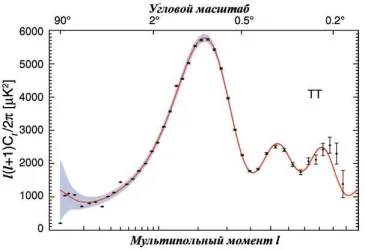
If A.D. Sakharov saw the power spectrum of angular harmonics of relict radiation! (It is depicted in Fig. 2.) Ya. B. Zeldovich also did not have the opportunity to see him, but many who took a direct part in the development of theory survived.
The power of science is most clearly manifested not when it is possible to explain an incomprehensible effect earlier, but when someone predicts something extraordinary and then they find it firsthand. There are not so many large examples of this kind in history. A textbook example is the discovery of Neptune "on the tip of the pen."
Sakharov oscillations in some plan are “cooler”, primarily by its transcendence - the inappropriateness of scale, both imprudibly small and inappropriately large. A man sits and writes formulas with incredible numbers: the age of the universe is 10-43 seconds, a density of –1098 grams per cm3, one of them tries to withdraw. Where does the belief that our logic works on such a scale, that the laws bred by man are applicable to them? From the point of view of an outsider, the scientist in this case is engaged in complete abstractions, fantasies for the money of taxpayers. As a result of significant efforts, a person displays on paper that the distribution of certain fluctuations of density in the universe should be described by a certain oscillating function of Bessel.
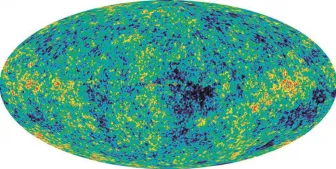
After decades, people launch a spacecraft with a precision receiver of microwave radio radiation, emitted by billions of years ago. And they see from the map of this radiation that very oscillating function of the Bessel!
The observation of the fact of acoustic oscillations is only the beginning. It turns out that they are better than something else, help to measure a number of parameters of our universe, including its age and geometry. This is about the same as if on a map of the early universe they would see a large -scale line with divisions in the megaparsecs, and not only a ruler - a watch and a whole “weather station” with distinguishable indications on dials.
For example, the height of the main peak above the substrate gives an assessment of the density of the substance in the universe, and the positions of peaks “feel” the geometry of space. Последнее свойство нетрудно понять: длина акустической волны, попавшей в максимум через 370 тыс. лет после Большого взрыва, фиксирована, а угол, под которым она сегодня видна, зависит от того, евклидово наше трехмерное пространство или нет. Именно из измерений положений пиков следует, что пространство на самом деле евклидово: сумма углов треугольника составляет в нем 180°, даже если речь идет о треугольниках со сторонами в десятки миллиардов световых лет.
Сахаровские осцилляции — не единственная зацепка для космологов — есть еще далекие сверхновые, скопления галактик, гравитационное линзирование. Но это, безусловно, самая надежная опора.
Мы рассказали всего о двух научных работах Андрея Дмитриевича Сахарова. Это лишь небольшая часть из того, что он сделал за свою жизнь. Однако даже по двум работам можно судить о мощи этого человека: в них не просто решены какие-то проблемы. В этих работах поставлены и решены проблемы, которые еще никто не видел в то время.
Валерий Рубаков,
Boris Stern