
Translated material
In Germany, the last will “Nazis number three” was violated: the Hess was dug, burned and thrown into the lake
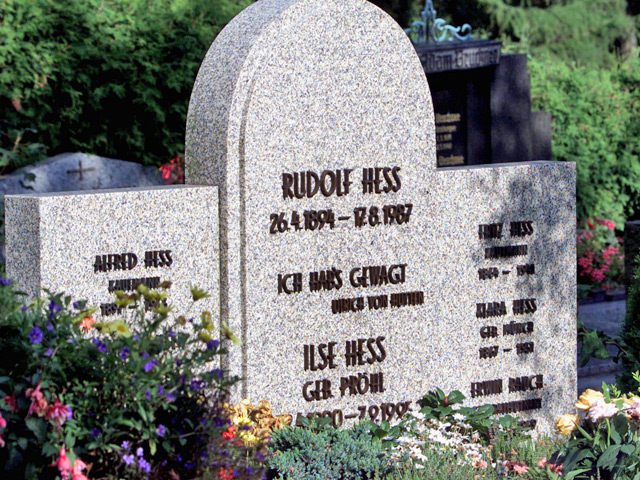
The remains of the Deputy Adolf Hitler for the National Socialist German Working Party of Rudolf Hess were cremated, and the ashes were dispelled over the lake, violating his will. The grave of the Nazis number three in the cemetery of the city of Vunzidel was opened after the descendants of Hess agreed to the exhumation, the newspaper Sueddeutsche Zeitung writes.
They were forced to agree to the burning of their ancestor were forced by the fact that the grave became the place of pilgrimage of the neo -Nazis, who held their memorable marches there. The Constitutional Court of Germany banned these shares. Now the last refuge of Obergruppenführer SS was one of the lakes in the Wunzidel - his body was burned, and the ashes were dispelled above the water.
In 1946, Hessa was sentenced to life imprisonment during the Nuremberg process. He died on August 17, 1987 at the age of 93. There is a version that Hess was strangled in the Berlin prison of Shpandau, staging suicide, reminds RIA Novosti .
In the will, Hess asked him to bury him in the Wunzidel, and the board of the local Evangelical community in 1987 gave permission for the funeral. However, after the Nazi processions began to be held in the cemetery, representatives of the church themselves asked to exhumer the remains of Rudolf Hess.
The sovereign representative of the Fuhrer
Rudolf Hess is one of the leaders of Nazi Germany, deputy Fuhrer for the party. He was born on April 26, 1894 in Alexandria in the family of a German merchant. During the First World War, he served on the Western front the platoon commander in the same regiment as Hitler. In 1919 he joined one of the units of the Volunteer Corps, and in 1920 he became a member of the National Socialist German Workers' Party. After participating in the failed "beer coup" in 1923, Hess fled to Austria.
Returning to Germany, he was sentenced to seven months of imprisonment, which he was serving with Hitler in Landsberg prison. Here Hitler dictated to Hess his book Mein Kampf ("My Struggle"). In 1925, Hess became the personal secretary of Hitler, in December 1932 - the chairman of the Central Party Commission and the deputy of the Reichstag, and on April 21, 1933 - the deputy of Hitler for the party. After the reorganization of Hitler’s military and political leadership in early 1938, the Hess became part of the “Secret Cabinet”. In August 1939, he was appointed Hitler’s successor - a third person in Nazi Germany after Goering.
A special decree on him was assigned control over all the activities of the Nazi government and other state bodies. Not a single government order, not a single Reich law had the strength until Hitler or Hess signed them. Hess was entrusted with decisions on behalf of the Fuhrer, he was declared the "sovereign representative of the Fuhrer", and his office - "the office of the Fuhrer himself."
The devotion of Hess to Fuhrer was absolute. “Hitler,” he said, “is just the personification of pure mind.” At one of the Nuremberg Party Congresses, Hess, as usual, was preceding Hitler’s performance, he said: "I was given for many years to live and work next to the greatest son of the nation, whom our people must carry after a thousand years of their history."
In May 1941, Hess made a flight to Scotland, who struck many, where, on behalf of Hitler, he suggested that Great Britain conclude peace and take part in a campaign against the USSR. In the UK, Hess was interned as a prisoner of war. In 1946, he appeared before the International Military Tribunal in Nuremberg. During the trial, Hess portrayed himself a mentally ill, defiantly tried to commit suicide. The imitation of madness did not help: it was sentenced to life imprisonment.
Hess stayed in prison for the longest - other war criminals either died or were released. The Shpandau prison (Western Berlin), in which he was serving the conclusion, was under the jurisdiction of the English military commandant’s office (the winning countries divided Berlin into zones), in the 1980s there was only one prisoner in it-Hess. According to the official version, Rudolf Hess at the age of 93 committed suicide, hanging on an electric cord.