
Translated material
The troubles of the forest edge
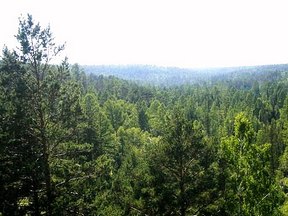
From the porthole of the aircraft, my Perm Territory looks like the very sung in the Soviet songs "The Extra -Faced Sea of Taiga." And from here, from below, it looks approximately the same. Since childhood, I saw and knew that I have been living among the majestic endless forests. In the Ural rivers, including, along the beauty of Kama, huge barges and rafts drove, endless trains with logs were going on on railways. Forests, composed of valuable commercial rocks, mainly spruce and fir, have always been considered one of the main strategic resources of the region. Foresting and forest processing constituted a significant part of our economy.
On the other side of the collapse
Time changes priorities. Compared to the Soviet years, my Prikamye, in which it curled and has come to nullified part of the industry, has become a raw materials appendage in its purest form. But the demand for raw materials has changed: today the world is expected from my huge Perm Territory, comparable in size with England or France, in fact only two things: oil and mineral fertilizers. So the sovereign owners of the region were a couple of large corporations: LUKOIL Oil Gerrys, potassium and nitrogen fertilizers “Uralkali” and “Uralhim”. Today they are a real Perm government, they plant their vice-governors, fill the chair of deputies of the regional parliament with their appointments. But the forest has become almost no one needs.
The harvesting of wood in my taiga Ural region today, if not completely confused, then in volume it is simply insignificant. The Soviet system of forestry and public procurement is destroyed, without the support of the state everything got up and fell apart. The tenth share of what was chopped in Soviet times is not cut down. Only 3.7 million cubic meters are cut in us per year. At the same time, only the annual forest growth is about 29 million cubic meters in the Perm Territory.
The social consequences of the forest collapse are also obvious: dozens of settlements built at one time specially for logging are abandoned to the mercy of fate. There is no work for people, schools and paramedic and obstetric centers are closing the power, since it is considered to be considered an invoice, roads are destroyed and overgrowing. People massively run from such villages. Those who are not able to run are drunk on parental pensions - it is they who become the only source of real money here - they degrade and die out. Huge spaces, tens of thousands of square kilometers, especially in the north of the Perm Territory, are depersonalized before our eyes.
I’m not talking about woodworking: all of it, for example, the same furniture factories, collapsed with a bang into the first post -perestroika decade.
In the southern part of the region, more and more agricultural vehicles abandoned two dozen years ago are overgrown and become the same forests before our eyes. Because agriculture, which is not very profitable on our freezing loams, also died out. There was no competition with the world producer, who has become firmly settled on our shelves, but this is a separate topic. Immediately, someone deftly threw us a comforting idea that this, they say, is even good: industry has risen and no longer pollutes the environment, and abandoned fields and pastures throughout the region become natural ecosystems. Although, according to first education, I am an ecologist to this day, I teach a little at the University Department of Nature Protection, such conversations cause me only a bitter grin. I and many other people are not at all happy that our forests will not be cut, and the fields are not sown and overgrow. Because if we do not do it ourselves, then on our overpopulated planet there will be very soon those who come and do it for us. And then the crops of our breads and forests will be coming around, and they will give us a good kick. And rightly.
Future forest owners
In general, this trend is already beginning to be visible well. Everything about the existing prey, processing, export of forest from the Perm Territory is played by Caucasian diasporas. Among the owners of sawmills are representatives of almost all Caucasian peoples, and from the Russian North Caucasus - Chechens, Ingush, Dagestanis - and foreigners: Armenians, Georgians, and, especially, Azerbaijanis. It is the latter who are more active in the region, including in areas of traditional residence of the local few Finno-Ugric people: Komi-Permyakov. People, since ancient times known as forest residents, hunters and lumberjacks. Here and there, the appearance of southerners is accompanied by “sudden” fires on sawmills and warehouses from local entrepreneurs. Against the background of these ashes, a small forest processing business develops violently. Local workers are not fundamentally taken there: a diaspora is a state in the state, lives according to their own laws, workers are imported only their own, without fear of migration barriers, live, work, and engage in everyday life.
But with local authorities and law enforcement agencies, visitors make contact very quickly and tightly. The police and the prosecutor's office through their fingers look at their sins. The success of visitors in the forest business is also facilitated by close ties with their compatriots in Turkey and Iran: it is from there that large orders and cash are received, most of the cut down forests are sent there.
The visitors are more active, entrepreneurial, united. They, of course, are more competitive than sluggish, often also drinking, and most importantly absolutely disinable local. Their gain in competition for the Ural forests is predetermined.
Where there were city lungs
The other side of the Perm Forest problem is the situation with city and suburban forests. That is, with those who should just fulfill the most important environmental environmental role, to be light cities and places of rest of the population. This is where massive barbaric cutting occurs, behind which the development of the territory is automatically follows - as a rule, elite cottages. Our officials, deputies and entrepreneurs now go a lot to the West. There they found that, it turns out, it is prestigious to live not in the very center of the stone jungle, as they thought before, but in their own house on their land. But only our elite does not want to pay attention to the fact that, for example, the average American living in his house reaches the Down Town for an hour and a half. Ours want to get to the center in 15 minutes!
The result is simple: the last decade the ax is freely walking through our city forests, recreation areas and water protection zones. This is most manifested, of course, in the regional capital: in Perm and Perm agglomeration. The fact that yesterday was a general property where mothers with strollers walked and boys played football in clearings, today is rented, and then in the private property of people close to power. Former green zones and overwhelming areas around reservoirs are covered with chic towers of new owners of life.
The process is put on a wide leg. It doesn’t matter that the distribution of city forests for housing development contradicts the Russian Forest Code and other legislative acts. Local authorities are cutting out to make such decisions on which one or another tidbit Forest Piece already, it turns out, has never belonged to the city forests! It is not difficult to slightly move a particular line on the electronic map - and you can grab part of the city park or even a specially protected natural area. It all depends on the will and influence of the customer. So, last year, the omnipotent “Lukoil” wanted to put five new gas stations in Perm, and not somewhere, but where he would especially like it. As a result, under one of them they torn off a piece of Victory Park, laid down in honor of the 60th anniversary of the end of the Great Patriotic War. Under the second refueling, the city authorities donated a fragment of a specially protected natural landscape. Two more - areas of city forests.
The courts frankly play along with this. The technology is simple: it is enough for any pretext to get a land plot from the city administration, put cement on a square on it - and the court will register for you at the beginning of the incomplete housing construction, and will provide you with the site for property.
Who will say "stop"?
Is there any resistance to this corruption bacchanalia in the region? There is, although I would like it to be more active and numerous. The Ecological Green Ecumena group and its active member, a pension accountant Valentina Viktorovna Ogloblin lead endless litigations for the fate of various forest plots stolen from the city. In some cases, the courts of first instance were forced to recognize the fact of illegal development and even decided to demolish it. But ... In a modern Russian situation, it is impossible to imagine that an ordinary eco-activist or public organization would deploy a heavy car with the distribution of material goods and would defeat power. Of course, the courts of higher authorities immediately canceled these decisions. Now Valentina Ogloblin filed a complaint with the European Court. The average period for consideration of such a complaint from Russia is 5-7 years. You have to wait ...
And the Green Akumen is conducting endless correspondence with Moscow supervisory authorities, with ministries and departments, trying to achieve justice. But what to expect from ministries and ministers in the light of stories similar to the below?
According to Russian law, especially valuable forests, the so-called forests of the 1st group, are growing in the water protection zone of the Kama reservoir. And a few years ago, one of these forest plots in the Dobryansky district, within the Perm agglomeration, by order of the Government of the Russian Federation, without any motivation, was suddenly removed from the 1st Group’s forests and was given under the construction of residential buildings. And then even more badly: construction began here in the coastal protective lane-where it is strictly prohibited by law. And the owner of the building was none other than the wife of the Minister of Ecology and Natural Resources of the Russian Federation Yuri Trutnev (nee Perm and former Perm governor) Natalya Petrova. Again, the old rule is confirmed that in Russia who protects what, he has that. It is noteworthy that the development project by some miracle managed to undergo a state environmental examination in the authorized body: Rosprirodnadzor. And all attempts by public organizations to obtain the conclusion of this examination met a completely unmotivated, but categorical refusal of the head of the Perm Department of Rosprirodnadzor Dmitry Klein. Despite the fact that familiarization with such an examination is a completely legal thing, it was not possible to do it here! Thus, it was not possible to find out how the state coxpertiza was able to circumvent the fact of building a house in the coastal protective lane, the Perm environmental public. "There is no Stalin on them!" - She just sighed once again the discouraged public.
So my forest Perm region lives. Forests thrown along the outskirts cease, fall, rot and burn. City and suburban forests are plundered to the right and left. How will this muddy chaos end, in which many are happy to catch their fish? God knows. I can only say that something is slowly shifting and accumulating in our population. Recently, in the Perm microdistrict, Verkhnyaya Kurya is a certain company that is associated with a large businessman and deputy of the State Duma from the United Russia party to Yuri Borisovtsa (the deputy himself denies this connection, no evidence of the connection is publicly - “Polit.ru” ) received ownership of a large forest area, previously used by the local community under the recreation area: here holidays were held here, children's tourist tourist raids, etc. The city prosecutor's office revealed signs of a crime when providing this site. But the marginal immediately put these materials under the cloth. Construction began on the site, put up protection. And indignant locals, despite the armed guards, invaded the territory stolen from them three times and destroyed all the buildings begun. When this happened for the third time, the guards opened fire, three residents received gunshot injuries. The FSB and the governor’s administration are now engaged in business. The frightened developer announced a moratorium on construction. The wounded in the hospital, healthy sits at home and save hatred. And who dares to call her unrighteous here? ..
The author is an environmental activist, associate professor of the Department of Biogeocenology of Perm State University.