
Translated material
Digital informers
Special services can only remove the cream
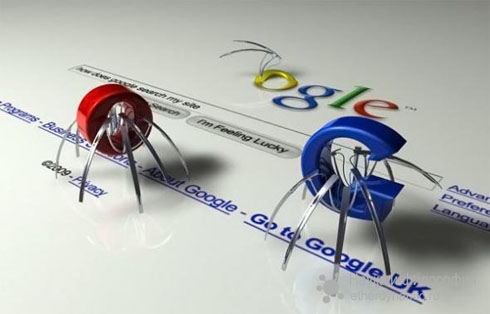
Life under Web control. Today, the global digital services market in the person of manufacturers, consumers and marketers extracts so much personal information about private users that special services can only remove the cream they need. In how - found the New Times
The essence of all new media is the presence of a personal identifier that turns any technical device into a feedback channel and, in fact, leakage of information about the client. What the latter may not suspect. Gadgets and modern technologies for marking goods do exactly the same.
GPS will report your whereabouts, and a local restaurant will send you a menu; The packaging using radio interpretes (RFID) itself will tell, or even show on the smartphone all the advantages of the goods lying on the shelves of the supermarket that you entered; The barcodes of the “quick response” (QR), if you take a picture of them on your mobile, make the phone browser open the website of the manufacturer with detailed information about the product. And while you enjoy this consumer paradise, marketers will compose the “client profile”, and the special services that control commercial hosting will lead the “work of operational development” if necessary.
Your curiosity will allow digital marketing specialists to create the so -called client’s path *** “client’s path” - planning technology created at the Ogilvy & Mather agency. Describes the path, following which a person reflects on the choice of goods and services. By tracking this “path”, experts will be able to learn more about a person than he can imagine: switching digital television channels, you talk not only about cultural and informational addictions, but also about political preferences. Twisting quietly from children and close sites of erotic content - share intimate information about your sexual addictions. Getting an on-line consultation with a doctor, the results of analyzes or simply buying medicines in an Internet aspect-inform information about your family's diseases.
Traces left on the Internet can even tell about those desires that a person has not yet realized. It is not for nothing that among the gurus of digital marketing there is an opinion that search engines are the databases “On Intent”. And this is the key to manipulation. So, in the spring of 2010, incriminating videos with the participation of the leaders of the unsystematic opposition and the “fashion model” Katya Mu-Mu got on the Internet. The girl went to nothing suspecting people through social networks in order to get into confidence, referred to common acquaintances, which were easy to install via the Internet, after which she invited her to her apartment, where scenes of an intimate nature were recorded on hidden camcorders. More than a year has passed since the first meeting to the moment of the appearance of videos on the network, but all this time the victims did not suspect the provocative nature of the connection, the moment of the first acquaintance through the Internet was so competently furnished.
On-line-Opera *
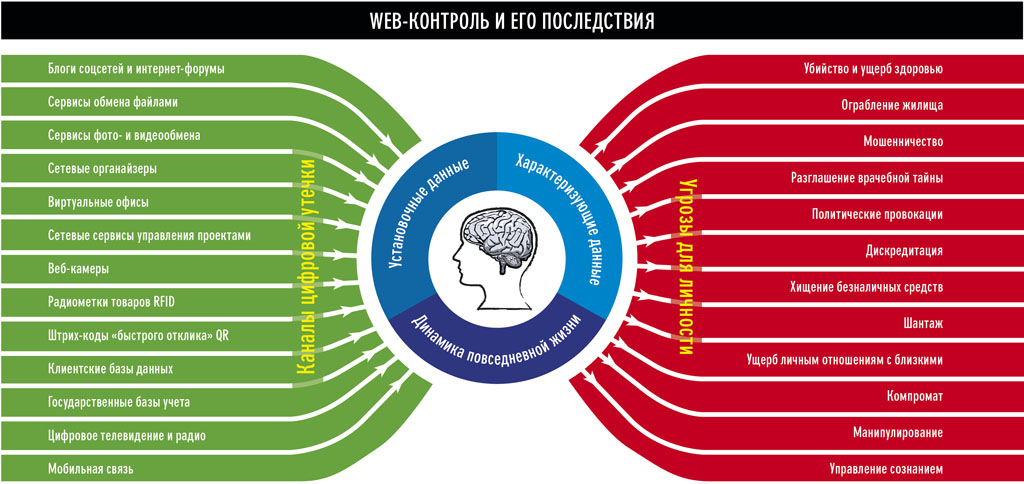
A set of measures aimed at obtaining and studying information about a particular person on the special services vocabulary is called “Operational Installation”. The general list of questions can be divided into three main blocks. The first is "installation data." This is key information about the object of study, such as the name, date and place of birth, registration address, biography, etc. The second is “characterizing data”. These are the value and behavioral characteristics of a person, his psychological portrait. And finally, information about daily life - movement routes, often visited places, contacts, communications, lovers, mistresses and so on.
Sometimes the Internet can become almost the only way to penetrate into closed groups of society. For example, the investigation in the murder case of Stanislav Markelov and Anastasia Baburova actively used the data found on the network. The frank posts of one of the witnesses in this case, Alexei Baranovsky, about Tikhonov’s professionalism in the field of “partisan struggle” became a serious argument for the jury.
The tasks of the operational installation can be very different. One of the rapidly growing niches in the detective services market is the collection of information proving marital infidelity. After the courts began to consider SMS messages as legitimate evidence, many private detectives began to actively use hackers.
As the senior officer of the external counterintelligence department of the SVR Vasily G. told The New Times, “the collection of data about a person on the Internet can be compared with the methodology of expressions often applied in the American special services: dozens of different people can approach the object of study under different pretexts. One person will bring the object to talk about children, the other about work, the third - about leisure. From these “fragmentary information” a mosaic of a person’s personal and social profile will be compiled. Today it is done with much greater success in all kinds of chats and blogs. Moreover, the information received in this way from the Internet is much more informative, since it contains photos, videos and a huge number of contacts, which is not difficult to establish. ” 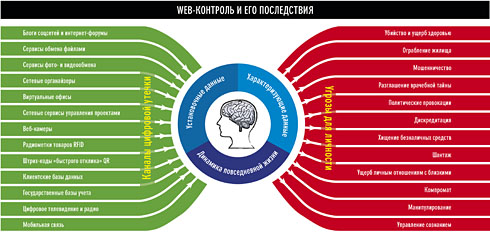
Click to increase
IQ-agents
As the colonel of the analytical department of foreign intelligence service, Mikhail K.: “After the full-scale implementation of Web 3.0 technologies, which is also called the“ semantic Internet ”, Web 7.0 will immediately appear-the robotic“ seven ” **“ seven ”in the USSR called the 7th control units engaged in external surveillance-monitoring entrusted objects, collecting private objects collecting private surveillance Information on the Internet, applying for this special semantic search programs - the so -called “intellectual agents”.
The evolution of the Internet has three fundamental stages. The first is Web 1.0. A comparative analogue is a World Electronic Library with a store. You can watch and buy. The second stage is Web 2.0: social network, active communication and user interaction. Users begin to leave a huge number of digital traces on the network. The endless “clouds” of these digital marks are filtered by search engines, but so far this is a search by keywords. A person should connect words in the meaning. The next stage is Web 3.0. This is a fundamentally different level: a new generation of search engines based on the mentioned “intellectual agents” can now find answers to the questions asked with minimal participation of a person. An example of an already current semantic search engine is an addition to Firefox browser, Blueorganizer software. This application automatically creates a context menu on the pages that you visit, and after its processing it can search and systematize the necessary information without your participation. The search configuration for “intellectual agents” (a set of questions of interest) can be set by the user or, as in the case of Blueorganizer, the program can do it on its own. Worse, if the task for the search is formulated by professionally trained real agents not at all virtual special services.
Manipulation *
The strongest player in the clearing of the Internet control of the personal life of citizens is, of course, the state. By order of a big brother, any sites and any pages in social networks can be hacked, as, for example, with the pages of Vladimir Poblovsky (the owner of the resource “Antiompromat.ru”) and Andrei Malgin (blogger, the last editor of the magazine “Capital”). If desired, the management of “K” can “agree” with the search engines like Yandex that posts from unwanted information or written by objectionable authors or the media do not get into their tops. Orwell is resting. Or, as they like to joke in Russian special services, even if you have paranoia, this does not mean that you are not pursued.
Reply to relate to all overwhelm