
Translated material
Dictatorship protective shaft
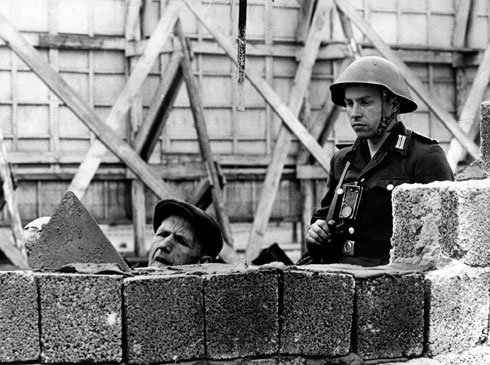
Construction under the muzzle of machine guns (photograph of 1961) ** protective shaft of dictatorship. 50 years ago, on August 13, 1961, a Berlin wall appeared, dividing two systems into three decades, two camps, the West and the East, Germans and Germans. As the wall was built, I recalled The New Times “The Palace of Tears”-even in the late 1980s to Soviet tourists this name did not say anything. But much has said to the Eastern Germans. They parted and cried here ...
The author of these lines had to go through the Palace several times. It was located twenty meters from the Central Berlin station Friedrichstrasse. In the basement floor of this glass building with a curved roof, a checkpoint was located, through which it was possible to get into the western Berlin. Going down to the lower lobby, you found yourself in front of a long row of double turnstiles, over which the border guard boot slightly towered. Then, after customs and border control, they fell into two tunnes: one led to the platforms of the city train (S-Bahn), the other in the subway. Friedrichstrasse was the only station where, again, it was possible to get to the west of the city on the subway. It was an amazing station. In the literal sense, the final. The electric trains from the east rested against the iron wall. From the west, too. The same iron wall (curtain) shared two platforms. It was possible to go to the western only underground through the "palace". One stop - and you are in West Berlin. The train goes along the flyover, fenced with high iron shields. So that neither from here, nor there. Darkly, light almost always burns in wagons. Escaping on the bridge above the Spree, you see the Berlin wall with towers and fortifications, and behind it is the truncated silhouette of the Reichstag (there was no domes then). And finally - freedom ... who at least once saw or survived it, is unlikely to forget what the Berlin wall is ... ** 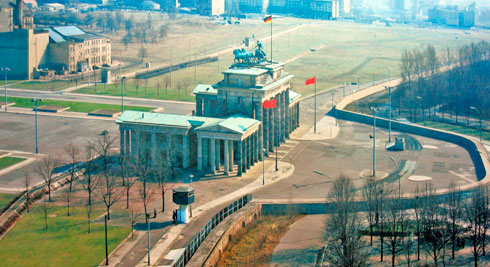
In July 1945, the Americans and the British entered Berlin, occupying 54.4% of the territory in the west of the city, where, however, almost two -thirds of its population lived. A month later, a piece was allocated to the French. Naturally, general control over the entire territory of Berlin did not work out - the contradictions were too great. The first single citywide parliament, where the absolute majority belonged to the Social Democrats (they received almost two and a half times more votes than the Communists), as well as the overall minister and almost the entire magistrate were literally expelled from the town hall “outraged workers”. And then the elections were already passing separately. So two governments appeared in Berlin.
The threat of existence in 1949 arose by Germany and GDR. Their borders passed along the boundaries of the occupation zones. Berlin sectors - along the topographic borders of the city regions. If since 1952 permits were needed to go from the GDR to the Federal Republic of Germany, then in Berlin this, in fact, was not required, since the city de facto remained one: there was a common infrastructure-transport, communication, and communication. People could work and live in different sectors. In principle, no one could prevent a citizen of the GDR to come to his capital - Eastern Berlin, to sit in a tram or train and end up in the western sector (control was purely conditional). And from there to the plane and - Aufviderzeen. Thus, from 1949 to 1961, more than 2.7 million people took to the west through the Berlin hole, mainly youth of draft age and qualified specialists. By the way, in West Berlin there was no military service. Yes, and there was much better. While in the east of the city, food cards were canceled only in 1958.
Free Berlin threatened the very existence of the GDR, which could simply depers up. Twice the USSR tried to squeeze the former allies from the city, depriving him of defense: in 1948-1949, introducing the blockade of Western sectors (as a result, all cargoes were delivered through the air along the so -called air bridge), and in 1958, when Khrushchev declared the entire Berlin a “free city”. It did not help. It was then that the CPSU and SUPG thought about the wall.
Day x June 15, 1961, the head of the GDR Walter Ulbricht stated at a press conference: “No one is going to build any wall. We need many builders to build housing. ” On the German New Head, this meant that the wall would certainly be. Having felt this unmistakably, the population of the GDR ran. Only in July 1961, East Berlin left 30,415 people, in 12 days of August-even more than 40 thousand, the remaining, waking up in the morning on August 13, found that they were living in another world. A chains of soldiers and local combatants (“Working class groups”) stood across the most lively tracks - there were about 50 thousand of them. The Soviet troops and military equipment took their positions behind them ...
Metro, trams and a city train could only go to the boundaries of sectors: the paths were dismantled. The streets began to burn out with barbed wire, the telephone did not work between the sectors, military boats appeared on the rivers and channels ... The entrances of the houses, if they went to border streets, were closed, security was assigned to them, and after some time workers appeared accompanied by armed people. The workers began to walled the windows. In some places, the house had to simply be divided, as their entrances were in different areas.
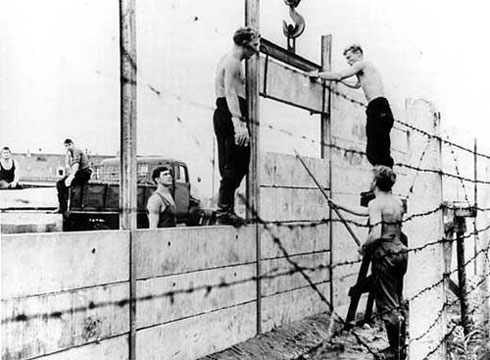
Construction with shooting sometimes in Russia can be heard that the wall was built in one night - now, they say, what power was. Do not believe this delirium. On August 13, they only began to divide the city with a “live shield”, “thorns” and mark future borders. The wall was built and improved constantly, up to its fall, changing only external forms. In the first days after August 13, control was not yet total: those who tried to escape to the West, as a rule, reached the goal. After a couple of weeks, this was much more difficult and more dangerous. They started shooting ... In the first year, 50 people were killed.
"
The wall collected a plentiful harvest. Fire was led to defeat - for every murdered or detainee, a premium, vacation and an increase in the rank were relied
"
To manage the construction of the “anti -fascist protective rampart” - this is how the same Gaderar New Heads called the wall - was entrusted to the Secretary of the Central Committee of the SUPG on security issues Erich Honecker. The “shaft” first consisted of ordinary barbed wire. However, a few days later, under the muzzles of machine gunners, builders mobilized throughout the country “exclusively for housing” began to fold around the clock from slag blocks around the clock, pulling the same “spine” on top; Then they began to demolish the buildings on the “border strip”, which after a while was clogged on the east side of another similar wall - this turned out to be a “strip of death”, which reached 400 meters wide in some places. Over time, 302 eleven-meter guard towers were built on this lane-so that from one tower one can see another, 127 km of contact-signal fences, wire and metal barriers, more than a hundred bunkers with machine-gun nests, dug 105 km of ditches, laid the control stripes, installed anti-tank and anti-aircraft fences, butter Powerful spotlights and signal speakers released specially trained dogs.
The entrances to all metro and city electric trains were walled up.
The wall survived four reconstruction, turning into the most perfect border system of the world. The height is 3.60 m, the width of one element is 1 m 20 cm, a particularly durable reinforced concrete 15 cm thick. It was installed on a concrete pillow 10 cm thick, and on top it was covered with a concrete pipe so that it was impossible to catch on the edge. The wall stretched around the three Western sectors of Berlin within the city and on the border with the rest of the GDR by 155 km (for comparison: the Moscow ring road - 109 km).
Wall and people
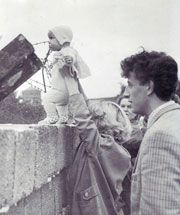 |
| There, behind the wall, is a grandmother (a picture of the mid-1960s) |
After the start of the construction of the walls of the Eastern Berliners, access to the west was closed. For some time, the inhabitants of the Western Berlin could go to the Soviet sector, presenting the identity card. However, they were soon offered to buy permission to enter one brand. But then the Westberlin Senate opposed, who considered it a violation of the status of the city. During the first decade of the existence of the wall, residents of the western part could only get to the eastern in the framework of the so -called humanitarian shares “pass” - otherwise they could not see relatives who sometimes lived on a neighboring street, but in another sector, they could not.
The transport infrastructure of the city was seriously injured. In the West, the city railway and tram began to gradually die - their central offices were in East Berlin, and the main income from operation went there. Therefore, the Senate urged residents to boycott these types of transport as possible in order to "do not support the division of the city financially." As a result, the tram disappeared in general, and three shortened lines remained from the train. In exchange, the metro began to be actively built, the bus network developed, and autobahns were laid. The standard of living in West Berlin, thanks to subsidies, Germany was high. There was even a 14 percent allowance for a salary for “harmfulness”.
In 1972, after the entry into force of a four -sided agreement on West Berlin
* * According to the document signed on September 3, 1971, the USSR Ambassador to the GDR Peter Abrasimov and ambassadors of the United States, Great Britain and France to Germany, the Western sectors of Berlin were not an integral part of Germany and were not controlled by it. The Westberlinians were allowed to go not only to the east of the city, but also further deep into the GDR. Transet routes in Germany were opened and through the through movement on a number of metro lines and city electric trains were restored. It looked, however, it looked terrible: the trains flashed without stopping, past the dusty and clogged East Boldolinsky stations, like illuminated ghosts in the “zone”, where border guards hid in the booths.
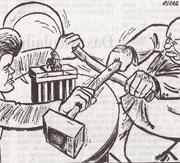 |
| The caricature from the Morgenpost newspaper: "Kennedy saves Berlin from Khrushchev with his bare hands." A hint of the failure of the USSR attempts to squeeze allies from the city |
The victims of the wall collected a plentiful harvest. An attempt to overcome the “protective shaft” on the ground, water or air was deadly (fire was led to defeat - a bonus, vacation and an increase in the rank were supposed to be for every murdered or detainee). Tunnels rummaged - one of them was even 145 meters long. But over time, there were fewer successful attempts. Such plans were already revealed at the preparation stage: 90 thousand only official informers did their job. In Berlin, according to various sources, over 200 people died. The last victim of the wall in February 1989, just shortly before her fall, was the 20-year-old young man Chris Goffro.
The wall proved its effectiveness, and something similar was built along the particularly complex sections of the external border of the GDR with Germany. There, however, in addition to the already mentioned protective structures, 60 thousand of the so -called self -shooters were installed (the rear of the wire will kill), and minefields of 860 thousand minutes were created. An attempt to flight cost 1117 people. 174 of them drowned in the Baltic Sea. At the wall or in the border zone, 20 children were shot dead. 27 border guards who were blown up by mines or were killed in a shootout with fugitives died. More than 2700 representatives of the Armed Forces of the GDR fled to the west. The border was guarded by over 50 thousand people.
The experience of the Berlin wall shows that the free movement of people during the confrontation is deadly for any dictatorship. As soon as the “most perfect border system” cracked, the fate of the GDR was a foregone conclusion. For, besides violence, there were no other ways to save the regime. People voted their feet.