Reports from the front line and from the city of the dead
For the first time after the collapse of the USSR, Russia waged a “hot” war with an external “enemy”, and no one will take up to predict the consequences of a five -day military campaign in South Ossetia. The information confrontation is just beginning. How will the diplomatic picking of Moscow and Tbilisi turn out? What will happen next? How will the war affect Russia, Georgia, the fate of unrecognized republics? The exacerbation of the Georgian-South-Ossetian conflict revealed numerous diseases of both the Russian and Georgian state. The New Times summed up the first results of the war, let all sides of the conflict speak out and reconstructed events at the front from the first to the last day
We begin to rebuild everything over the wall, ” - the generals and the head of the South Ossetia owl Ossetia, Anatoly Barankevich, stands on Tskhinvali Square between the buildings of the former Alan Hotel and the former railway station and distributes orders to the volunteers gathered around.
“But I don’t go with a machine gun anymore, but just a gun just in case,” the mayor of Tskhinvali Robert Guliev jokes. “The Ministry of Emergency Situations is already unfolding the camps, we establish the supply of humanitarian assistance.”
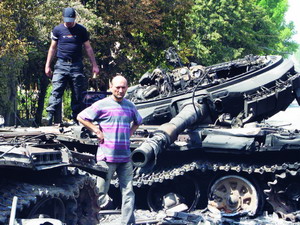
The favorite story of Ossetian volunteers is now about how, on the night of the first assault on Tskhinvili, General Barankevich, remembering his Afghan experience, personally knocked out two Georgian tanks. Their fragments near the former university building still interfere with movement. The cars are stained so that it is difficult to imagine how it was done by the forces of one Barankevich, but the story has already become a common legend, and the New Times correspondent met at least two dozen “eyewitnesses” of this historical event.
"You would see ..."
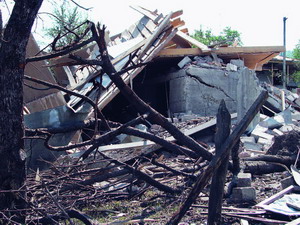
The Ministry of Emergencies launched its camp between the former building of the hospital and the former maternity hospital. “Former” - because all these buildings are actually destroyed. The sign “Republican Hospital” survived over what the front door used to be the front door. Next to what was once registered, the inscription “Exit from the hospital after 22 hours through the reception department” survived. The doctor Dina Zakharova opens his notes and says that 217 wounded have passed through their hospital in the last days, of which 22 could not be saved. “Almost everyone was already taken out, now there is nowhere to keep them here, but if you arrived yesterday, there was a completely different situation,” the doctor says. - On the outskirts of Tskhinval, Georgian artillery covered a group of fighters. They made a stop, thought to eat. Four died at once. 12 people brought to us. The legs are torn off, the veins stick out. The fire was still fired for a long time, and they were not able to take them out. Blood loss. "
Zakharova shows the basements of the hospital, where in the days of the most fierce battles the victims were covered. “Look at these conditions and decide for yourself whether we were ready for war or not,” she says. - Here we seemed to operate, here we seemed to have a surgical department. Now there is almost no one here, only our midwife is still lying. She saw the Georgian tank out the window and managed to run until he shot at the house. She is already coming to herself, but we are afraid to touch her, and she herself is afraid. ”
The morgue building 100 meters from the hospital also did not survive. The corpses are folded right on the floor. Here, however, are only those who are nobody to bury. The cemetery does not work, and because of the heat of the body, they quickly decompose. People bury their relatives almost in the gardens. “Consider all this, keep in mind those who are not clear when they start to disassemble, keep in mind that we can’t even imagine how many killed and wounded in the villages can be, and understand that the exact number of victims is already unlikely to be determined,” the doctor said.
According to doctors, 70% of the wounds are fragmentation, 30% are bullet. This is also confirmed by employees of the "Disaster Medicine" in the Dzau 1 hospital, the temporary capital of South Ossetia. Over the first days of the war, more than 200 wounded passed through them. “They operated on nonstop,” the doctors say. “First aid - and send people to Vladikavkaz.” One of them says: “I ask young guys, volunteers, whether they represent where they are going. They answer: "Yes, everyone saw films about the war." They believe that, as in a movie, either heroically will die, or heroically win. They do not understand that heroically it will not work. There can be no heroism, when shit, intestines and brains are mixed or when the leg is torn off and the bone sticks out. ”
Episodes of expectation
The whole war is a protracted expectation. The wounded is waiting for treatment, refugees are waiting for evacuation, the military is waiting for the order for a long time, but it is still not, the journalists are waiting for something, the doctors are waiting, the columns of armored vehicles are burning out the roads, stopping the movement, and also wait. At the entrance to the Rock tunnel connecting the Northern and South Ossetia, the New Times correspondent was breaking through for several hours through a car through a mash from tanks, an armored personnel carrier, and other equipment that stood on the border for more than a day and waited for something. Armored vehicles are going, stopping, unexpectedly unfolds and goes back. The meaning of maneuvers, the decisions of which are made by the high authorities, is incomprehensible to ordinary officers. They just shrug their shoulders: "It is difficult to win with such a discipline." A few kilometers from DZAU, the fighters of the 42nd division transferred from Chechnya stopped. In peacetime, they are based in Hankala. “They alarmed when I was in the market. At first I decided that as usual - educational. But no - they collected it and transferred here, ”says one. The other a day before the business trip to Ossetia married. They lie on the sidelines, drink beer from two-liter bottles and are also waiting for something. They only say that the losses are much higher than this officially reports: "Our 1st and 3rd battalions no longer exist." After a day later, the VGTRK correspondents who brought to Vladikavkaz will say: "Over the past day, the Hankalians completely crumbled." In the meantime, they leave home addresses, ask them to send photos to them, and then they suddenly offer: “Do you want to go to Tskhinvali? Can anyone drive? Let us give you our “Urals”, quickly dominate. ”
Quickly, however, in this war, it does not work anywhere. The road from Tskhinvali to Vladikavkaz took almost 9 hours from the New Times correspondent (in peacetime, this path takes 2-3 hours). Where she was driving, why she was driving and driving whether she was generally somewhere in a huge amount of armored vehicles remained incomprehensible. The military arranged chaos on the road.
Fear
Passing through the Georgian village from Tskhinvali to DZAU, a bus with refugees in which the New Times correspondent was driving under fire. Elderly Ossetians, who survived a lot during the days of the assault on the capital of the republic, sat without moving. Only one young man fell to his knees, grabbed a handrail with his hands and seemed to pray, looking crazy with crazy eyes somewhere. Where they shoot. Then it turned out that this was not an shelling - some Ossetians took other Ossetians for the Georgians and fell into each other. But he was scared. Maybe a couple of days ago he would not be so scared, but too much has changed during these days.
Fear sits in people, even chosen from the military zone. In a children's boarding school on Telman Street in Vladikavkaz, children from 6 months to 7 years old with their mothers were placed. 74 people. Women in the lobby watch TV without looking up. Children play in the yard. Children smile, they have already forgotten, it seems, all the worst. Mothers are remembered and, despite the guard, they are afraid that even here, in Vladikavkaz, they will be attacked by Chechens or Ingush. The policeman, guarding the boarding school, somehow sadly shakes his head, listening to them, and asks: "Understand their condition." In his voice and compassion, and request, and justification at the same time.
This was not included in the official telechonik, but Prime Minister Vladimir Putin was also scared. The head of government rushed to Vladikavkaz from Beijing and held an urgent meeting in the administration building, making many warlike statements. Information about the Prime Minister’s arrival flew around the city instantly. Several hundred women gathered in the square in front of the building. Refugees, mothers of those who are fighting, are just those who have relatives in Tskhinvali. They cried quietly and waited. The police cordon did not allow them to the building. They expected that their former president, and now the prime minister would come to them and say something, somehow calm down. The prime minister came out, the women screamed, Putin ran to the car under the cover of the FSO fighters. A few days later, in the same way, under the guise of his guards from a mythical threat in Gori, Mikhail Saakashvili ran in Gori, and the Russian television chronicle was losing these personnel for a long time. Only the Georgian leader fell and his bodyguards covered with body armor, and Putin Fesseoshniks stuffed into the car, after which the motorcade rushed off the square. Women began to sob already in a voice.
Finale or beginning?
The war seems to be over. Information and diplomatic wars continue and will last more than one month. Perhaps the Russian Investigative Committee under the Prosecutor General’s Office will finish its investigation. Maybe the parliament recognizes the independence of South Ossetia and even Abkhazia. Maybe the UN Security Council at the 38th meeting will finally develop its position. Maybe Mikhail Saakashvili will ever understand that the Grad and the total destruction of civilians are not resolved by territorial conflicts. Maybe the diplomats will finally be able to draw up a document with a full list of 5, 8 or 11 conditions for resolving the conflict. The situation changes at such a speed that everything can be. Perhaps someday even Russian state television will stop cutting the refugee phrase from the plot: “There is no case with us, after all, after all. Their territories are concerned. Earth. Geopolitics".
_______________
1 Georgian name - Java.
For almost two days in the city of Tskhinvili, under volleys of Grad and Aviation bombing, 30 Russian journalists worked. In the city of the dead, the correspondent of The New Times was also at the siege position
Mikhail Romanov
Tskhinvali - Moscow
The war began half an hour before 08.08.08. From this day, wolves were shot: too many of them bred in the mountains. All Thursday there were local battles, but on the outskirts of Tskhinvali. And even more so no one used the rockets of the Grad system. At about 9 pm, the city began to be aimed at firing with automatic weapons and grenade launchers, but even then no one believed that full -scale military operations would begin. Mortar fire was fired from the side of the villages of Nikosi and Eredvi. Journalists shot the blazing government of the government and the Children's World store. By 11 pm on August 8, they gathered in the basement of the Alan hotel: the Su-25 Georgian Air Force appeared in the sky.
Cannon fodder
At night, the excited assistant to the Commander of the SSPM 1 Vladimir Ivanov is running: “Journalists! Urgent everyone to the headquarters! " General Marat Kulaklametov is going to make an urgent statement. At first, Kulakhametov intended to perform on the street, where there are huge maps of the terrain on the stands. But they begin to jeorize in “grades”, and this is no longer a joke. Everyone falls to the floor. The shelling is carried out by the Georgian military from a strategic position - they captured Priki heights, from where the whole Tskhinvili was visible as in the palms. General Kulamalametov was stingy with the comment: "This is a war." Everyone understood this without him. Time - 23.40.
The city is already full of corpses: mostly Ossetian militias, young men in camouflage and with sleeves on their sleeves, which with machine guns went against tanks to protect the cellars stuffed with relatives. The meaning of the expression "cannon meat" becomes clear.
At 6 in the morning, everyone is urgently evacuated to the base of peacekeepers, again under the bombing of Grads. As it turned out later - on time. After half an hour, the three remaining colleagues saw how Georgians and machine guns and rifles ran at the hotel. Journalists barely escaped by car of Channel One. By this time, 80 percent of the city no longer existed.
On the basis, everyone is ordered to go down to the bunker - this is a room of 15x3 meters, littered with large boxes. The inhabitants of nearby houses were already hidden here, a lot of boymaters: there are no places. Peacekeepers are also cannon fodder: what can they do with their machine guns against “grades”? Journalists are literally awarded into shelter. It is unrealistic to sit down, men in the center are forced to stand. There is no light in the bunker, as in the whole city,. It is unbearably hot. Sometimes people run out into the street to squeeze their T -shirts, the military tear boxes to fan the cardboard, like a fan. It does not help.
In the afternoon, Georgians took the city for the first time: they are a few hundred meters from us, this is heard. We wrap a mop with a white T -shirt to stick it through the bins of the bunker. Reporters propose to set the microphones of federal television channels on the "fishing rods". After a dispute in high colors, we decide not to stick out either a T -shirt or microphones.
A few hours ago, Masha served us in the Farn, the only working cafe of the city. A citizen of Belarus, she came to stay with her father and work as a waitress. Valentina Ivanovna also came to visit - to her mother. We have four children in the bunker. Two boys of 2 and 3 years old are holding like real men. A two -year -old girl is constantly crying. 8-year-old Zalina tells her mother Alla: "If the 3rd school is bombed, then, then, I won’t go to school anymore?" Ossetian men are silent. Women accept soothing drops and wind up one another in Ossetian: it ends all this with a collective cry. Even more women shout if any of the journalists forgets to turn off the mobile phone and take out the battery: the military explained to them that the goal is to be given for the attack. At first we are trying to explain to them that on the street, three meters, journalists are constantly talking by phone, and television people have satellite plates on the roofs of cars. In vain. “Well, where are the Russians? Did they abandon us? " - They ask us endlessly. In total, we are 30 journalists and about 150 civilians. We have water that we drink from one bucket, passing in a circle. Nobody wants to eat, although the cook, nicknamed Kuzya, offers to go up to the dining room and taste the boiled pasta.
Slit with an overlap
As the military explained, the bunker is rather a decoration. With a direct hit of the projectile, everyone would have torn to shreds: the pit is only sprinkled with a 20-centimeter layer of earth. On the jargon of the military - "Slit with an overlap." In the zone of a 20-year conflict, on the basis of Russian peacekeepers, there is not a single real shelter. The head of the Council of Council of South Ossetia, Lieutenant General Anatoly Barankevich, yells into the mobile phone: “Tell Medvedev: we hold on with the last forces! Georgian troops in the city! We are waiting for reinforcement! "
The next day the military is breaking a generator, and journalists can work normally. Television workers make stand-ups against the backdrop of blazing university and fire protection buildings. Only the NTV producer Petr Gaseev dares around the city on the Niva: he was repeatedly fired by snipers, his whole car in holes from fragments. As a result, they wounded. Petina shooting a portable camera is the first frames of the dissipated city that the country saw: an order came from Moscow to “rumble”, that is, to share a picture with colleagues from other television channels. Gaseev shows shots: a hit tank 20 meters from our fence. Next to the car lies Georgian, or rather, what remains of him. Inside the tank, Petya finds two sheets of paper. Instructions written in English and Georgian. It is supposed to pass the prints of the thumbs and legs, a blood group for identification.
Georgian troops were storming the city at least three times. At these moments, you can go out into the street for a couple of hours, because, since there is a contact battle in Tskhinvali, it means that shells no longer fall on top. Again arriving residents tell terrible stories: Georgians open underground and, without understanding who inside, throw grenade inside. Before the eyes of an eyewitness Zaura Pliev, a Georgian tank presses a woman with a little daughter. The hospital is bombed. The hotel suffered from tanks: the skeleton still holds, but the 4th floor is completely defeated.
Minutes of silence are insidious. Many Ossetians go to their homes to return with food and water, change clothes (almost all were in slippers and robes). A woman sitting next to the peacekeepers, like everyone else, decided to go out and see what happened to her house. Half an hour later, an employee of the Press Department returned to the base and said that the unfortunate person in his eyes received a sniper bullet right in the head.
We spend the night on the bare floor of the bath: it is not stuffy here, and you can at least stretch your legs. At midnight and at three in the morning - the most terrible blows to the "hails".
Escape
On Saturday, August 9, at five o’clock in the evening, Boris Chocheyev, Vicepremier Kokoita, was breaking through to us. He went out to call from the basement to the street, and after three minutes the rocket hit his house with a direct fire in his house, destroying the neighboring ones. “There is no 58th army in the city. Russia betrayed you, journalists. And all the Ossetians, ”he says, although for almost a day the military reports that Russians are fighting directly in the city. A new wave of panic begins. Women cry. Peacemaker guys begin to write farewell letters to relatives. One of them offers to throw weapons and run in forests. One of the contractors shows an SMS message from a fellow soldier, whose battalion was in the so-called Shanghai area near the village of Khetagurovo. There, in the first hours of the war, fierce battles were going on. The message is: "We do not even have cartridges." Peacekeepers say that a whole battalion died in Shanghai. The battalion is about 400 people.
The chief of the Southern Bureau of Channel Channel Olga Kiri is crying. И от ужаса, и еще от того, что неоднократно передавала в Москву вести о триумфальном заходе в город русских. Мнения телевизионщиков разделились: одни хотят выбраться даже и под атакой с воздуха до наступления темноты, другие хотят переждать активную фазу боев. Точку ставит журналист НТВ Руслан Гусаров: командным голосом он приказывает журналистам садиться в машины с надписью «TV». Мы берем с собой маленьких детей с мамами. Самому Руслану места в машине не хватает… В городе добровольно остаются съемочные группы Антона Степаненко с Первого канала, Евгения Поддубного с ТВЦ и Юрия Романюка с украинского канала «Интер». Машины движутся на высокой, предельно возможной скорости. Кругом трупы, но сквозь пыль мы не различаем, осетины это или грузины. Журналистскую колонну обстреливают два раза из минометов, впрочем, ни одна машина не пострадала.
На выезде из города наконец видим 58-ю армию. Стволы танков расчехлены. На одном стволе написано: «На Берлин». Техника движется со скоростью 20 км/ч. БМП постоянно ломаются, и из-за одной машины стоит вся внушительная колонна. Несколько БМП, не доехав, развернулись обратно — не хватило солярки. Кто-то спасается из мертвого города, кто-то спешит на помощь живым. Самый длинный в стране Рокский тоннель — 4 километра — в дыму и гари от выхлопов бронетехники. Видимость — один метр. Но это уже никого не беспокоит. Самое страшное для нас позади.
1 Смешанные силы по поддержанию мира.
Chronicle of a five -day war • New Times • RIMA — Russian Independent Media Archive